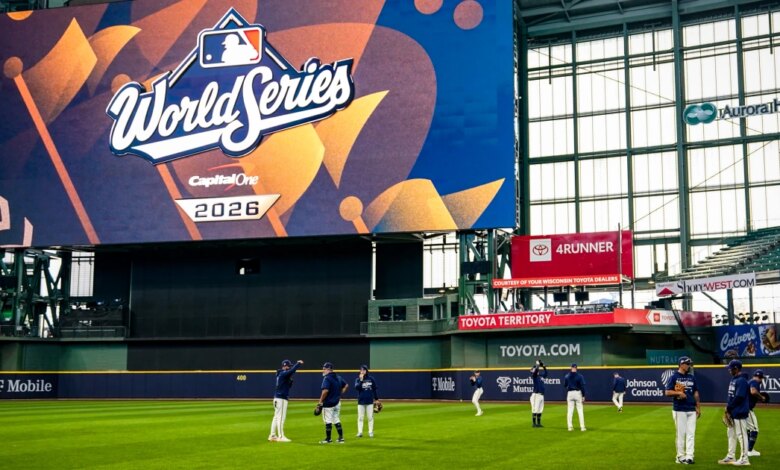
The upcoming World Series marks a significant shift in Major League Baseball’s financial narrative. For the first time since the Kansas City Royals took the championship in 2015, the eventual winner will be a team that ranks in the bottom half of the league in total spending. This development arrives at a volatile moment for the sport, as a potential lockout looms and the debate over a mandatory salary cap reaches a fever pitch.
MLB Commissioner Rob Manfred has spent much of the year emphasizing the need for structural changes to ensure what he calls “competitive balance.” Speaking in July, Manfred argued that for the game to reach its “full potential,” the league must address fan concerns regarding the core fairness of the competition. He stated that the league needs to ensure fans in every market enter a season with a “realistic belief” that their team has a genuine chance to win.
The league has leveraged these concerns to push for a salary cap, an idea long resisted by the players’ union. Ownership groups have frequently claimed a direct correlation between payroll and on-field performance, suggesting that the current system favors high-spending clubs in major markets. However, the players’ union points to the current World Series matchup as a direct contradiction to that narrative.
Meyer, representing the players’ union, stated that the presence of lower-spending teams in the final is “further evidence” that the league’s justification for a salary cap “holds no water.” According to Meyer, the push for a cap is less about competitive balance and more about “juicing profits and franchise values” for owners.
While the matchup may validate the competitive parity of the league, it presents a distinct challenge for television broadcasters. Historically, “small-market” matchups have struggled to capture the broad national audience that marquee teams like the Los Angeles Dodgers or New York Yankees command. Combined viewership for this year’s ALCS and NLCS was up slightly over last year, but the World Series faces a different hurdle.
Historical data illustrates this disparity. Recent World Series matchups involving the Dodgers, Yankees, or Toronto Blue Jays averaged over 15 million viewers, the highest figures since 2017. In contrast, smaller market appearances have historically bottomed out. Tampa Bay’s first World Series appearance in 2008 averaged 13 million viewers, which was a record low at the time. A subsequent appearance by the team in 2020, during the height of the pandemic, drew only 9.8 million viewers—the second-lowest average in the history of the sport.
This “small-market haze” has also been visible during the earlier rounds of the current postseason. Viewership for Tampa Bay fell from 4 million when playing the Yankees to 3.7 million when matched against the Cleveland Guardians. A similar trend affected Milwaukee; while a previous series against Los Angeles drew 7.9 million viewers per night, a Division Series matchup between Milwaukee and the San Diego Padres managed only 2.6 million viewers.
As the league heads toward a potentially contentious off-season and a looming lockout, the success of this World Series in capturing a wide audience will likely be a central talking point in the upcoming labor negotiations. The clash between ownership’s desire for a cap and the union’s defense of the current market structure remains the primary obstacle to long-term labor peace.