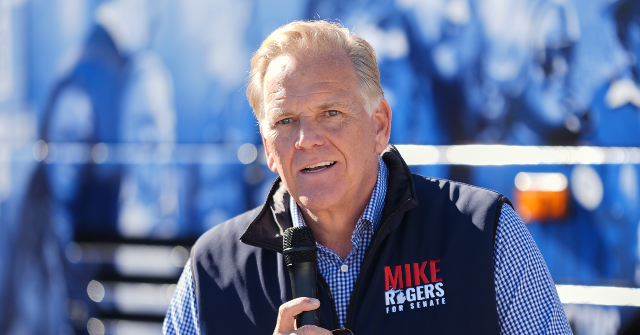
Michigan Republican U.S. Senate nominee Mike Rogers outlined his campaign strategy and voter outreach efforts in the final stretch before the November 3 election, while sharply criticizing his Democratic opponent, Abdul El-Sayed, over national security concerns and foreign policy positions.
Speaking about the ongoing contest, Rogers pointed to what he described as shifting political dynamics across the state, claiming his campaign is drawing support from traditional Democratic constituencies, including Jewish voters and working-class communities in Detroit, Pontiac, and Flint. Rogers estimated that his campaign could secure between 35,000 votes from Jewish Democrats and an additional 10,000 to 20,000 African American votes statewide, arguing that crossover voting could prove decisive in a tight race.
“This is about the way you think. It’s not about the way you pray,” Rogers said, adding that his family’s military service reflects a defense of constitutional rights. “This really isn’t about left or right anymore. This is about the heart and soul of America, given this guy’s ideology and his policies.”
Rogers raised multiple allegations against El-Sayed, focusing on a 2012 letter concerning former Egyptian President Mohamed Morsi, past leadership in the Muslim Student Association at the University of Michigan, and campaign contributions from individuals associated with advocacy groups such as the Council on American-Islamic Relations. Rogers argued that these connections, combined with El-Sayed’s foreign policy stances regarding Iran and the Islamic Revolutionary Guard Corps, rendered his opponent unfit for national security responsibilities, including a potential assignment on the Senate Foreign Relations Committee.
Additionally, Rogers questioned El-Sayed’s medical background, noting that while he attended Columbia Medical School, he did not complete a residency or medical boards to practice as a physician. Rogers also highlighted criticism from El-Sayed’s former campaign staffer, who alleged misrepresentation during a previous 2018 gubernatorial run.
The Republican nominee also cited opposition from within El-Sayed’s own party, referencing an opinion piece by former Michigan Democratic Party Chairman Lon Johnson and his wife declining to support the nominee. Rogers pointed to remarks from liberal commentator Van Jones and a Democratic senator from New Jersey describing the platform as fringe, alongside local defections including a Saginaw County sheriff endorsing the Republican ticket.
Detailing the final days of the campaign, Rogers described an intensive ground operation that included door-to-door canvassing reaching seven million doors, alongside a statewide bus tour and rallies across Michigan. Rogers contrasted his ground game with his opponent’s campus events, expressing confidence that grassroots mobilization will produce a victory on Election Day.