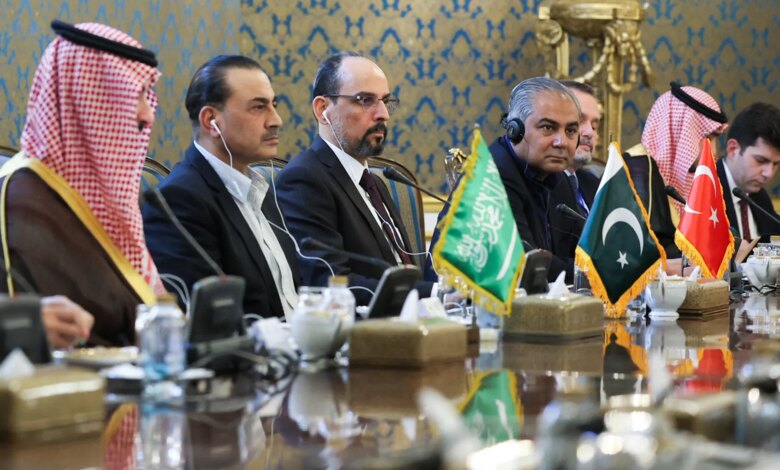
Ministers and senior security officials representing the three nations of the Mecca Joint Defence Agreement have arrived in Tehran for high-profile discussions aimed at addressing regional security threats and defusing a new escalation between the United States and Iran. The delegation includes Saudi Defence Minister Khalid bin Salman Al Saud, Pakistani military chief Asim Munir, and Turkish intelligence chief Ibrahim Kalin. During their visit, the officials met with Iranian President Masoud Pezeshkian and scheduled further talks with Supreme National Security Council secretary Mohsen Rezaei.
The diplomatic mission represents one of the most significant high-level dialogues held in the Iranian capital in recent months. The meetings occur amid intensifying threats of new US strikes against Iran, as Washington weighs options to break a prolonged diplomatic deadlock. President Donald Trump has indicated he is considering major military action to pressure Tehran, which has refused to accept a peace agreement unless several core demands are met.
The core disputes driving the current crisis involve maritime transit, nuclear oversight, and economic blockades. The United States and regional powers are pressing for the restoration of uninterrupted international shipping and transit through the Strait of Hormuz, alongside renewed international inspections of Iran’s highly enriched uranium reserves. Meanwhile, Israel has stated objectives aimed at overthrowing the Islamic Republic. In response, Tehran is demanding the complete lifting of the US naval blockade on its southern ports, which has severely restricted crude oil exports and overall trade, and a return to a preliminary memorandum of understanding agreed upon by the parties in June.
With the US refusing those terms and threatening major strikes against civilian infrastructure, regional powers are scrambling to insulate themselves from potential fallout. Analysts note that if renewed hostilities commence, Iran could retaliate against neighboring countries, mirroring earlier strikes on US bases and regional infrastructure. Reflecting growing alarm, the US Department of State issued an order on October 21 instructing nonemergency US government employees and their families to depart Saudi Arabia due to ongoing threats from Yemen-based Houthi rebels.
The discussions in Tehran are also expected to cover the persistent drone and missile campaigns waged against Saudi Arabia by Yemen’s Houthi movement, an ally of Tehran. Riyadh is reportedly exerting increased pressure on its pact partners to curb the threat, even as analysts question the military options available to the alliance. According to Ayesha Siddiqa, a senior research fellow in the Department of War Studies at King’s College London, parties to the Mecca agreement lack viable military options for direct engagement with the Houthis, and both Turkiye and Pakistan are unable to commit ground troops to Yemen.
The current diplomatic push closely follows Pakistan army chief Asim Munir’s recent visits to both Saudi Arabia and Iran, and coincides with Islamabad enforcing restrictions on overland border trade with Tehran in alignment with US sanctions and blockade measures. Iranian authorities stated ahead of the meetings that they favor security solutions originating entirely from within the region.
Observers remain divided on whether the three-nation alliance possesses sufficient leverage to alter Tehran’s strategic calculus or bridge the divide with Washington. Ali Vaez, deputy director of the Middle East and North Africa Program at the International Crisis Group, described the visit as an effort to tip the balance toward compromise before military hostilities resume, though he cautioned that the delegation risks arriving with goodwill but no concrete formula to resolve the core disputes. Umer Karim, a researcher focusing on Saudi foreign policy, suggested that the talks are primarily designed to safeguard Saudi security and compel Tehran into concessions rather than eliminate the risk of a wider war.