
Researchers at Berkeley Earth have calculated a 96 percent probability that 2026 will surpass 2024 to become the hottest year on record, driven by the rapid development of a strong El Niño weather pattern. The monthly analysis released Thursday indicates that the natural climate phenomenon is already worsening droughts and floods, pushing up food prices, and fueling wildfires across the globe.
The current El Niño event is a natural feature of global weather marked by the occasional heating of the eastern tropical Pacific. It temporarily exacerbates human-caused global warming by pushing ocean heat and moisture into the atmosphere for months. The ongoing pattern mirrors previous historically strong events in 1997 to 1998 and 2015 to 2016, which brought dry conditions to Indonesia, the Philippines, and parts of the Americas, alongside wet conditions to the United States South and West. However, scientists note that current baseline temperatures are significantly higher than during those past periods.
Zeke Hausfather, a research scientist at Berkeley Earth, pointed to ongoing debates among climate researchers regarding the unprecedented nature of the current conditions. There is some evidence that the Pacific has not produced such conditions in a millennium, according to Hausfather, who noted that the event may well be the strongest El Niño in a thousand years.
While Berkeley Earth projects a near certainty for a new global temperature record, other scientific bodies view the trajectory slightly differently. The United States National Oceanic and Atmospheric Administration forecasts that 2026 is unlikely to supplant the 2024 heat record, though it will still finish as a close second. Berkeley Earth is one of several organizations that maintain global temperature datasets, with findings across different groups typically falling within a tenth of a degree of each other. The European Union’s Copernicus Climate Change Service, utilizing data through September, currently tracks 2026 as the second hottest year to date.
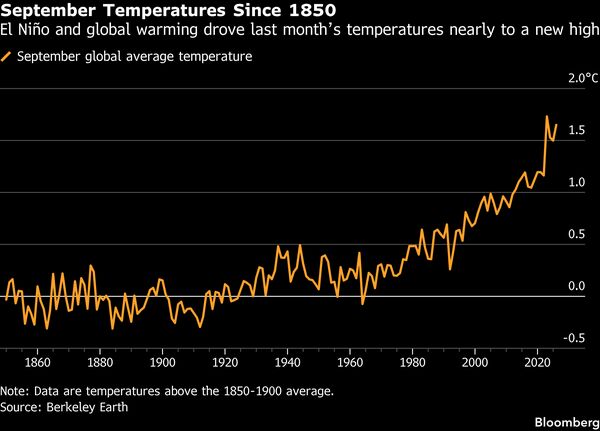
The probability calculation has shifted dramatically over the course of the year. In January, Berkeley Earth assigned just a 12 percent chance that 2026 would surpass 2024, and those odds dropped further by May. The strength of the El Niño surprised many scientists as it developed, and its onset in June quickly flipped the projections. The pattern may not peak until December.
Because atmospheric temperatures lag behind El Niño activity, scientists express high confidence that 2027 will be even warmer than 2026. Last month registered as the second warmest September globally, reaching 1.65 degrees Celsius above the pre-industrial norm. That figure sits just 0.06 degrees behind September 2023, a period when global average temperatures reached such abnormal heights that researchers famously characterized the anomaly in stark terms. Robert Rohde, chief scientist at Berkeley Earth, noted that conditions remain quite hot even without matching the extremes of 2023.
September 2026 also registered the highest departure from the norm for any month outside of September 2023 and August 2026. During the month, 53 countries established national heat records. Southwestern Europe, including Spain, Portugal, and Italy, experienced particularly severe late-summer temperatures. Meanwhile, eight nations—including Singapore, the United Arab Emirates, and Burkina Faso—broke their national records by margins exceeding 0.5 degrees Celsius.
The underlying El Niño system, measured by sea-surface temperatures in a specific region of the eastern tropical Pacific, has surpassed monthly benchmarks previously reached only in 2015 and 1877.