Ro Khanna Challenges Democratic Establishment Over Proposed California Billionaire Wealth Tax

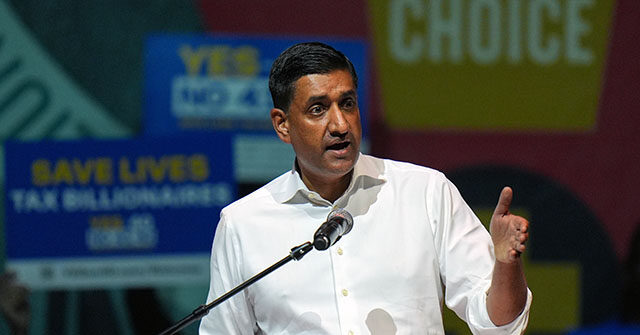
Rep. Ro Khanna (D-CA) is intensifying his push for a first-of-its-kind tax on the ultra-wealthy, arguing that the massive fortunes concentrated in California were built on the back of public investments. During a recent interview on the podcast “Conversate with Killer Mike,” the Silicon Valley congressman defended Proposition 40, a high-stakes referendum that would impose a one-time 5 percent tax on the state’s more than 200 billionaires.
Khanna, who describes himself as a “progressive capitalist,” framed the tax as a matter of fairness rather than an attack on entrepreneurship. He directly addressed the source of modern mega-wealth, which he argues has become disconnected from traditional income tax structures. While high-earning professionals like lawyers or investment bankers may pay between 40 and 60 percent in various taxes on their income, Khanna noted that billionaires often pay very little because their wealth is tied to asset appreciation rather than a paycheck.
“These are people who get valuations at $32, $33, $40 billion dollar companies,” Khanna said during the interview. He pointed to his own district and the surrounding 50 miles, which he said holds roughly $25 trillion—nearly one-third of the entire nation’s wealth. He argued that the growth of these assets is not an isolated achievement, noting that the federal government funded the foundational research for the internet, artificial intelligence, and the university systems that enabled these companies to thrive. “You didn’t build this money yourself,” Khanna said, echoing a famous progressive sentiment regarding public infrastructure. “So why not pay 5 percent? By the way, your wealth has increased 144 percent over the last three years.”
Proposition 40 would direct the revenue from this one-time levy toward California’s healthcare system. If passed, it would mark a significant shift in U.S. tax policy, targeting assets rather than transactions or income. However, the measure faces a steep climb. It has drawn criticism not only from the business community but also from prominent Democrats, including Governor Gavin Newsom. Critics warn that such a tax could trigger “wealth flight,” driving the state’s most affluent residents to relocate and potentially destabilizing the state’s tax base.
The political battle is further complicated by two competing referendums on the same ballot. Proposition 41 and Proposition 42 are designed to effectively neutralize Proposition 40 if they receive more votes. Proposition 41 would mandate rigorous audits of new tax programs, while Proposition 42 would implement a ban on new state personal property taxes and certain retroactive taxes.
Khanna suggested that the opposition from within his own party is driven by the influence of campaign donors rather than sound policy concerns. He specifically mentioned Newsom, who is widely seen as a potential 2028 presidential contender, suggesting that some Democrats are hesitant to alienate the donor class. “They don’t want to offend these billionaires because they want their money for running for office,” Khanna claimed, adding that many of his colleagues privately support the measure but fear the financial repercussions of a public endorsement.
The debate over Proposition 40 serves as a proxy for a larger ideological struggle within the Democratic Party. Khanna framed the choice as a binary between the “corporate Democratic Party” and the more populist, New Deal-style vision championed by figures like Senator Bernie Sanders (I-VT). Khanna and Sanders are currently the architects of the “Make Billionaires Pay Their Fair Share Act,” a federal proposal that would mirror the California initiative by applying an annual 5 percent tax on billionaires nationwide.
Addressing concerns about high earners from diverse cultural backgrounds—an issue raised by host Killer Mike—Khanna maintained that the public is not the one afraid of the tax. “The billionaires are afraid,” he said, asserting that the policy is focused on a specific tier of nearly 1,000 individuals across America whose wealth explosion has outpaced any previous era of economic growth. For Khanna, the fight in California is the first step in a broader national effort to capture a portion of the vast wealth currently held in unrealized capital gains.