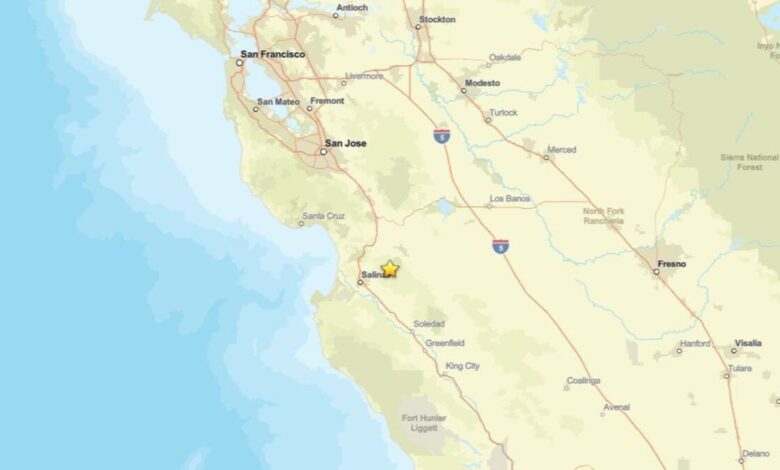
A preliminary 2.6 magnitude earthquake struck the Monterey County region on Wednesday afternoon, according to the U.S. Geological Survey. The tremor was recorded at 4:29 p.m., with its epicenter located approximately seven miles southwest of Ridgemark at a depth of six miles.
The event follows a series of seismic movements in the area over the preceding week. The USGS reported that four earthquakes measuring magnitude 2.5 or above have been detected locally within the last seven days. The most significant of these was a 3.1 magnitude tremor that struck west-southwest of Gustine on October 21.
Other notable seismic activity in the region during the past week includes a 3.0 magnitude quake south of Tres Pinos on October 22, a 2.5 magnitude tremor southeast of Aromas on October 26, and a 2.6 magnitude event east of Seven Trees on October 27.
Seismological data indicates that magnitude measures the energy released at the source of a quake, superseding the historical Richter scale. Earthquakes ranging between 2.5 and 5.4 in magnitude are frequently felt by residents but rarely result in significant damage, according to Michigan Tech guidelines. Tremors measuring below 2.5 are generally imperceptible to most people.
Federal agencies note that earthquakes can trigger secondary hazards such as fires, tsunamis, landslides, and avalanches. While seismic events can occur in any region, they are most common in states and territories including California, Alaska, Hawaii, Oregon, Washington, and Puerto Rico. Globally, an estimated 500,000 detectable earthquakes occur annually, of which approximately 100,000 are felt and about 100 cause damage.
Safety authorities advise individuals to take immediate protective action when shaking begins. Recommended procedures vary by location: motorists should pull over, stop, and set the parking brake; individuals in bed should turn face-down and cover their head with a pillow; people outdoors must stay away from buildings and avoid entering structures; and those indoors should remain inside away from doorways rather than running outside.
The standard protocol for personal protection remains dropping to hands and knees, covering the head and neck, and holding onto a sturdy shelter or interior wall. Post-earthquake hazards can include structural damage, gas and water leaks, downed power lines, and subsequent aftershocks.