
In the wake of the artificial intelligence boom, investors are increasingly identifying quantum computing as the next major hardware frontier. However, as the technology transitions from academic research into commercial adoption, a clear divide is emerging between competing technical modalities. Two of the most prominent pure-play companies in the sector, IonQ and Rigetti Computing, represent this struggle, offering investors two distinct visions of the future of high-performance computing.
The competition between these firms is fundamentally a battle of engineering approaches. IonQ has staked its future on ion-based quantum devices, while Rigetti Computing utilizes superconducting machines. While several companies are vying for dominance, the recent financial performance and strategic expansions of these two players offer a window into how the market is maturing as of late 2026.
IonQ has established itself as the commercial heavyweight in the trapped-ion space. Though ion-based systems are generally slower than the superconducting machines favored by industry giants like IBM, they possess a significant advantage in fidelity—a critical metric that measures the accuracy and reliability of quantum calculations. IonQ currently holds the world record for fidelity, an attribute that has translated directly into commercial traction.
In the second quarter of 2026, IonQ reported revenue of $80.1 million. This figure is particularly striking as it not only dwarfs its immediate pure-play competitors but is nearly double the second-quarter sales of all other pure-play quantum companies combined. The company has demonstrated a consistent growth pattern since going public in 2021, and its trajectory remains aggressive. For the full year of 2026, IonQ has forecast sales between $280 million and $290 million, a massive leap from the $130 million reported in 2025.
Beyond its core technology, IonQ is moving to secure its supply chain and expand its service offerings. Earlier this year, the company acquired SkyWater Technology, providing it with a dedicated foundry for constructing quantum computer chips. More recently, on October 12, IonQ announced the acquisition of Elisity, a cybersecurity firm, in a move to bolster its capabilities in quantum cryptography. This expansion comes at a cost, however; the Elisity deal involves stock valued at up to $1.3 billion, which may result in significant dilution for existing shareholders. IonQ’s operating losses have also ballooned to $337.2 million in the second quarter, up from $160.6 million the previous year.
Rigetti Computing offers a different value proposition. As a vertically integrated company, Rigetti maintains control over the entire development cycle, from chip design and manufacturing to the software layer. Its focus on superconducting machines aligns it with the prevailing industry modality used by several tech titans. While Rigetti’s revenue scale is smaller than IonQ’s, its growth is accelerating. The company reported $5.1 million in second-quarter revenue, a substantial increase from the $1.8 million recorded in the same period of 2025. In fact, Rigetti’s total revenue for the first half of 2026 reached $9.5 million, already surpassing its full-year 2025 revenue of $7.1 million.
Rigetti’s prospects are bolstered by significant institutional support. In September 2026, the company was awarded $100 million by the U.S. Department of Commerce to further its technology. Furthermore, a partnership with Hewlett-Packard aims to integrate Rigetti’s quantum devices into existing supercomputing environments, creating hybrid solutions that could bridge the gap between classical and quantum processing. Despite these wins, Rigetti remains deeply in the red, with second-quarter operating losses rising to $28.1 million from $19.9 million a year prior.
When comparing the financial health of the two firms, the scale of their reserves remains a deciding factor for many analysts. IonQ ended the second quarter with a massive $3 billion in cash, cash equivalents, and investments. Rigetti, while smaller, maintains a respectable $541.3 million stockpile, which, alongside its $100 million government award, provides a short-term cushion for ongoing research and development.
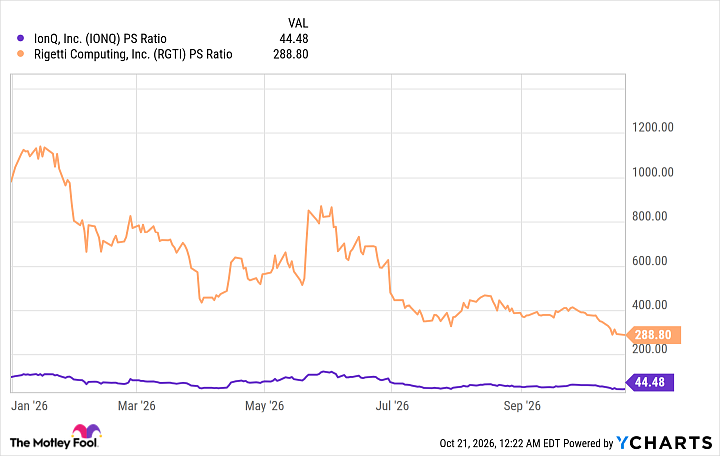
From a valuation perspective, a divergence in market sentiment has emerged. As of October 22, 2026, Rigetti’s price-to-sales ratio sat at more than six times that of IonQ. This suggests that while Rigetti is growing, the market is pricing its stock at a significant premium relative to its current revenue generation. Conversely, IonQ’s much larger revenue base and comprehensive platform positioning have led some to view it as a more stable value play, despite the dilution risks associated with its acquisition-heavy strategy.
Ultimately, the path forward for both companies depends on their ability to scale while fending off larger, deeper-pocketed rivals like IBM. While Rigetti is betting that its vertical integration and alignment with industry-standard superconducting technology will win out, IonQ is leveraging its high-fidelity results and aggressive market expansion to consolidate its lead. For now, the quantum race remains a high-stakes competition where accuracy, speed, and capital reserves will determine which architecture eventually dominates the global landscape.