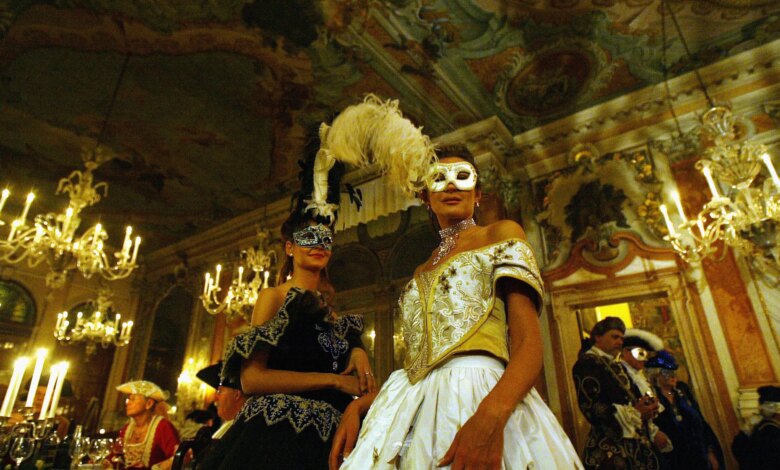
The anonymous nature of masquerade balls has long given the masked fête a seductive quality rooted in mystery, intrigue, and escapism. By donning masks and elaborate costumes, attendees are granted the freedom to revel without social restraints, offering a rare chance to step outside everyday identities—even if just for one evening. Centuries after their inception, masquerade traditions continue to captivate partygoers drawn to the enduring appeal of hiding in plain sight.
The origins of the masquerade stretch back to 15th-century Europe, establishing core components that remain unchanged: dancing, elaborate fashion, and an atmosphere of suspense. Most famously in Venice, the festive Carnevale di Venezia celebrations brought together villagers and the highest echelons of society, including royalty. Taking place just before Lent, Carnival offered a structured period to release inhibitions before the solemn days of austerity.
By the Renaissance era, costumed extravaganzas had embedded themselves deeply into European culture. The introduction of masks provided a natural progression that allowed guests to mingle anonymously across rigid social divides. However, the concept of masking predated these grand celebrations. In 1268, authorities issued a temporary mask ban after men used face coverings to conceal gambling and other illicit activities. By the 15th century, though, masks were commonplace in royal courts, worn at parties, weddings, and political ceremonies.
During the late 16th and early 17th centuries, the masquerade tradition spread across Europe, gaining significant popularity in France and England. French King Louis XIV hosted opulent masked gatherings at Versailles, enabling high-ranking court members to socialize away from public scrutiny, whether for secret romances or political maneuvering. Years earlier, in 1393, King Charles VI hosted the infamous Bal des Ardents in Paris, where a tragic torch fire killed four French nobles. The ensuing backlash temporarily paused such macabre entertainment, but the format ultimately evolved into a grander aristocratic tradition. In England, King Charles II made masquerades a regular fixture among the nobility. During the 18th century, Swiss-born British impresario John James Heidegger introduced more public masquerades, opening the doors to untitled commoners willing to pay for entry and temporarily leveling social hierarchies.

This social mixing soon drew pushback. The Church of England criticized masquerades for encouraging immorality, while Venetian authorities reimposed mask bans to crack down on criminality. Carnival season in Venice was officially suspended by authorities in 1797, though private elite masquerade parties persisted. The Venetian tradition was officially revived in 1979 and now takes place annually between late January and mid-February. In New York City, the annual Save Venice masked gala, Un Ballo in Maschera, continues to pay homage to Carnival, taking place every spring at The Plaza Hotel to raise funds for preserving Venetian art and design.
While modern masquerades are frequently associated with Halloween and gothic aesthetics, their historical roots were tied more closely to societal structure than the supernatural. In 15th-century Europe, different social classes rarely occupied the same room outside of Carnival season. Today, while social stratifications are less rigid, escaping the constant visibility of the digital age has become a distinct luxury.

The endurance of the masquerade trope in popular culture further highlights a widespread public fixation on the format. On-screen portrayals range from a 1990s cinematic adaptation of Romeo + Juliet and Sofia Coppola’s Marie Antoinette to Cinderella-inspired retellings like Ever After. More recently, television series such as Gossip Girl and Bridgerton have featured masquerade episodes, introducing the timeless tradition to younger generations.
In the United States, few events captured the public imagination quite like the 1966 Black and White Ball, hosted by writer Truman Capote at New York City’s Plaza Hotel. Attended by more than 500 guests, the star-studded roster included figures like Andy Warhol, Lee Radziwill, Henry Fonda, and Frank Sinatra. The strict dress code required black-and-white attire, with masks mandatory until a midnight unmasking. Women wore elbow-length gloves and intricate headpieces, while men donned tuxedos. Thrown in honor of Washington Post publisher Katharine Graham, the event was dubbed the party of the century, and its immense press coverage helped launch a modern era of public fascination with media figures. Even with small masks, many recognizable attendees were easily identified, as every invitation was personally curated by Capote based on reputation and success.

Decades later, the appetite for immersive masked experiences remains strong. In New York City, a Phantom of the Opera-inspired immersive musical requires guests to wear masks as they navigate the world of Christine Daaé, with tickets heavily booked months in advance. Around Halloween, hotels across the United States host annual masked soirées in grand ballrooms, including the Baccarat Hotel New York’s Black Crystal Masquerade and the Masquerade Ball at The Brown Palace in Denver, Colorado.
In an era defined by constant digital connectivity and public exposure, the ability to vanish behind a disguise carries renewed appeal. Rather than simply hiding, a masked fête offers attendees the chance to shed everyday routines, adopt an entirely new persona, and embrace an unfamiliar confidence. Whether seeking anonymity in a crowd or stepping into a theatrical fantasy, guests continue to find liberation in the enduring power of the mask.