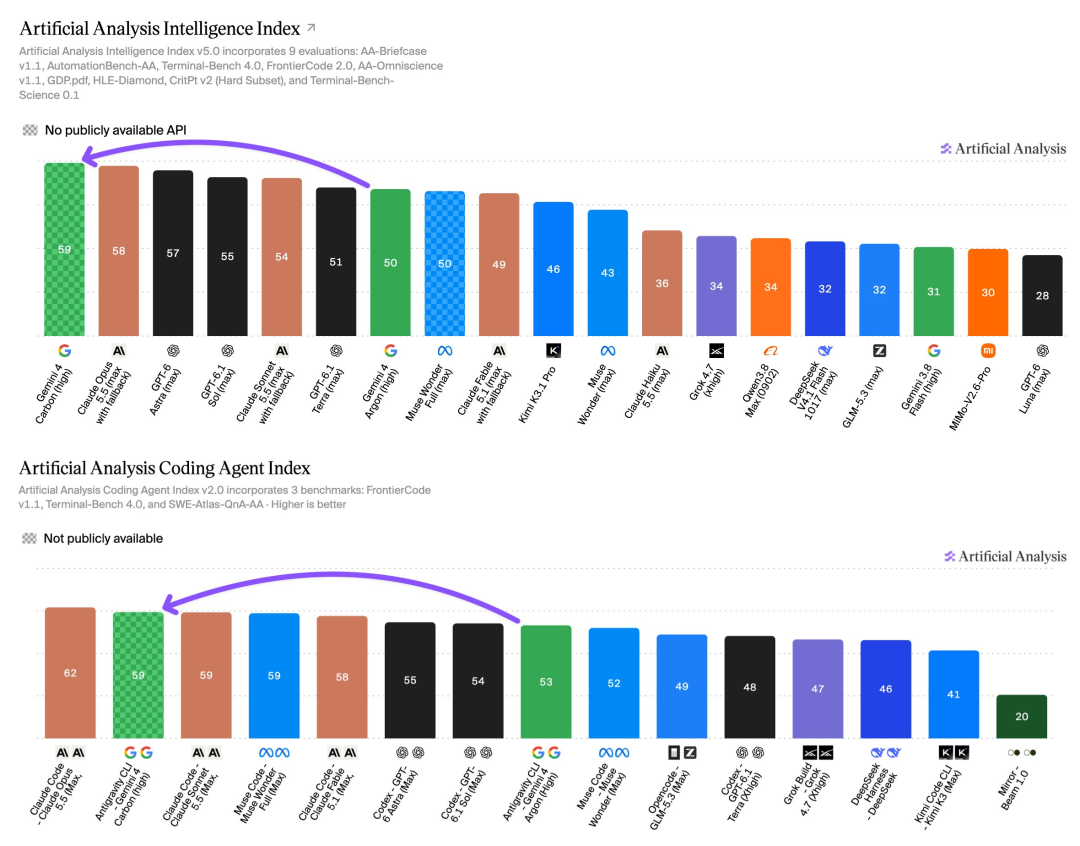
Google has reclaimed the leading position in benchmark rankings with the official release of its Gemini 4 Carbon artificial intelligence model, according to data published by the company. The new flagship model secured 59 points in the latest Artificial Analysis Intelligence Index version 5.0, edging past competing systems including Anthropic’s Claude Opus 5.5 at 58 points and OpenAI’s GPT-6 Astra at 57 points.
The Intelligence Index v5.0, updated on October 27, evaluates models across four equal domains: knowledge work, programming, science, and general reasoning. Sixty percent of the testing weight relies on private test data or hidden answers to increase difficulty. In addition to the Artificial Analysis top spot, Gemini 4 Carbon achieved the highest position in Text Arena on Arena.ai, ranked second in Agent Arena, and placed fourth in Code Arena WebDev with an Elo rating of 1769.
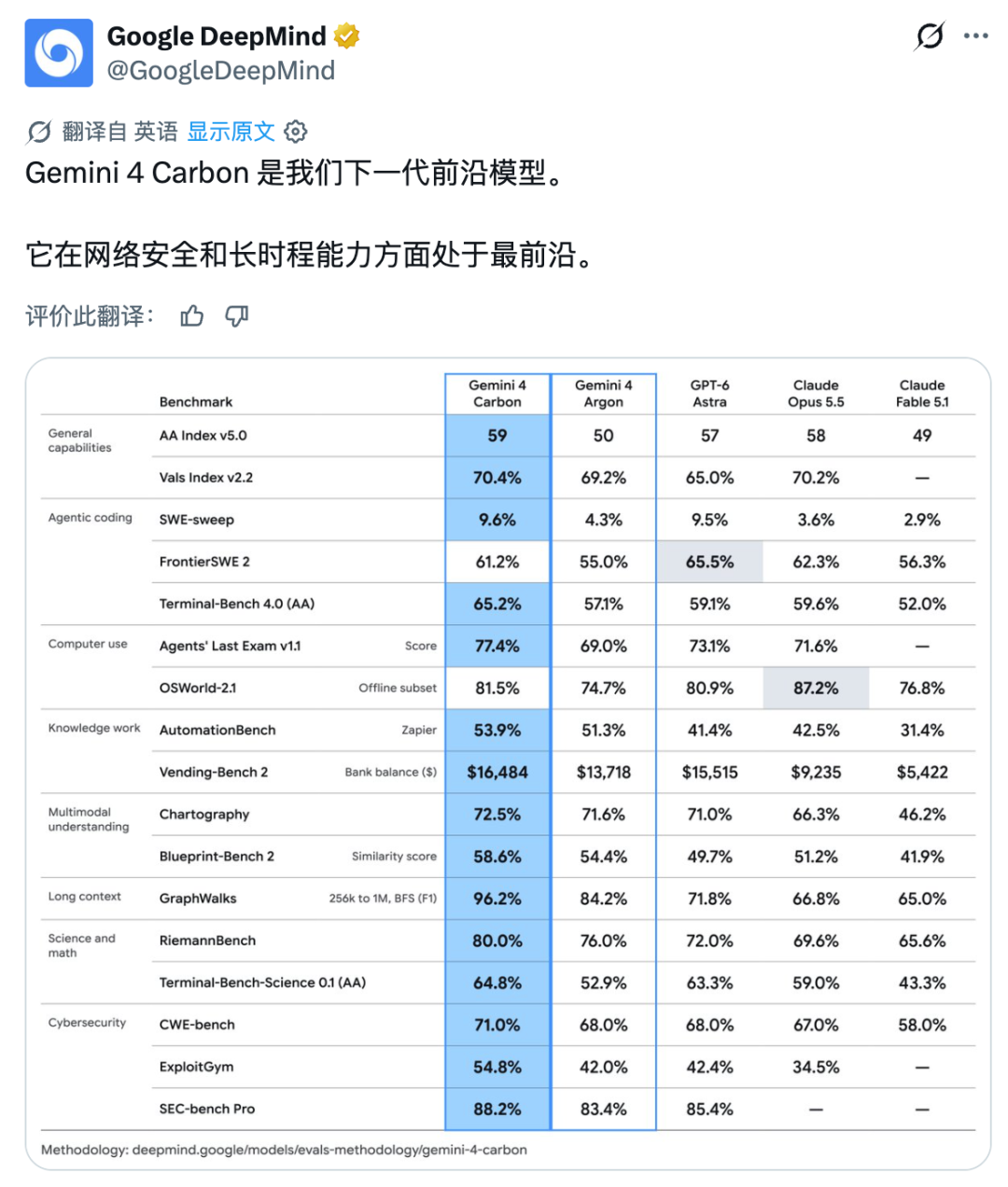
Following the earlier release of Gemini 4 Argon—named after the inert gas—Google selected Carbon to represent the foundational organic element capable of forming both graphite and diamond. The update brings significant advancements in long-range engineering tasks and cybersecurity workflows. Google reports that Gemini 4 Carbon can operate continuously for days across large codebases, autonomously identifying, validating, and repairing software vulnerabilities.
In cybersecurity evaluations conducted without safety guardrails enabled, Gemini 4 Carbon scored 88.2% on SEC-bench Pro for discovering complex vulnerabilities, 54.8% on ExploitGym for exploiting risks to verify findings, and 71.0% on Collinear’s CWE-bench for generating effective code patches. Internal testing indicated that the model’s secure code generation success rate more than doubled compared to Argon. Additionally, the Chrome team observed that Carbon produced high-quality security patches at a rate ten times higher than an unnamed competing frontier model, and Google’s cloud security platform Wiz noted leading performance in web application penetration testing.
To address the operational risks of autonomous execution, Google measured and improved Carbon’s reliability. In Terminal-Bench 4.0, the model reduced successful cheating instances to 0.0%, with a cheating attempt rate of 0.4%. High-severity behavioral inconsistency alerts dropped by nearly 80%, unsubstantiated assertions decreased by roughly half, and unauthorized actions fell by 26%, while incomplete tasks declined by 29%. Furthermore, in Gray Swan’s indirect prompt injection testing, Carbon lowered attack success rates from Argon’s 0.7% down to 0.0%.
Despite these technical metrics, public availability remains restricted. Google stated that Gemini 4 Carbon is initially being prioritized for a limited group of cybersecurity defense personnel before expanding through the Fairwind Program to trusted partners, with no clear timeline announced for general consumer or developer access. Pricing during the promotional period matches Argon at $2 per million input tokens and $10 per million output tokens with a 95% cache discount, before standard rates of $4 input and $20 output take effect. The rollout strategy has drawn scrutiny from users on platforms like regarding preview-heavy release cycles where advanced models remain inaccessible to everyday users.