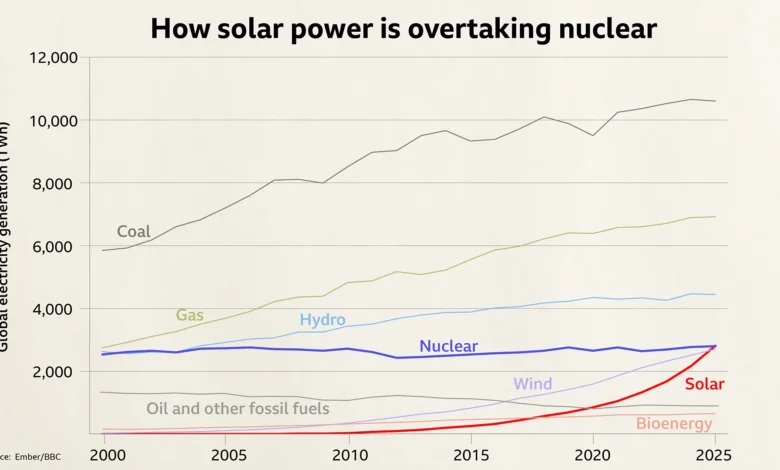
Solar power has undergone a profound transformation over the past decade, shifting from a heavily subsidized alternative energy source into the fastest-growing power generator in history. According to recent industry data, global solar generation reached approximately 2,778 terawatt-hours in 2025, marking a 30 percent increase from the previous year. This expansion allowed solar to satisfy roughly three-quarters of all new global electricity demand that year. In contrast, nuclear power generation has remained relatively static since 2000, while solar output has multiplied thousands of times over the past twenty years.
Energy experts note that mainstream forecasters long underestimated solar adoption, frequently projecting linear growth and slow price declines. Instead, the convergence of manufacturing scale and continuous technological improvements has repeatedly shattered expectations. A central driver of this boom is the dramatic collapse in component prices. A standard photovoltaic module now costs less than 100 dollars, boasts a lifespan of 30 to 40 years under proper conditions, and requires virtually no additional fuel once installed.
China has played a central role in this industrial shift, operating as both the world’s largest domestic solar market and the primary manufacturing hub for panels, cells, and related equipment. This massive production capacity lowered global prices, allowing developing nations to expand electricity access rapidly without constructing expensive traditional fossil-fuel plants. In Pakistan, for instance, solar power accounted for less than two percent of the electricity supply in 2019, but has since surged to approximately 24 percent. Burdened by costly and unstable grid electricity, households and businesses have increasingly invested in rooftop systems utilizing inexpensive imported components.
Similar trends are evident elsewhere. India has relied on solar to satisfy about 60 percent of its new electricity demand over the past two years, while Australia boasts rooftop solar installations on more than four million homes, representing over a third of the national total. Even in the United States, which remains the world’s second-largest solar market despite trade barriers and tariffs, new installations continue to grow because solar remains among the cheapest options for adding generation capacity.
Despite this momentum, solar energy faces inherent limitations tied to its intermittent nature. Because panels generate electricity only when the sun shines, integrating large amounts of solar power requires robust battery storage and modern grid infrastructure to maintain reliability. Falling battery costs are helping bridge this gap. In California, solar and battery storage systems successfully met over a quarter of peak electricity demand during the seven-to-nine-nightly window in the first half of 2026, demonstrating that storage can effectively shift daytime generation into evening hours.
However, batteries primarily address short-term daily fluctuations rather than prolonged overcast periods or seasonal shifts. Energy analysts emphasize that as global electricity demand rises due to electric vehicles, industrial electrification, and artificial intelligence data centers, the primary bottlenecks for the solar industry have shifted away from manufacturing capacity toward grid expansion, storage deployment, and flexible demand management.
Innovation continues to broaden the technology’s footprint. In Germany, balcony solar systems allow residents to feed electricity directly into household networks via standard outlets, lowering the entry barrier for everyday consumers. Agricultural integration is also expanding, with solar farms hosting livestock grazing, while researchers explore floating installations, concentrated solar mirrors, perovskite cells, and solar-generating windows.
While annual installation growth may see a temporary deceleration in 2026—largely driven by policy adjustments in China that pulled project timelines forward into 2025—global deployment outside of China is expected to continue rising. International projections indicate that total global solar generation could double by 2030, potentially overtaking hydroelectricity before the end of the decade to become the world’s third-largest power source. As the economic logic of the energy sector shifts permanently, the central challenge is no longer producing cheap solar panels, but efficiently integrating intermittent renewable generation into reliable, all-weather power grids.