Fondation Louis Vuitton Exhibition Sheds Light on Turn-of-the-Century Collector and Designer Gustave Fayet

An extensive new autumn exhibition at the Fondation Louis Vuitton in Paris is working to rescue the largely forgotten reputation of Gustave Fayet, a turn-of-the-century figure whose life spanned high-end art collecting, museum leadership, and multidisciplinary design. Titled “Gustave Fayet: Collector – Artist Designer,” the survey adopts a dual approach to examine Fayet both as a discerning accumulator of masterpieces and as an ambitious creator supported by personal wealth.
Born in 1865 into an affluent family of winegrowers and landowners, Fayet lived until 1925 and amassed a staggering collection of Post-Impressionist and avant-garde art. Over his lifetime, he acquired 10 paintings by Vincent van Gogh, 101 works by Paul Gauguin including 54 paintings, and 128 works by Odilon Redon including 84 paintings and pastels. His holdings also featured pieces by Degas, Cézanne, Toulouse-Lautrec, Renoir, Bonnard, and Matisse. Many of these works were dispersed beginning in 1928, but loans from institutions and private collections worldwide have reunited them for the current Parisian survey.
The exhibition opens with archival records tracing Fayet’s acquisitions through original invoices, personal inventories, and individual index cards handwritten for each artwork. Fayet maintained direct correspondence with prominent art dealers such as Ambroise Vollard and Paul Rosenberg, as well as artists including Paul Signac, Aristide Maillol, and Gauguin. Before emerging as a major collector, Fayet practiced painting himself, focusing initially on plein air landscapes in the spirit of the Barbizon school, alongside later India ink drawings of his family from around 1914 to 1915. In his hometown of Béziers, he served as assistant curator and later director of the local museum, where he exhibited an oil-on-cardboard work by Picasso titled Woman by the Sea from 1901, marking only the second time Picasso’s work had been shown publicly in France.
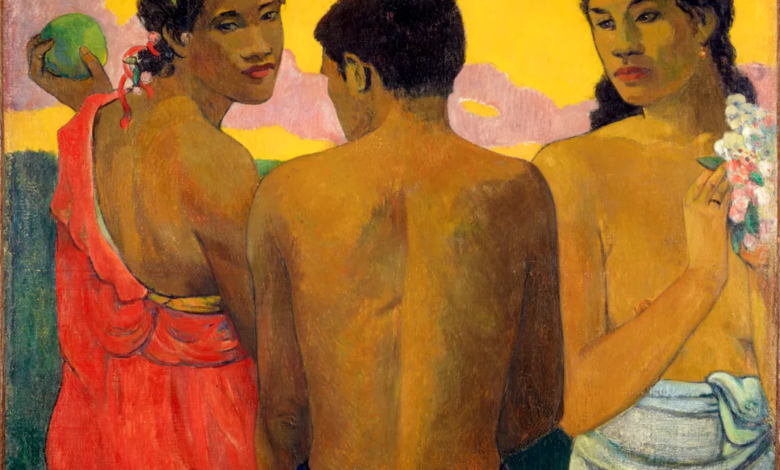
Curator Sylvie Patry notes in an accompanying text that Fayet supported artists working at the margins of, or in opposition to, institutional authorities. While he operated partly as a speculator, his van Gogh collection was never traded. He owned canvases depicting factories, thistles, plane trees, and the hospital garden at the Saint-Rémy asylum. Van Gogh’s 1889 Self-Portrait with Bandaged Ear notably hung in Fayet’s bedroom. Fayet was also the most significant collector of Gauguin’s work during the artist’s lifetime, and their correspondence spanned from 1900 to 1903. When Fayet relocated from Béziers to Paris in 1905, his reception room featured a salon-style hanging of Gauguin’s art that filled the entire space, including The Yellow Christ from 1889 and the wood-engraving series Noa Noa. Notably, Fayet’s collection included work by only two women painters: Berthe Morisot and Jacqueline Marval.

Fayet’s connection to Odilon Redon represents another major facet of the collection. Redon created pastel portraits of the Fayet family, including his wife, Madeleine, in 1907, and their nine-year-old daughter, Simone, with a doll in 1906. In 1908, Fayet purchased Fontfroide, a Cistercian abbey, which he restored and filled with Asian Buddhas and Moorish furniture. He commissioned Redon to create large decorative panels for the abbey library, including Le Jour, La Nuit, and an overdoor panel titled Le Silence. Classified as historic monuments, these vibrant works left Fontfroide for the first time to appear in the exhibition. Redon was also the subject of a 1911 graphite portrait drawn by Fayet, just as Redon had drawn Fayet in 1910 using red chalk, graphite, and pastel.
The museum’s top floor shifts focus to Fayet’s own artistic production. In 1896, he founded a stoneware workshop in Béziers with sculptor and former Rodin student Louis Paul, producing vases with matte glazes and iridescent finishes. From 1912 onward, he filled botanical blotting papers with vivid floral motifs that served as designs for wallpaper, fabrics, and rugs. In 1920, he established the Atelier de la Dauphine in Paris to transform his drawings into housewares, securing commissions from high-end clients such as couturière Jeanne Lanvin, for whom he crafted four rugs for her townhouse on rue Barbet de Jouy. Fayet also became a shareholder in Maison Della in 1920, employing 15 women to weave carpets based on his watercolors using a symmetrical knotting technique, modeling his enterprise after couturier Paul Poiret’s Atelier Martine.

Gallery 10 highlights Fayet’s wool rugs displayed tapestry-style in a chapel-like space, reflecting his view, quoting Edgar Allan Poe, that the carpet is the soul of the apartment. The space is illuminated by four stained-glass windows created by Richard Burgsthal using medieval techniques for Fontfroide. The exhibition concludes with a display of 1920s glamour featuring satin dresses, Grecian robes, and embroidered coats by Paul Poiret, Jacques Doucet, and Jeanne Lanvin, illustrating the broader lifestyle and aesthetic universe of the Fayet family.