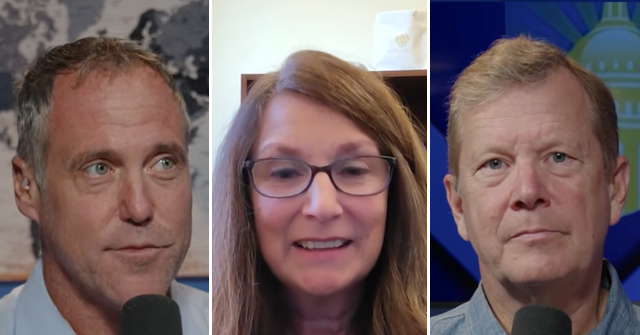
Federal efforts to secure American elections have increasingly focused on voter registration list maintenance, with Department of Homeland Security and Justice Department officials pushing states to clean up their rolls by removing deceased registrants and noncitizens. According to investigative journalist Peter Schweizer and former Homeland Security official Heather Honey, resistance from several state governments has complicated these security initiatives.
Honey, a senior counselor and former assistant secretary at the DHS, recently discussed voting security measures alongside Schweizer and author Eric Eggers. Federal authorities have long promoted the Systematic Alien Verification for Entitlements system, known as SAVE, as a tool for verifying citizenship and immigration status. President Trump made the database available to state and local officials at no cost, eliminating previous per-transaction fees. Approximately half of U.S. states have utilized the system’s bulk-upload feature to cross-reference their entire voter registration databases against federal records, uncovering nearly 500,000 deceased registrants and roughly 30,000 noncitizens.
However, several states have resisted using the SAVE system. The Justice Department filed a lawsuit against California after determining that more than 20,000 individuals identified as likely noncitizens were registered to vote in the state. Under California law, registered voters are automatically mailed ballots, despite federal restrictions against noncitizens voting in federal elections. Homeland Security Investigations and federal partners employed multiple data-enrichment methods to review publicly available voter files obtained by the federal government.
States declining to use the SAVE system are not exclusively governed by Democrats, though the majority are, according to Honey. Some officials cited privacy concerns regarding the transfer of unredacted voter files containing Social Security numbers and driver’s license information. Honey disputed that reasoning, noting that many of those same states transmit complete motor vehicle databases—including individuals not registered to vote—to private nonprofit entities such as the Electronic Registration Information Center.
In July, DHS Secretary Markwayne Mullen sent a letter requesting that California segregate, without destroying, the approximately 20,000 vote-by-mail ballots linked to individuals flagged as likely noncitizens, pending independent or collaborative citizenship verification. California officials responded that attempting to separate received ballots would severely disrupt election operations. Honey countered that election systems already segregate ballots for curing missing information and process provisional ballots under federal law as a matter of routine procedure, noting that local jurisdictions have previously managed to flag duplicate mailings.
Discussions surrounding voter registration accuracy also touch on automatic voter registration practices tied to motor vehicle departments, which critics argue contribute to registration errors. While legislative proposals such as the SAVE America Act have advanced through the House of Representatives, administration officials maintain that existing federal authorities under the DHS and Justice Department permit enforcement actions to ensure proper voter roll hygiene. Measures such as withholding emergency management funds have been raised regarding noncompliant states, while national security responsibilities are cited under DHS authority to justify federal oversight of election infrastructure.
Beyond registration records, administrative steps have been taken across the broader election ecosystem, including guidance issued by Dr. Oz to long-term care facilities to protect vulnerable residents from coercive absentee ballot practices known as granny farming. Although federal election security efforts have drawn criticism from various quarters, officials maintain that implemented protocols have strengthened the overall reliability of American voting systems.