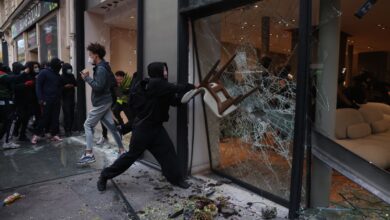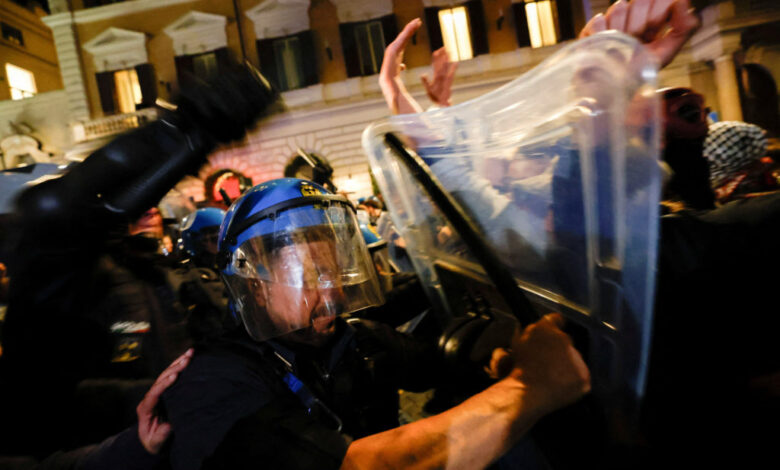
Thousands of young people marched Saturday through the streets of several major Italian cities, including Milan, Rome, and Turin, as authorities deployed large numbers of police and soldiers in an effort to prevent a repeat of the violent clashes and looting that marred similar demonstrations the previous week. While the Milan demonstration remained largely peaceful, brief clashes with police broke out in both Rome and Turin. In Milan, thousands of young participants moved through the streets while luxury boutiques were boarded up and army vehicles stood watch. By late afternoon, however, most shops had reopened. Premier Giorgia Meloni announced a raft of measures in response to the unrest, including sending an additional 500 soldiers to Milan and introducing tougher penalties for minors. Police noted that minors made up a large portion of the violent protesters the previous week and detained several teenagers in Milan as a preventive measure. As night fell in Milan, huge crowds gathered, chanting insults against Meloni and holding banners reading “No to lies of the state.” A group of protesters dumped manure outside Italy’s energy regulator and burned a symbolic, oversized electricity bill. The newly deployed 500 soldiers joined hundreds already stationed in the city, backing about 5,000 police and other security personnel equipped with drone surveillance, railway station checks, rapid-response units, and online monitoring. Security measures extended beyond the city center due to concerns that protesters might move into other neighborhoods. The Milan march concluded peacefully Saturday evening outside the Milan Polytechnic, more than 3 kilometers from the city center. Meanwhile, officials reported investigating a 30-year-old freelance journalist suspected of acting as the mastermind behind the newly formed Oct. 17 movement, which has driven recent protests in Italy. Milan police reported that last week’s violence and looting involved about 2,000 very young protesters—many described as naturalized, second-generation Italians—alongside foreign nationals. Over the previous two-week period, police arrested 45 people, including 34 minors. A group of about 30 far-right activists linked to the Inter Milan soccer club made a brief appearance chanting anti-immigrant and anti-Muslim slogans before being isolated by police. Defense Minister Guido Crosetto clarified that the soldiers deployed Saturday were only recently authorized to use plastic restraint ties and only in areas around train stations, without permission to carry pepper spray or tasers. Security was similarly heightened in Rome, where authorities locked down luxury shopping streets and increased controls around the Circus Maximus and Piazza del Popolo. A small number of protesters attempted to force their way into the Colosseum before guards ushered them out. Elsewhere in Rome, several hundred students demonstrated peacefully to emphasize they were not rioters. A separate anti-war march in central Rome experienced brief clashes with police near the Piazza della Repubblica after organizers attempted to hold the crowd back using batons and tear gas. The protesters retreated when a water cannon was deployed. In Albania’s capital, Tirana, riot police used water cannons against large groups of protesters who threw projectiles and set government buildings on fire. Authorities reported that 2,500 officers patrolled the streets on Saturday, responding to over a week of unrest where demonstrators hurled rocks, flares, firebombs, and fireworks. High school and university students in Tirana are demanding lower tuition fees, greater state investment in education, and an end to corruption, while joining a broader anti-government movement calling for the resignation of Socialist Prime Minister Edi Rama. Rama stated his government was preparing a response to student demands and invited them to dialogue, while warning that violent protesters would face penalties. In Spain, thousands of retirees and citizens marched peacefully in Madrid to protest potential changes to public pensions ahead of upcoming elections, while separate demonstrations in Lisbon targeted government housing measures that critics argue favor landlords over tenants.