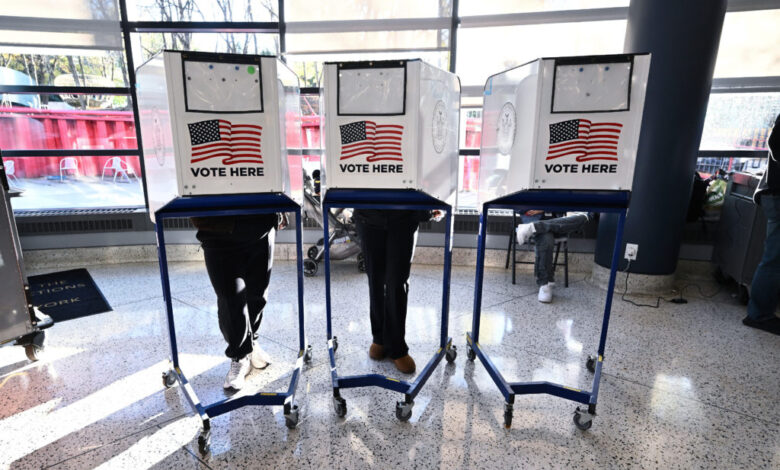
With just one week remaining before Election Day and tens of millions of early ballots already cast, political campaigns across the United States entered their final stretch, with Democrats placing the economy, everyday living costs, and affordability at the center of their closing message.
President Donald Trump campaigned in Texas, making his fourth trip of the season to a historically Republican state where Democrats see potential for gains. During a rally, the president urged voters to support state Attorney General Ken Paxton in his competitive U.S. Senate race against Democratic candidate James Talarico, while promising swift relief on energy costs. “Gasoline and diesel prices will soon come down,” President Trump told supporters, predicting prices would plummet quickly for consumers.
Talarico countered with an appeal focused directly on economic pressure and affordability. Speaking to voters, Talarico argued that political corruption had driven up healthcare premiums and gutted household finances to benefit billionaires, framing the current financial strain as a direct result of political corruption that voters could end at the ballot box.
Voter sentiment on economic issues varied widely across regions and priorities. In Texas, voter Susan Campos expressed frustration with economic inequality, stating that the country needs leadership focused on everyday citizens struggling to pay for basic necessities like gas and groceries rather than just the wealthiest one percent. In Mississippi, voter Leigh House accepted higher energy costs as a necessary trade-off for global freedom, while in California, voter Blake Marnell emphasized that illegal immigration and high housing costs remained the dominant concerns, arguing that a smaller population would naturally lower housing expenses.
Democrats sought to nationalize the economic message across multiple states. In Ohio, gubernatorial candidate Amy Acton rallied supporters by promising to make the state affordable again through collective action and shared purpose.
Republicans, meanwhile, offered differing counter-arguments and policy visions. In New York’s 17th Congressional District, incumbent Republican Representative Mike Lawler emphasized the need for less government involvement and more bipartisanship, pointing to high state taxes, a difficult business climate, and out-migration. However, some local voters, such as Primrose D. Sullivan, expressed frustration with out-of-control property values, leaving them open to considering alternative political options.
In the critical swing state of Michigan, Vice President J.D. Vance campaigned on returning control of the country to everyday citizens and supporting Republican candidates up and down the ballot. Michigan features a tight U.S. Senate race between former Congressman Mike Rogers and Democrat Abdul El-Sayed, which is viewed as one of several contests likely to determine control of the Senate. During a campaign event in Grand Rapids supporting Rogers, Health and Human Services Secretary Robert F. Kennedy Jr. delivered remarks criticizing Arab and Muslim societies, claiming they lacked scientific and literary output and asserting that their traditions had been damaged by the Muslim Brotherhood.
As the clock ticks down to Election Day, candidates nationwide continue pressing their respective economic and governance arguments to persuade the remaining undecided voters.