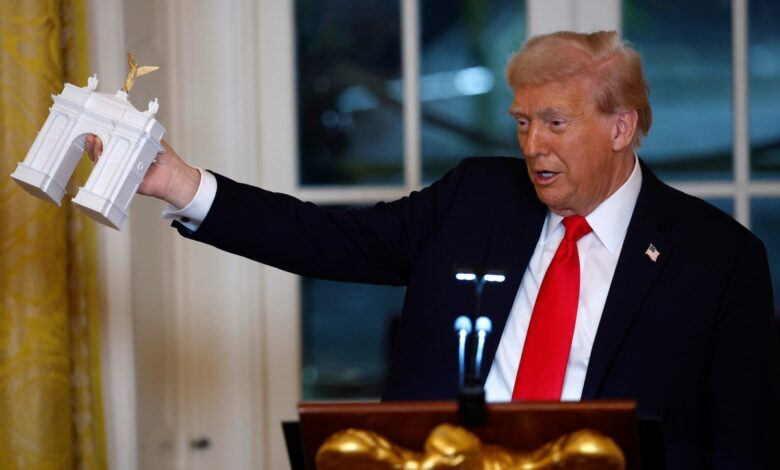
Washington, D.C., and Virginia filed a federal lawsuit on Saturday seeking to block the Trump administration’s proposed 250-foot triumphal arch near Arlington National Cemetery, escalating a high-stakes legal battle just days before construction could potentially begin.
The joint legal action labels the project “flagrantly unlawful” and asks the federal court to issue preliminary and permanent injunctions halting construction and site preparation at Memorial Circle. The eight-count complaint names the National Park Service, the Department of Interior, Interior Secretary Doug Burgum, and National Park Service official Jessica Bowron as defendants.
Lawyers for the two jurisdictions argue that the administration lacks required congressional authorization, violates statutory height restrictions, and failed to satisfy environmental and historic preservation requirements. “The court should not allow this cynical gambit to succeed,” attorneys wrote, accusing federal officials of rushing toward construction before the judiciary can properly intervene.
Virginia Attorney General Jay Jones described the proposal as an “illegal vanity project” and “an affront to this hallowed ground and the extraordinary sacrifices it represents.” Jones added that the commonwealth maintains a solemn duty to preserve the dignity of the sacred location.

The complaint asserts that the arch cannot lawfully proceed without explicit approval from Congress. It cites the Commemorative Works Act alongside a separate federal statute barring buildings or structures on federal land in the District without express congressional authority. Plaintiffs also contend the 250-foot structure violates the Height of Buildings Act, which generally restricts buildings on business streets or avenues in D.C. to 130 feet while excluding the arch from statutory exemptions.
In addition to statutory claims, the lawsuit alleges violations of the Administrative Procedure Act, the National Environmental Policy Act, and the National Historic Preservation Act. Unlike a separate ongoing challenge brought by three Vietnam War veterans and a historic preservationist—where the Justice Department has contested legal standing—D.C. and Virginia argue they will suffer direct, concrete harm from the development.
According to the complaint, construction would disrupt regional traffic and emergency services, divert government resources, and damage environmental and historic interests. National Park Service documents cited in the filing indicate that construction would span two to three years, operating 20 hours per day. The project would close the south side of Memorial Circle, reduce westbound traffic from Memorial Bridge to two lanes, and introduce heavy construction traffic. Daily traffic through the rotary exceeds 27,000 vehicles, 1,100 bicyclists, and 1,200 pedestrians.
Plaintiffs warn that resulting congestion could impede emergency responders traveling between the District and Arlington County under mutual-aid agreements and interfere with a designated evacuation route out of Washington. The lawsuit further highlights the administration’s announcement that the arch would serve a dual military function, housing drones, snipers, and ammunition. Defense Secretary Pete Hegseth stated in a court declaration that the structure represents a “generational national defense opportunity.”

During a hearing on Friday, U.S. District Judge Tanya S. Chutkan questioned the government’s national security justification, pressing counsel on how a major tourist destination could safely function as a military installation near the flight path to Ronald Reagan Washington National Airport. Chutkan noted that cranes could reach approximately 320 feet and pointed out that aviation reviews occurred prior to the military utility announcement.
The lawsuit also contends that the arch would permanently alter the historic landscape by obstructing the traditional sight line between the Lincoln Memorial and Arlington House. The National Park Service has previously acknowledged that the structure would occupy the center of the vista and introduce a competing illuminated element that affects the Washington Monument’s visual prominence. Furthermore, Virginia’s Department of Historic Resources previously objected to an expedited federal review, arguing that the compressed timetable failed to afford adequate evaluation of potential adverse effects.
The legal confrontation unfolds as Judge Chutkan weighs whether to halt the project in the separate veterans’ lawsuit, where Navy veteran Shaun Byrnes testified that he would rescind his wish to be buried at Arlington if the monument were built. Chutkan expressed skepticism during the proceedings, asking, “What is the harm of waiting? What is the rush to put this arch up?”
The National Capital Planning Commission is scheduled to consider final approval for the project on November 5. Administration officials previously indicated that if the commission approves the arch and the Interior Department issues a final authorization, work could commence the same day. D.C. and Virginia argue that breaking ground would instantly inflict irreparable harm by creating irreversible physical and financial facts on the ground.