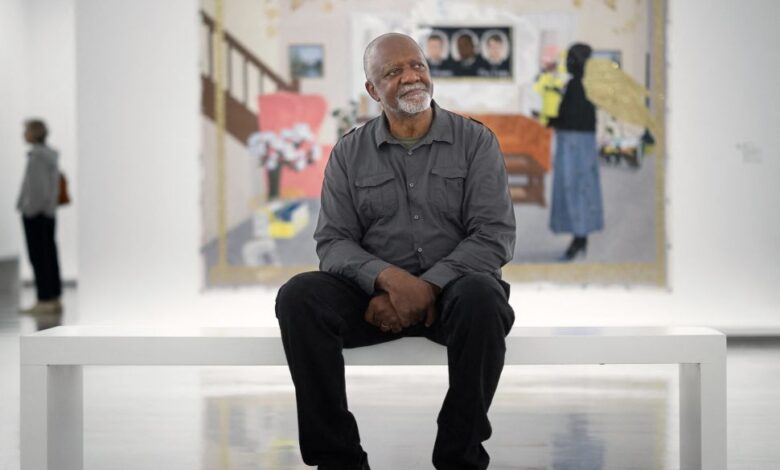
The Musée d’Art Moderne de Paris has launched the first major French retrospective dedicated to American painter Kerry James Marshall, adding to a recent surge of exhibitions highlighting Black American artists in the French capital. Titled “The Histories,” the landmark exhibition spans more than four decades of Marshall’s career, featuring 70 paintings drawn from public and private collections, including the Pinault collection and the Fondation Louis Vuitton.
Born in Birmingham, Alabama, in 1955 and based in Chicago, Marshall is celebrated for monumental figurative works that challenge the historical exclusion of Black communities from the Western art canon. “You’re never gonna see the range of treatment of Black subjects anywhere else, by anybody,” Marshall remarked in a video interview accompanying the exhibition. Curator Mark Godfrey noted that Marshall meticulously references art-historical archetypes while inserting Black lives into nuanced scenarios where racist indignities are sublimated. The artist also constructs counterfactual portraits of historical figures lacking visual records, such as abolitionist David Walker or a wedding portrait of Harriet Tubman, aiming to portray them with full humanity rather than as flattened, heroic symbols.

The Paris exhibition follows previous runs at the Royal Academy of Arts in London and the Kunsthaus Zürich. While the 70-painting checklist is largely identical to those venues—featuring eight newly made works, though only one new relative to London and Zurich—the Parisian installation introduces distinct structural changes. Organized across 12 sections spanning from 1980 to the present, the works are displayed against stark white walls along a single continuous path, contrasting with the enfilade of rooms and long sight lines found at the 18th-century Royal Academy building. Because Marshall’s work is less familiar to Parisian audiences than to Londoners, Godfrey prioritized a chronological arrangement for the first two-thirds of the exhibition.
The show begins with nods to early conceptual inquiries into invisibility and abstraction, touching on Ralph Ellison’s legacy in the 1986 painting *Invisible Man* and dialogues with Kazimir Malevich’s *Black Square*. Subsequent galleries trace the legacies of the Middle Passage through complex, allusive compositions from the early 1990s, such as *Plunge* and *Voyager*, which blend historical trauma with everyday scenes and code West African spiritual symbols, including Yoruban iconography and Haitian voodoo veves.

Everyday life and urban community form another core focus, heavily influenced by Georges Seurat’s *A Sunday on La Grande Jatte*. Marshall’s *The Garden Project* series, set in 1940s and ’50s public housing developments constructed during an era of hopeful Black migration from the American South, depicts gardens, children playing, and middle-class leisure rather than crime or suffering. Other highlights include *De Style* (1993), a barbershop scene referencing Piet Mondrian that was among the first of Marshall’s paintings acquired by a museum, and four souvenir paintings from 1997 honoring 1960s civil rights figures alongside ordinary middle-class domestic interiors.
The exhibition also incorporates large-scale sculptural works, such as the floor-based installation *Wake*, first shown at the 2003 Venice Biennale. Reminiscent of West African *Nkisi Nkondi* sculptures, the piece accumulates medallions of African Americans with each installation, transforming a symbol of historical trauma into an expanding monument of cultural achievement. An interlude displaying original sketches from Marshall’s self-published and recently reissued comic book *Rhythm Mastr* sits alongside major later paintings, including *School of Beauty, School of Culture* (2012) and the rococo-inspired *Vignettes* series.

The show concludes with a sequence of eight new works created for the retrospective. These recent canvases examine complex historical ironies, including intra-African slave trading dynamics in *Cove* (2025), and a speculative wedding portrait of Senegalese poet and future president Léopold Senghor and his French wife, Colette Hubert, symbolizing a woven history between Senegal and France. Discussing the artist’s enduring vision, Godfrey recalled visiting the Louvre and Musée d’Orsay with Marshall during the opening, noting the painter’s deep engagement with the compositional challenges mastered by historical European masters.