ChangXin Memory Technologies is reportedly preparing to launch mass production of HBM3E high-bandwidth memory within the next two months. The initiative follows risk test production that began in August, during which the company provided initial samples to select customers, moving the technology steadily toward commercialization.
High-bandwidth memory has become an essential component for artificial intelligence accelerators, data center graphics processing units, and high-performance computing systems. By delivering substantially higher bandwidth than traditional DRAM, HBM serves as a critical core technology for training and executing large-scale artificial intelligence models. The global HBM market is currently dominated by SK Hynix, Samsung Electronics, and Micron.
According to JEDEC standards, HBM3E utilizes a 1024-bit bus design with single-pin transfer speeds ranging from 9.2 Gbps to 12.4 Gbps, while mainstream configurations typically operate at 9.6 Gbps. The architecture delivers a total bandwidth of approximately 1.2 TB/s and offers capacities ranging from 24GB to 36GB, utilizing both eight-layer and twelve-layer stacking configurations.
Despite the impending production schedule, moving to full-scale manufacturing presents substantial hurdles for CXMT. Industry reports indicate that the company faces significant yield challenges. Because high-bandwidth memory relies on vertical stacking of multiple DRAM dies connected via through-silicon vias, the manufacturing and packaging demands are exceptionally high. Current overall yields for CXMT’s HBM3E products are estimated between 20% and 30%, which remains notably behind leading international competitors. Front-end wafer fabrication yields stand at approximately 30%, while back-end packaging processes yield an additional improvement of roughly 70%, though overall efficiency requires considerable advancement.
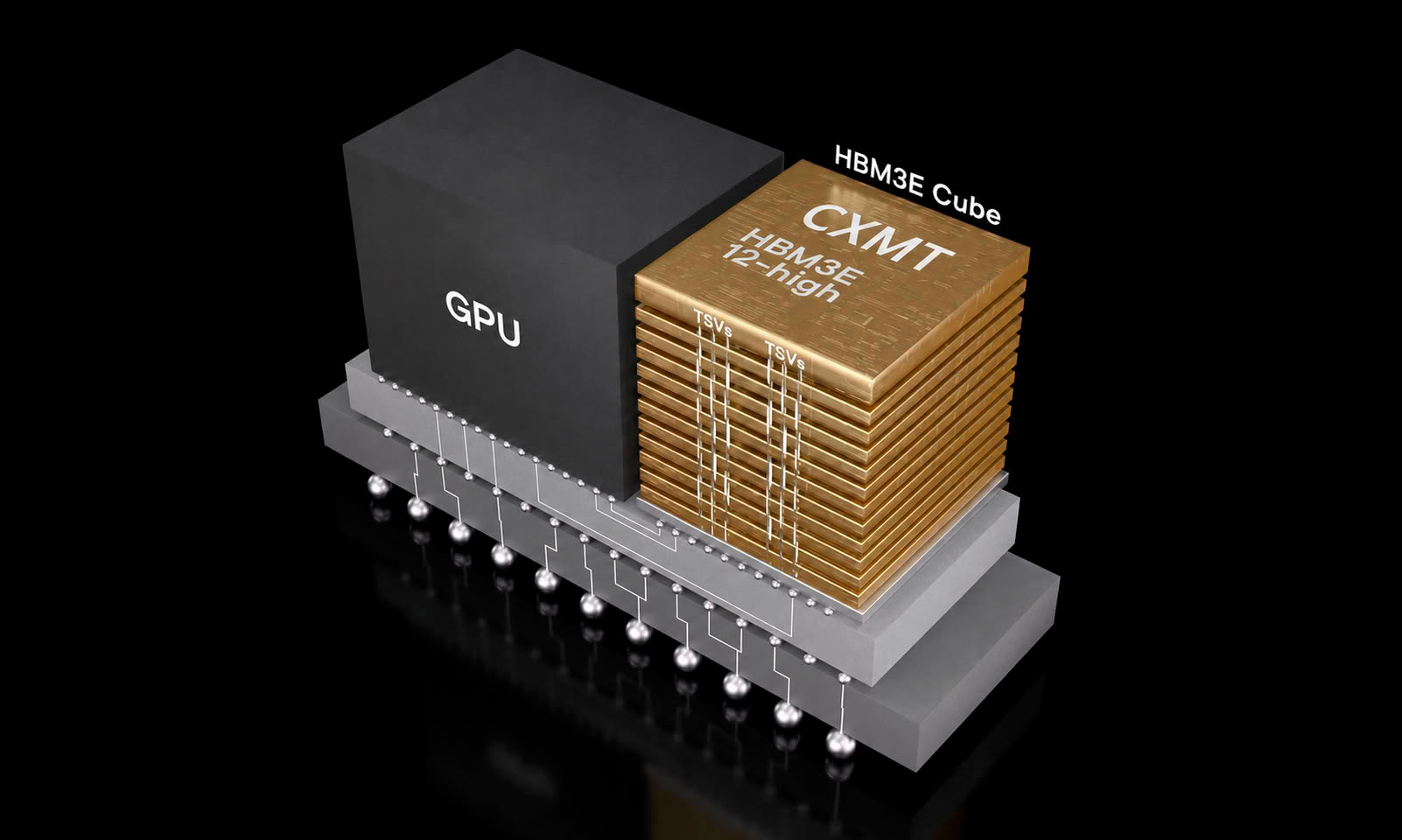
Industry observers attribute the primary technical hurdle to the maturity of through-silicon via technology. Compared with international manufacturers, CXMT maintains a gap in stacking precision. While Samsung utilized approximately 5,000 TSV connections per single layer during the HBM2 era, and SK Hynix exceeded 8,000 connections on HBM3 products, CXMT is attempting its HBM3E design with roughly 3,000 TSVs, imposing strict demands on manufacturing precision and reliability. Consequently, the company is expected to focus initially on eight-layer stacked HBM3E products rather than pursuing larger twelve-layer configurations in the near term.
Meanwhile, market sources indicate that CXMT has supplied domestic AI chip firms with two versions of its HBM3E samples, comprising a standard edition and a yield-optimized variant currently undergoing client testing and verification. Initial performance assessments suggest that CXMT’s current HBM3E offering aligns more closely with SK Hynix’s previous-generation HBM3 than with leading international HBM3E benchmarks.
Even with lower initial yields, analysts note strong commercial motivations for proceeding with volume production. Driven by surging demand from domestic artificial intelligence chip developers and supply tightness exacerbated by import restrictions, local market interest in indigenous memory alternatives remains high. Recent upward pressure on AI chip prices has been widely attributed to constraints in high-bandwidth memory supplies. Domestic semiconductor firms, including Alibaba’s T-Head semiconductor division and Cambricon, have previously evaluated domestic HBM options to reduce reliance on overseas supply chains.
Industry projections suggest that if client validation proceeds without disruption, AI accelerators incorporating CXMT’s HBM3E memory could reach the commercial market as early as 2027. Although a technological gap of one to two generations remains relative to global market leaders, entering the high-bandwidth memory sector establishes a crucial domestic component for China’s expanding artificial intelligence hardware ecosystem.