
In the Edinburgh lobby of Rockstar North, a floor-to-ceiling mural bears a short, foundational slogan: ‘PARANOIA IS GOOD’. Once home to The Scotsman newspaper, the heavily guarded building now houses the principal creators of Grand Theft Auto VI, the most anticipated video game of the decade. Despite years of intense public speculation and disruptive leaks, the atmosphere inside the studio weeks before the game’s release is surprisingly calm.
Rob Nelson, Rockstar North’s co-studio head and head of development, sits down to demonstrate a current build of the game. Rather than following a stage-managed script, Nelson freely explores the fictional state of Leonida, highlighting a world built on intricate simulation and handmade density. The map is roughly twice the size of Grand Theft Auto V, with a total landmass nearly matching the playable maps of Grand Theft Auto IV, Grand Theft Auto V, and Red Dead Redemption 2 combined.

The game centers on partners in crime and romance, Jason Duval and Lucia Caminos. Stepping out into Leonida, the environment responds dynamically to player actions. Pedestrians feature distinct personality traits, aggression levels, and roughly 600,000 recorded animations. NPCs react not only to direct aggression, such as a drawn weapon, but also to how a firearm is carried—whether slung across a back or held openly in the hands.
Aaron Garbut, co-studio head and head of development, notes that the game contains significantly more interiors than its predecessors, each built with layered details reflecting individual lives and habits. Systems developed for specific interactions, such as character reactions to unpleasant odors, now intersect organically with other environments, producing unscripted moments of gameplay.
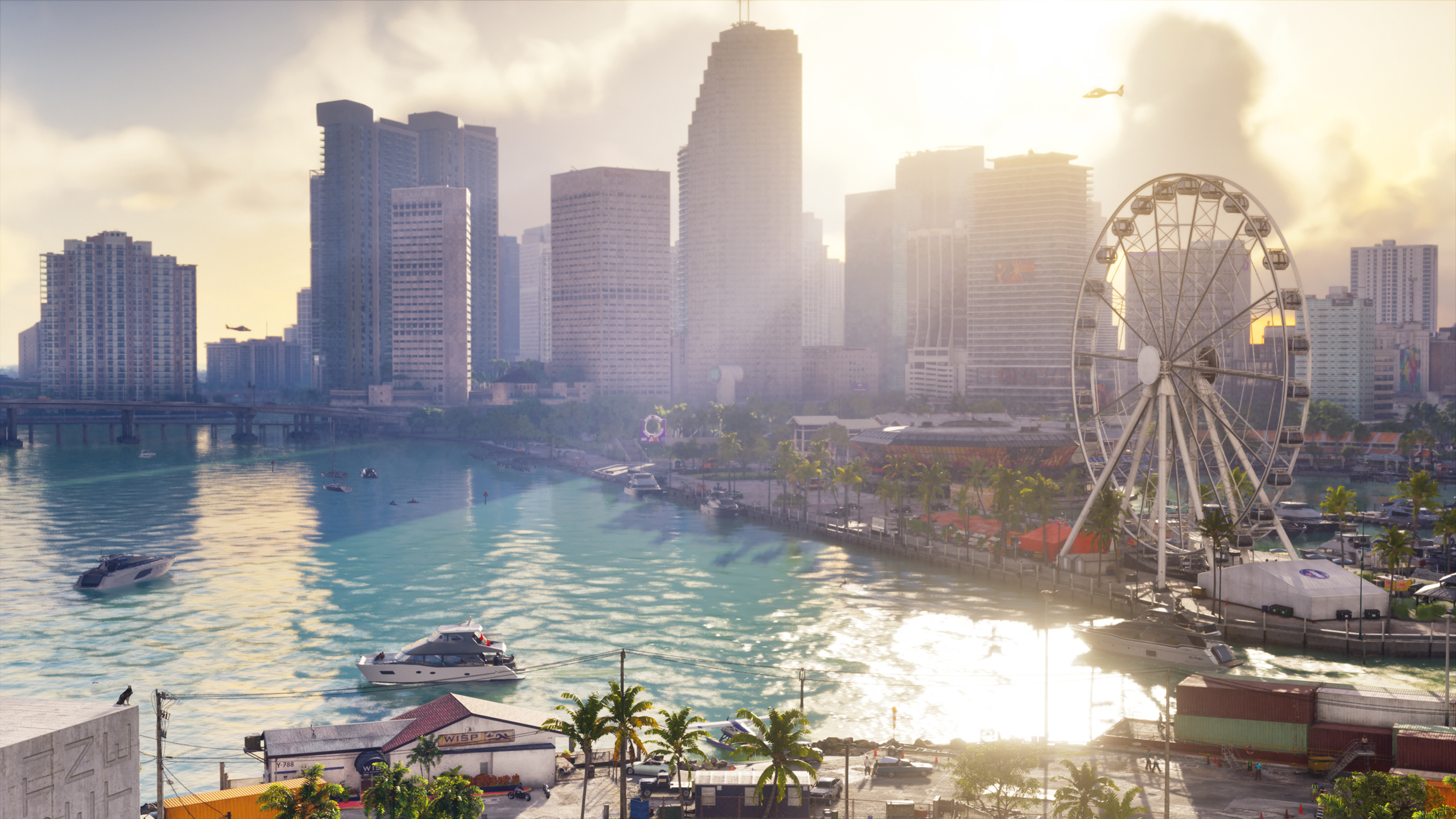
The simulation extends to dynamic weather systems where cloud movements, wind, humidity, and time of day independently alter the environment. Storms form gradually in the distance, wetting roads and affecting vehicle handling, boat physics, and pedestrian behavior. Meanwhile, vehicle mechanics incorporate fuel gauges, engine health, and onboard trackers that complicate petty crimes and police evasion.
Law enforcement responses are governed by an advanced ‘heat’ system tracking physical descriptions, clothing, weapons, and witnesses. Players can evade detection by changing clothes, dropping weapons, or splitting up from partners. Additionally, a ‘Criminal Profile’ system tracks behavior from ‘Professional’ to ‘Irredeemable’ using angel and devil metrics, influencing how Jason and Lucia’s narrative unfolds.

The relationship between the dual protagonists is driven by a shared past and measured on a four-point scale affected by shared activities, though the overarching narrative focuses on the characters’ desire to move away from a life of crime. Phil Hooker, head of development responsible for game stability, emphasizes that the expansive world allows players to adopt varied rhythms, whether utilizing fully functioning public transit systems or engaging in criminal enterprises.
Built over a decade by thousands of developers across multiple studios, including major contributions from Toronto and San Diego, the project relies on institutional memory and rigorous, iterative milestone reviews led by studio leadership, including company president Sam Houser. With development nearing completion, the studio prepares to hand its meticulously constructed world over to the public when Grand Theft Auto VI launches on November 19, 2026, for PlayStation 5 and Xbox Series X.