We live in unsettled times, with images coming at us constantly from every direction. Political figures urge the public to question traditional media outlets, opposing factions present conflicting versions of the truth, and artificial intelligence can now produce convincing pictures of events that never actually took place. In this environment, photography—particularly the tradition of concerned photography—faces unprecedented challenges and takes on renewed importance.
By concerned photography, commentators mean images that are thoughtfully created with a clear purpose. They are grounded in human judgment, timing, and a distinct point of view. They are made by photographers who were present on the scene, observed reality unfold, and made deliberate choices about how to represent it. In a world where producing an image is becoming almost effortless, the scarcest commodity is no longer imagery itself. It is trust.
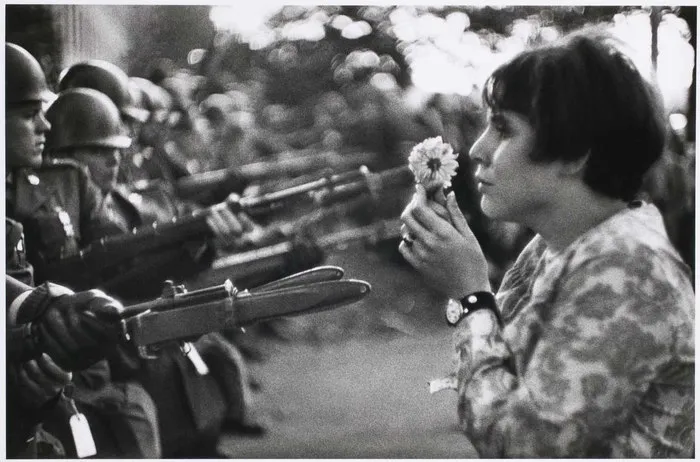
Photography has always been about more than merely recording what happened. Historical events become embedded in collective memory because a photographer made an image that allowed people to see, feel, and understand them in a visceral way. Robert Capa’s photographs of the D-Day landings did more than document soldiers arriving on the beaches of Normandy; they communicated the frenetic rush and danger of war. Marc Riboud’s image of the march on the Pentagon captured the deep emotion of a decade. William Anders’ famous 1968 Earthrise photograph gave humanity an entirely new perspective on the planet, and Jeff Widener’s photograph of a lone man standing before a line of tanks on Chang’an Avenue near Tiananmen Square transformed an individual act of defiance into an enduring symbol of resistance.
In each case, the photograph is more than a passive record of an occurrence. The manner in which the image was made drives the story it tells. A photographer was present, made active choices, and created an artifact that shaped how an event was understood by the public. That chain of human authorship matters deeply.

For most of photography’s history, people could argue passionately about what an image meant, but they were far less likely to question whether the depicted event had happened at all. Today, however, those questions increasingly arrive together: What am I looking at? Where did it come from? Who made it? Is it real?
This tension is not entirely new to the digital age. In 2003, Los Angeles Times photographer Brian Walski combined elements of two separate photographs taken during the Iraq War to create a more dramatic composition. When the digital alteration was discovered, the newspaper withdrew the photograph and dismissed him. That incident mattered because altering a news photograph violated an established system of trust connecting the photographer, the publisher, and the audience.

Twenty years later, an AI-generated image of Pope Francis wearing an enormous white puffer jacket went viral online. It looked sufficiently like a genuine photograph that many viewers initially assumed they were looking at a real moment in time. The difference between these two examples illustrates more than mere technological advancement; it highlights a profound shift in media distribution. In the first instance, an image passed through an established institution with standards for authenticity and strict consequences for violations. In the second instance, a synthetic image entered global circulation without passing through any comparable editorial filtering system.
Generative artificial intelligence accelerates a transformation that was already underway with the rise of social media: images increasingly reach audiences completely separated from the context that once helped establish their credibility. Consequently, viewers must demand more from visual media. Observers point out that people must think critically and pay closer attention to the specific circumstances under which images are created.

Photography is not important simply because cameras exist; it is important because photographers exist. A human photographer brings much more than technical skill to an image. They bring intention, patience, judgment, ethics, and intuition. Photographers decide where to stand, what to include inside the frame, and what to leave outside it. They respond directly to changing light, weather, movement, danger, physical access, uncertainty, and human complexity.
Most importantly, a human photographer can be held accountable for the image they produce. Observers can ask where the photographer stood, what happened before and after the captured moment, why the scene was framed in a particular way, and what ethical responsibilities the photographer owed to the subjects. These questions become increasingly vital when a convincing image no longer requires anyone to have witnessed anything in reality.

Robert Capa famously stated that if pictures are not good enough, the photographer is not close enough. Embedded in that maxim is an assumption that someone was actually there. This does not mean photography is inherently truthful, as it never has been. A photographer chooses where to point the camera, when to release the shutter, and what specific moment to select afterward. Images can be cropped, contextualized, and interpreted in dramatically different ways. Yet those very choices are why human authorship matters.
Concerned photography explicitly acknowledges those choices. The photographer is not a neutral recording device but a human being thoughtfully creating an image for a purpose and taking responsibility for what that image communicates to the public. As cameras become more capable and artificial intelligence makes sophisticated image creation accessible to almost anyone, technical proficiency alone becomes less distinguishing.
The more important skill is learning how to see. That means developing sound judgment about what deserves attention, understanding how images communicate meaning, finding a distinctive point of view, and recognizing the ethical responsibilities that accompany the representation of other people and the world. These are skills that do not become obsolete as technology improves; rather, they grow more valuable.
The same evolution applies to audiences. Visual literacy increasingly means understanding not just what an image shows, but who made it, why it was made, and whether it deserves public trust. In a world where images can be generated endlessly and discarded just as quickly, photography risks becoming disposable—something society consumes rapidly without careful consideration. The future of photography will not be defined by the sheer volume of images produced, but by which images cause people to slow down and stop to consider their meaning.