The European Union and Canada have initiated plans to forge an unprecedented transatlantic partnership, aiming to establish Canada as the bloc’s first associate member as both economies confront an increasingly volatile geopolitical landscape dominated by the United States and China.
The framework for the deeper alliance was advanced during a summit in Montreal, where European Commission President Ursula von der Leyen and Canadian Prime Minister Mark Carney outlined a strategy to insulate their economies from external pressure tactics and trade intimidation. European Council President Antonio Costa also joined the discussions, which focused on building a resilient economic foundation amid what European officials describe as a systemic decay of traditional international orders.
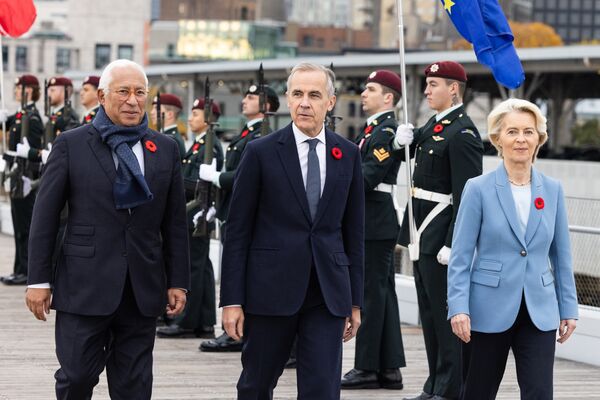
“We are witnessing a deeper decay in the international order,” von der Leyen said ahead of the meetings, emphasizing that leaders can no longer remain constrained by legacy geopolitical structures. Carney echoed those concerns, telling reporters that multilateral institutions have weakened significantly as the world grows more dangerous and divided.
The proposed association stops short of full EU accession but represents the deepest possible integration framework for a non-member state. According to a joint statement released at the summit, the partnership will encompass integrated supply chains, coordinated economic-security policies, closer defense industry cooperation, and expanded European investment in Canadian critical raw materials. The two sides also agreed to assess the feasibility of exporting Canadian liquefied natural gas to the European market.
Infrastructure development forms another core pillar of the initiative. Officials plan to advance new subsea cable infrastructure to enhance digital connectivity directly linking Canada, Europe, and Asia. Currently, much of Canada’s data and voice traffic routes through the United States, and the country lacks sovereign, Canadian-owned submarine cables connecting it to international networks.
The push for a restructured international alignment gained momentum following the release of a U.S. national security strategy in December, which warned of European civilizational decline. The document drew sharp pushback abroad; German Chancellor Friedrich Merz remarked that the traditional conception of the West no longer functions as a normative bond holding nations together, while French President Emmanuel Macron warned earlier this year that Europe risks disappearing within five years if it fails to counter the dual vulnerabilities of Chinese hegemony and U.S. unpredictability.
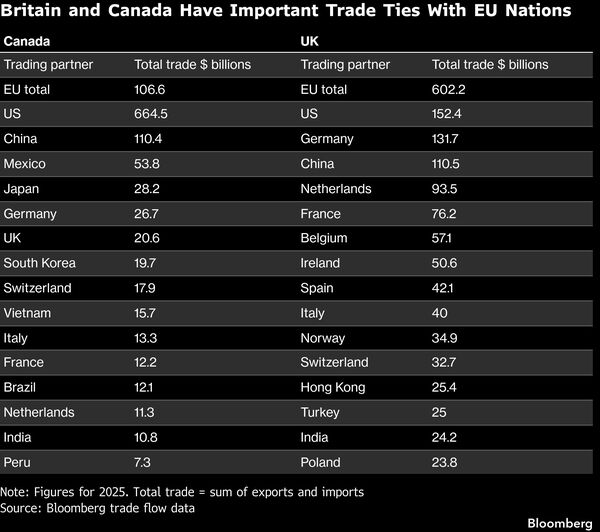
For Europe, Canada presents a stable partner boasting vast energy reserves, critical minerals, and advanced capabilities in artificial intelligence, quantum computing, and space technology, alongside shared commitments to climate policy and support for Ukraine. EU trade chief Maros Sefcovic noted that the partnership is anchored by a clear alignment of shared values.
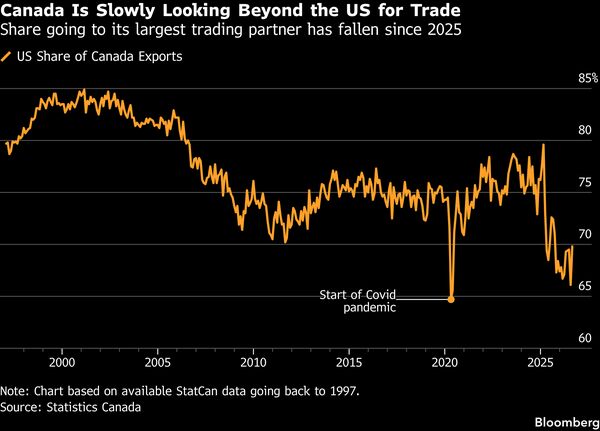
For Canada, the agreement offers access to a market of approximately 450 million consumers and a vital avenue to diversify away from an overwhelming economic reliance on the United States. Ottawa has struggled to finalize a trade agreement with the U.S. administration, leading to retaliatory tariffs after negotiations collapsed in August. Although lower-level talks have resumed, trade tensions persist, compounded by threats of additional tariffs targeting the Canadian automotive sector.
The path toward formalizing the associate status follows a structured diplomatic timeline. Carney, von der Leyen, and Costa are scheduled to meet in the coming months to define the precise scope and substance of the association. In March, Canadian cabinet ministers will meet with the European Commission’s college of commissioners, culminating in a formal leadership summit in June where both sides intend to conclude negotiations.
“This is about sovereignty,” Carney said. “Our ability to live our lives as we wish, create opportunity, build prosperity, address sustainability, and reinforce our freedoms.”