A high-stakes political battle is unfolding around Proposition 45, a California ballot measure designed to overhaul the state’s environmental review process. While proponents frame the initiative as a necessary step to accelerate essential housing, water, and clean energy projects, opponents and representatives of non-federally recognized tribes argue the measure contains provisions that would strip them of their voice in local land development.
At the center of the dispute is language in the initiative requiring government agencies to consult exclusively with federally recognized tribes on development projects, leaving out dozens of tribes lacking federal status. This mirrors recent legislative and administrative efforts backed by economically powerful, federally recognized tribes aiming to limit the consultation footprint of unrecognized groups. Non-federally recognized tribes characterize these moves as an attempt to protect financial interests, such as casino operations, and avoid territorial negotiations over ancestral sites.
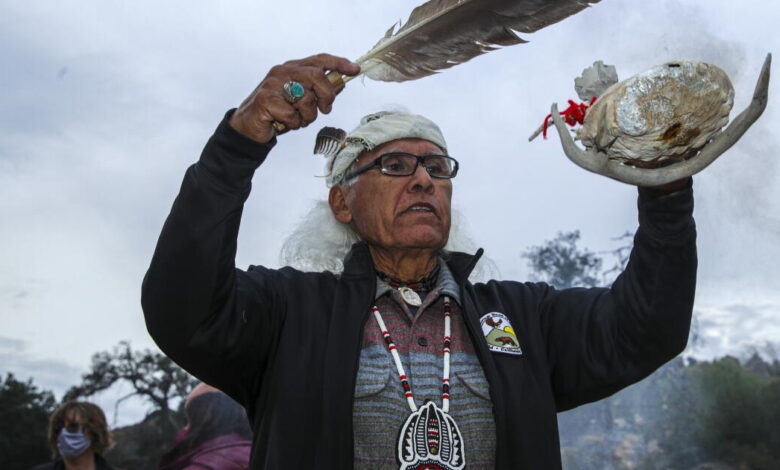
Andrew Salas, chairperson of the Gabrieleño Band of Mission Indians — Kizh Nation, criticized the measure’s impact on ancestral representation, stating that wealth and political influence are being prioritized over historic connections to the land. None of the Gabrieleno and Tataviam tribes within the greater Los Angeles area hold federal recognition.
Scheduled for the Nov. 3 ballot, Proposition 45 seeks to establish a streamlined environmental review framework for projects deemed essential. This includes housing developments, transportation networks, water systems, healthcare facilities, wildfire mitigation efforts, educational institutions, internet access expansion, and clean energy projects. The measure would impose stricter deadlines for reviews and court challenges, prevent local governments from requesting repeated analyses, and permit developers to submit a single alternative proposal with lesser environmental impact instead of multiple options.
Financial backing for the initiative includes a $750,000 contribution from the Yuhaaviatam of San Manuel Nation, a federally recognized tribe that serves as one of the largest contributors to the Yes on Prop 45 committee. Amelia Matier, a spokesperson for the campaign, defended the measure’s consultation standards by emphasizing that federal recognition forms the legal and constitutional foundation of tribal sovereignty and government-to-government frameworks. Matier added that unrecognized tribes would still retain the ability to participate through general public comment.
Opponents counter that relying solely on federal recognition empowers external recognized tribes to consult on developments hundreds of miles away from their original homelands, overriding the authority of local Indigenous populations. Jonathan Cordero, executive director of the Association of Ramaytush Ohlone, estimated that at least one-third of tribal cultural resources protected under the California Environmental Quality Act, or CEQA, are located within the traditional homelands of tribes lacking federal recognition. Cordero warned that passage of the proposition would lead to the destruction of hundreds of sacred sites and irreplaceable cultural resources.
Under existing law, CEQA serves as a primary mechanism for tribes to influence state and local land development by commenting on how proposed infrastructure or housing might impact graves, ceremonial grounds, and ancient villages. Unlike standard public comments, tribal consultation permits Indigenous leaders to discuss sensitive locations confidentially with officials prior to the publication of draft environmental reviews. The Kizh Nation has historically utilized this process to consult on hundreds of projects annually in the Los Angeles Basin, leading to protections for ancient ecological landmarks like a 13,000-year-old oak tree in the Inland Empire, as well as significant land returns for unrecognized tribes.
The debate over recognition stems from a complex historical legacy. While California currently hosts over 100 federally recognized tribes—affording them access to federal funding, education services, healthcare, and potential reservations—dozens of other communities remain unrecognized despite historical ties. In the 1850s, federal agents negotiated treaties with more than 130 Indigenous communities across California, setting aside roughly 7% of the state for reservations. However, Congress ultimately refused to ratify those treaties and failed to notify the affected tribes.
The modern federal recognition process remains lengthy and rigorous. Since its establishment in 1978, only 18 tribes nationwide have successfully gained recognition through the administrative pathway, with just one located in California—Death Valley’s Timbisha Shoshone Tribe. Coastal tribes subjected to Spanish, Mexican, and American colonization, including the Gabrieleno, faced severe displacement and cultural suppression, with federal agents subsequently failing to establish reservations for them in the late 19th century.
The ballot measure follows a pattern of recent friction. Last year, three federally recognized tribes championed a legislative bill aimed at restricting participation rights for unrecognized tribes in all project consultations, not just those designated as essential under Proposition 45. Shortly thereafter, the state agency maintaining the official list of tribal contacts proposed a revision that critics argued would effectively exclude unrecognized groups, drawing support from multiple federally recognized tribes.