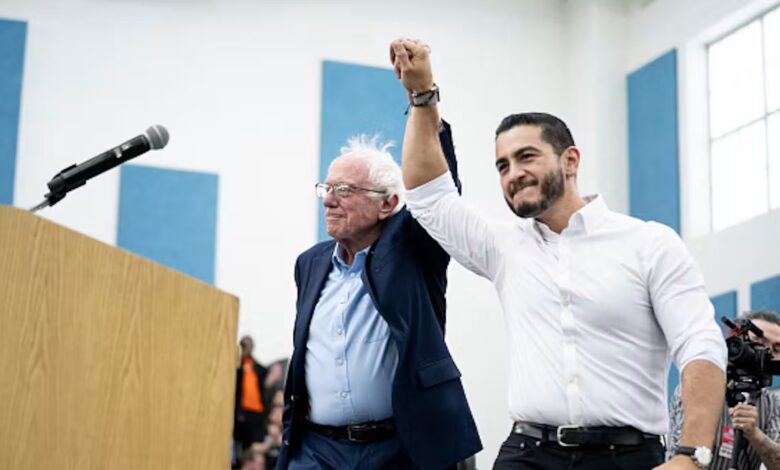
Senator Bernie Sanders intervened in Michigan’s high-stakes Senate contest on Wednesday, injecting $1 million into Democrat Abdul El-Sayed’s campaign to counter a massive expected influx of outside conservative spending. The move came after Sanders learned that the pro-Israel American Israel Public Affairs Committee was preparing to deploy up to $9 million to support Republican candidate Mike Rogers.
Following the financial injection, Sanders began calling other donors to secure additional support. By the end of the day, his team had gathered $300,000 in pledges from about a dozen Democrats, according to a statement from his office. Sanders acknowledged that his fundraising efforts would not match the scale of the opposition spending but argued it would provide necessary support for El-Sayed to remain competitive. Sanders entered October holding $22.4 million in his own campaign account and had previously contributed $250,000 during the first week of the month to the Abdul for Michigan Victory Fund, a joint committee shared with the Democratic Senatorial Campaign Committee and the Michigan Democratic Party.
Progressive leaders have increasingly rallied around the Michigan Democrat as the midterm contest intensifies. Representative Alexandria Ocasio-Cortez directed $1 million to the race while campaigning in Michigan, following an earlier summer rally alongside Sanders. Representative Pramila Jayapal, chair of the Congressional Progressive Caucus, reported that El-Sayed reached out directly on Wednesday with a request for assistance. Jayapal’s leadership political action committee previously contributed $350,000 to support El-Sayed during the primary and is evaluating additional financial backing.
The fundraising surge targets a razor-thin contest. A recent poll placed El-Sayed ahead of Rogers by a single point among likely voters, 50% to 49%, a margin resting well within the poll’s three-percentage-point margin of error.
Economic pressures and foreign policy have emerged as central campaign themes as voters grapple with rising costs amid the ongoing war in Iran. The national average for a gallon of gasoline has risen above $4.27, climbing from under $3 prior to the conflict, according to data from AAA. Rogers has sought to address voter frustration in a campaign ad by stating that the war needs to end quickly, though he defended the underlying rationale during a debate on Wednesday, arguing that preventing Iran from acquiring a nuclear weapon is necessary to maintain regional stability.
Meanwhile, El-Sayed has faced a series of controversies and criticisms during the campaign. Opponents have raised allegations concerning ties to the Muslim Brotherhood, and he has drawn backlash for campaigning alongside political streamer Hasan Piker following remarks Piker made regarding the September 11 attacks. Additional scrutiny has focused on his professional background, with critics questioning his public presentation as a physician given that he does not hold an active medical license in Michigan or New York. The campaign has also navigated fallout from a resurfaced video clip in which El-Sayed criticized Mackinac Island, a popular Michigan vacation destination.