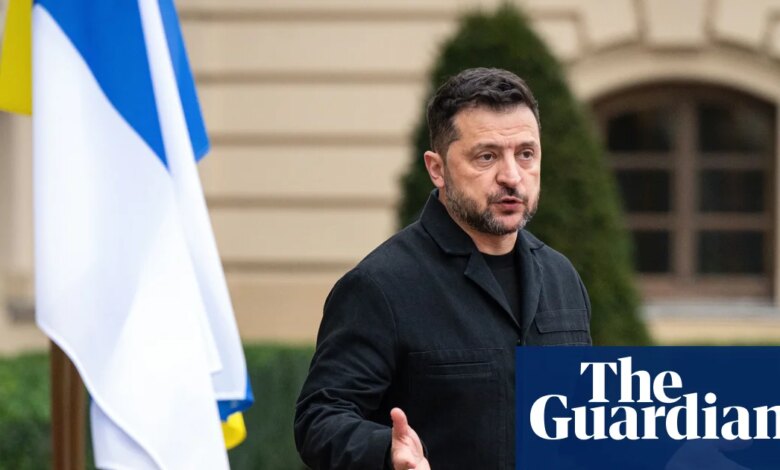
Ukrainian President Volodymyr Zelenskyy has signaled a potential shift in the diplomatic landscape, announcing a planned trilateral meeting involving representatives from Kyiv, Washington, and Moscow scheduled for November. The talks are intended to restart the long-stalled peace process aimed at ending the ongoing war, though the Ukrainian leader remains firm on key non-negotiable points regarding national sovereignty and military capability.
“We are ready to talk,” Zelenskyy stated during an interview on Sunday. He outlined a two-tier approach to the upcoming negotiations: territorial disputes are to be addressed exclusively at the leadership level, while other logistical and technical issues will be handled by designated working groups. Central to this diplomatic push is Zelenskyy’s renewed call for a direct meeting with Russian President Vladimir Putin, whom he identifies as the sole figure in Moscow with the authority to make the definitive decisions required to end the conflict.
Despite the willingness to engage in dialogue, Kyiv has established clear boundaries for any negotiation. Zelenskyy emphasized that Ukraine will not entertain discussions regarding limitations on its armed forces or any form of enforced postwar neutrality. Ukraine continues to pursue full membership in NATO, a goal that remains a point of contention among some alliance members but which Kyiv views as essential for its long-term security.
The announcement follows significant developments in Ukraine’s technical and military cooperation with the United States. Zelenskyy confirmed that critical warnings regarding imminent Russian ballistic missile strikes—information vital to Ukraine’s air defense systems—have been fully restored. This intelligence flow was reportedly bolstered following a meeting in Oslo between Zelenskyy and U.S. special envoy Steve Witkoff.
Parallel to this, the operation of the Starshield satellite internet service has returned to full capacity. According to Zelenskyy, the system has been operating at speeds of up to 420km/h since early Saturday. This restoration comes after the service was reportedly throttled earlier in October, a move that coincided with diplomatic pressures between Kyiv and Washington over the direction of the conflict.
Friction persists between the two allies regarding Ukraine’s targeting of Russian oil refineries. Washington has reportedly pressured Kyiv to suspend these operations, citing concerns that the strikes drive up global energy prices. Zelenskyy has countered this pressure with specific conditions for a ceasefire on energy infrastructure. He stated that Ukraine would only halt its strikes if Moscow ceases its attacks on Ukraine’s power grid, if the U.S. authorizes the use of Starshield over Russian territory to detect ballistic missile launch sites, or if the U.S. provides additional Patriot missile defense systems.
The diplomatic maneuvers are taking place against a backdrop of intensified aerial warfare. Over the past week, Russia has unleashed a massive barrage against Ukrainian urban centers. Zelenskyy reported that Russian forces launched approximately 2,300 strike drones, 1,600 guided bombs, and 48 missiles of various types, including ballistic models. This surge in attacks has led to renewed pleas from Kyiv for Western allies to accelerate the delivery of interceptor missiles.
In the Black Sea region, the Russian defense ministry claimed that its drones successfully targeted cargo vessels. One ship was reportedly hit while bound for the port of Chornomorsk overnight, while another was struck during the day while en route to Odesa. Moscow alleged these vessels were transporting military supplies for the Ukrainian army. Furthermore, Russian forces conducted overnight strikes on logistics and distribution centers in the city of Kharkiv.
Conflict has also spilled across the border into Russia. In the city of Belgorod, local authorities reported that a Ukrainian drone attack overnight resulted in the deaths of three people and left 13 others injured. A subsequent drone strike later on Sunday claimed a fourth life. Regional officials stated that the overnight bombardment damaged 30 apartment buildings in the border region.
Regional politics are also in flux following an inconclusive presidential election in Bulgaria on Sunday. The race will proceed to a runoff between incumbent leftist President Iliana Yotova and pro-Western reformist Andrey Gyurov. The outcome holds significant implications for regional support for Ukraine: Yotova has voiced opposition to military aid and favors dialogue with the Kremlin, whereas Gyurov has been a vocal supporter of Kyiv. The election took place under heightened security following recent drone activity affecting Black Sea shipping lanes.