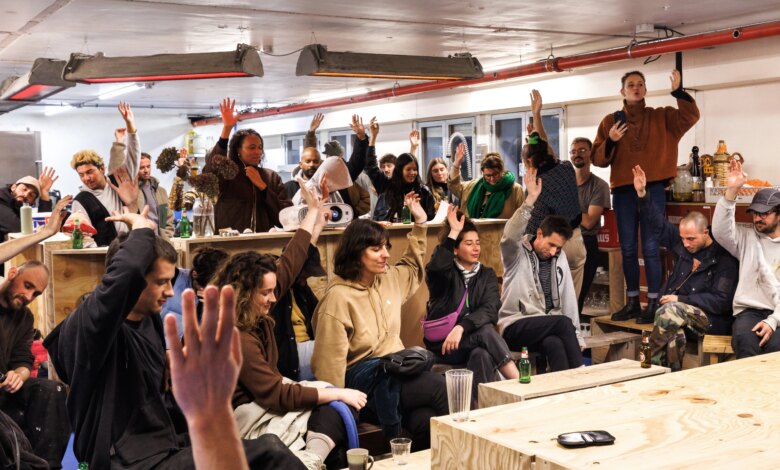
For more than a decade, the Paris artist-run production studio Le Wonder has charted an unconventional path through the city’s real estate landscape. Rather than succumbing to the familiar cycle where artists revitalize neglected industrial areas only to be priced out by subsequent gentrification, the collective has developed an autonomous model of shared infrastructure, direct negotiation, and cooperative governance.
Founded by artist Nelson Pernisco, the initiative traces its roots back to the Paris underground squat scene of the early 2010s. The collective’s first formal incarnation, Point G, operated near the Canal de l’Ourcq from 2012 to 2013. That initial effort led to a much larger occupation of the former Wonder battery factory near the Saint-Ouen flea market. Spanning a massive, polluted industrial complex where walking from the entrance to the occupied building took about ten minutes, the site accommodated roughly 60 artists by 2016. Members repaired dilapidated structures, replacing 86 windows, and established shared music facilities, exhibition spaces, and private studios before demolition forced another move.
Subsequent relocations brought the collective to the Liebert building in Bagnolet, and later to a former industrial property near La Défense owned by Bouygues Immobilier. During these years, the collective learned that corporate real estate partners were often motivated less by tax incentives or security than by the cultural storytelling artists provided. However, corporate priorities proved volatile; a later printing facility site, Fortin/Le Progrès, was demolished in 2023, with the real estate developer erecting an office building bearing the Wonder name without permission.
Determined to break its dependence on private developers, Le Wonder sought a public-sector partner. In April 2023, the collective relocated to a 6,000-square-meter former industrial garage at 109 rue de Paris in Bobigny, securing an agreement directly with the French state. The site features extensive workshops for woodworking, metal fabrication, ceramics, glass, foundry processes, and film postproduction, operating on an annual equipment investment ranging between €10,000 and €30,000.

Today, Le Wonder accommodates around 70 resident artists in spacious individual studios ranging from 50 to 100 square meters. The collective relies on a disciplined logistical framework, frequently hauling 130 truckloads of reusable walls, electrical installations, and fittings during relocations, while maintaining a board anchored by a core of ten long-standing members.
Following extensive discussions with municipal and regional authorities, Le Wonder is now preparing to double its footprint. The collective successfully proposed a plan to restore a nearby building to house storage facilities for Parisian museum collections, paving the way toward a long-term emphyteutic lease with a proposed term of 25 years. With a combined business and property undertaking that could reach €18 million, the initiative aims to cement a permanent infrastructure for artistic creation, production, and preservation.