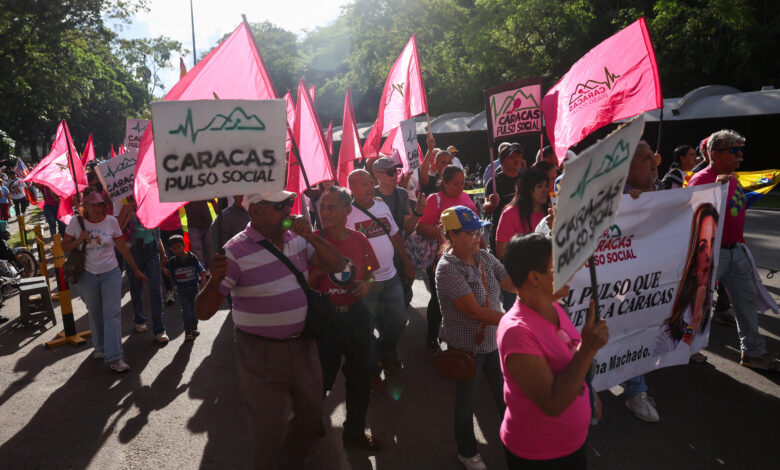
Thousands of Venezuelans took to the streets on Thursday in the first nationwide opposition protest in nearly two years, gathering in Caracas and other major cities to demand free elections and broad political changes.
The demonstrations, organized by the Vente Venezuela movement led by Nobel Peace Prize winner Maria Corina Machado, took place in the capital as well as cities including Valencia, Maracay, San Cristobal, and Maracaibo. Participants waved Venezuelan flags and called for a definitive timeline for future elections.
“Seeing this makes me happy because I know change is possible,” said 18-year-old cosmetology student Leosmary Hernandez, who joined hundreds of demonstrators in northern Maracay. “I’ve been through so many hardships, so many problems because of the dollar, and difficulties studying. I have high hopes for my country and for our next leader, president, Maria Corina.”
Machado has been outside Venezuela for nearly a year after going into hiding following the contested 2024 presidential election. Her proxy roundly won that vote according to tallies released by the opposition, though the government—which never released full counts—backed Nicolas Maduro, with the backing of the nation’s legal and electoral institutions. Machado’s last public appearance inside the country occurred during protests in January 2025 to mark Maduro’s third inauguration, an event where she was briefly detained.
The political landscape shifted dramatically in January when U.S. forces captured Maduro. Since then, the United States has worked closely with an interim government led by acting President Delcy Rodriguez, Maduro’s former deputy. While both U.S. President Donald Trump and Rodriguez have stated that elections will eventually take place, neither has set a date for a legislative vote or a presidential contest. Machado has insisted that elections must be held by July 2027.
Trump has frequently praised Rodriguez for her management and willingness to welcome U.S. investors, noting last month that it remains too soon to consider elections. Meanwhile, Machado’s desire to return home, particularly following devastating twin earthquakes in June, has created friction in Washington, with U.S. officials advising her to delay her trip.
Simultaneously, the ruling Socialist Party, which has held power since 1999 under late President Hugo Chavez and subsequently Maduro, organized its own march. Ruling party supporters planned to gather at Caracas’ Plaza Venezuela—the same location selected by the opposition two hours later—and march toward a site near the presidential palace to commemorate breast cancer awareness month. Interior Minister Diosdado Cabello, known for his close ties to the country’s security services, was pictured attending the government-backed march on state television, prompting opposition supporters to relocate their protest to a nearby area.
In the past, Venezuela’s socialist government has deployed security forces against protesters decrying political repression, high inflation, and poor public services. Beyond electoral demands, Thursday’s demonstrators also called for the release of individuals they argue are held for political reasons.
Legal rights organization Foro Penal, which represents detained opposition figures and others frequently facing charges such as treason, reports that more than 320 political prisoners remain detained in Venezuela. These detentions persist despite recent releases under an amnesty law supported by the legislature earlier this year. The Venezuelan government has consistently denied holding political prisoners, characterizing the amnesty law as generous.
Separate from the street demonstrations, U.S.-backed talks involving a faction of the opposition and the interim government held their latest session this month. These negotiations aim to reshape the top court and the electoral council to ensure fairness in future elections, though participants acknowledge that enacting such changes will take significant time. Machado’s political movement is not included in these talks, though she has stated she will not obstruct their progress.