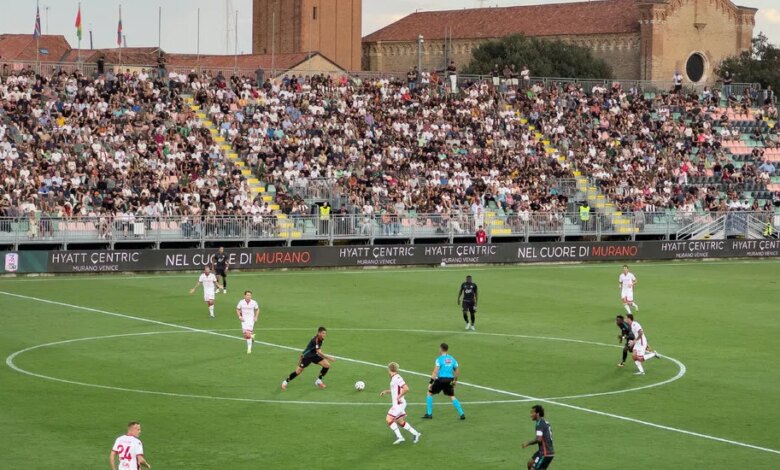
Dressed in sleek black jerseys and playing in a stadium uniquely situated on the edge of a lagoon, Venezia FC recently suffered a demoralizing 4-2 defeat to Florence. During the match, a defender’s slip led to an easy goal for the opposition, and a Venice striker sent a ball so far over the crossbar it appeared destined for the sea. When the score reached 4-1, frustrated supporters began streaming out of the gates early. Ettore Saramin, a 75-year-old fan, voiced the collective anger of the local crowd: “Change the defense, change everything! They are humiliating us!”
While the mood inside the Pier Luigi Penzo stadium remains somber, the club’s image outside the pitch has never been more polished. Venezia FC has successfully rebranded itself as a “cult style hit,” with its promotional material featuring an aesthetic described as gritty Italian glam. High-profile figures, including Pete Doherty of the Libertines, Victoria De Angelis from the rock band Maneskin, and artist Corbin Shaw, have all been seen wearing the team’s kits. This fashion-forward approach has turned a historically provincial team into an international sensation, yet the disparity between the club’s aesthetic appeal and its sporting reality has reached a breaking point.
The team currently occupies last place in Serie A, Italy’s top soccer league. After six consecutive losses to start the season, the prospect of demotion looms large. The struggle on the field has prompted a difficult question for the club: can a soccer team survive on branding alone when it fails to win games? Oliviero Cassará, a 44-year-old supporter, summarized the sentiment during a water bus ride to the stadium: “It is no use to have cool T-shirts if your team sucks.”
Founded in 1907, the Venice soccer team has spent most of its history fluctuating between the top and lower tiers of Italian soccer, often plagued by financial instability. The trajectory changed in 2020 when Duncan Niederauer, a former chief executive of the New York Stock Exchange, became the primary owner and president. Under American ownership, the club underwent an aggressive visual overhaul. The German design studio Bureau Borsche replaced the traditional team crest with a geometric, midcentury-modern golden “V.” Marketing materials transitioned from standard athlete photography to high-fashion shoots featuring models like Theopisti Pourliotopoulou and Solange Smith lounging on gondolas in saturated, cinematographic light.
Nicola Boscaro, the club’s chief revenue officer, explained that the goal was to link the team as closely as possible to the global prestige of the city of Venice. “Nobody knew that there was a soccer team in Venice,” said Mirko Borsche of the design studio. “But everyone knew Venice.” The rebranding effort has included a partnership with NOCTA, a collaboration between Nike and the rapper Drake, to design recent collections. Boscaro admitted that the current business model “is not built around winning,” suggesting that the team’s commercial success could exist independently of its results on the pitch.
However, for the Venetian locals who frequent the taverns surrounding the stadium for Aperol Spritzes before kickoff, the lack of results is a deep source of anxiety. Venice has managed only one victory this season, a win against Naples, while suffering losses to AC Milan, Lecce, Frosinone, Lazio, Atalanta, Genoa, and Florence. In an attempt to salvage the season, the club announced a coaching change on October 13. Despite the sporting crisis, the club did invest in talent this year, completing its most expensive signing ever by acquiring Nigerian striker Akor Adams for over 16 million euros, approximately $18 million.
Tensions between the new global brand and the local community are further exacerbated by plans for a new, larger stadium on the mainland that would be accessible by car. The current Pier Luigi Penzo stadium, which holds only 10,000 people and is reachable only by water, is considered one of the most romantic venues in sports. For die-hard fans like 33-year-old Matteo Crivellaro, moving the team away from its lagoon-side home feels like another step in the city’s “selling out” to tourism. “The butcher, the baker, there is nothing left anymore,” Crivellaro said. “With the stadium on the mainland, you are taking away another piece of identity from Venice.”
While influencers now flock to the lagoon stadium to take photos for social media, local supporters remain skeptical of the new audience’s loyalty. Longtime fan Diego Carraro noted that the new crowd “burns through two phone batteries” during games. Crivellaro remains unconvinced that the fashion-focused fans will stick around if the team’s fortunes continue to decline. “When it rains,” he said, “they will go away.”