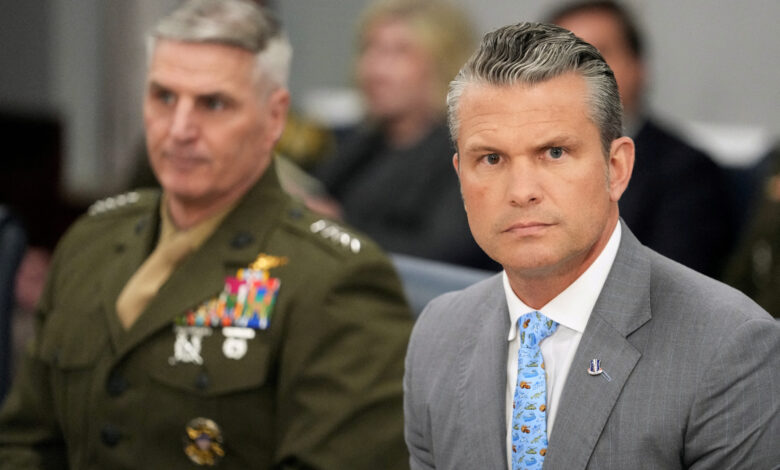
U.S. Defense Secretary Pete Hegseth is scheduled to meet with Southeast Asian defense counterparts in the Philippines, where he is expected to address questions regarding Washington’s long-term commitment to the Indo-Pacific region. The diplomatic gathering takes place as the ongoing conflict in Iran strains U.S. military readiness and tensions intensify with China.
The Pentagon stated that Hegseth’s attendance at the meetings in the Philippine province of Cebu is intended to reaffirm Washington’s strategy of “peace through strength” in the Pacific. However, security analysts note that regional nations will likely use the sideline discussions to seek clarity on the endgame in Iran, expectations for allies and partners, and how Washington plans to balance competing military demands without diluting its focus on the Indo-Pacific theater.
Collin Koh, a security scholar at Singapore’s S. Rajaratnam School of International Studies, noted that regional governments want greater certainty regarding alliances and partnerships. Meanwhile, Southeast Asian economies continue to grapple with the economic fallout of the Iran war, which began with U.S. and Israeli strikes on February 28. The conflict has disrupted shipping lanes and global oil markets, exposing the region’s vulnerability to imported-fuel shocks and moving energy security to the forefront of the Association of Southeast Asian Nations agenda.
Greg Poling, director of the Asia Maritime Transparency Initiative, said the gathering provides Hegseth an opportunity to address concerns involving China, the disputed South China Sea, and Washington’s treaty obligations. Poling pointed out that regional capitals seek reassurance of American resolve despite political friction in Washington and the strain that the Iran conflict has placed on U.S. military capabilities and operational readiness.
The discussions carry particular weight for the Philippines, a U.S. treaty ally whose relations with Beijing have deteriorated amid repeated maritime confrontations in the South China Sea, Chinese economic sanctions, and the recent summoning of the Chinese ambassador. Demonstrating the active regional friction, China’s defense ministry confirmed that its defense attaché in the Philippines will participate in the meetings. Furthermore, just days before the scheduled October 28 and 29 sessions, the Philippine military reported monitoring and shadowing a Chinese Liaoning aircraft carrier group as it transited waters off the southern Philippines toward the Celebes Sea.
Alongside the broader ASEAN talks, defense chiefs from the United States, Japan, Australia, and the Philippines—collectively known as the Squad—are scheduled to hold separate meetings on October 28. Experts anticipate that these discussions among like-minded partners may yield stronger signals on security cooperation than the broader forum.
Koh suggested that the eventual chairman’s statement is likely to adopt traditional, restrained ASEAN diplomatic language rather than sharp rhetorical positions, noting that Manila’s dual role as ASEAN chair while directly locked in a maritime dispute with China creates a uniquely sensitive diplomatic balancing act. Poling added that the Philippines has had to navigate between aspirational regional cooperation in areas like energy connectivity, the digital economy, and coast guard coordination against the headwinds of escalating maritime friction with China and stalled negotiations on a South China Sea code of conduct.