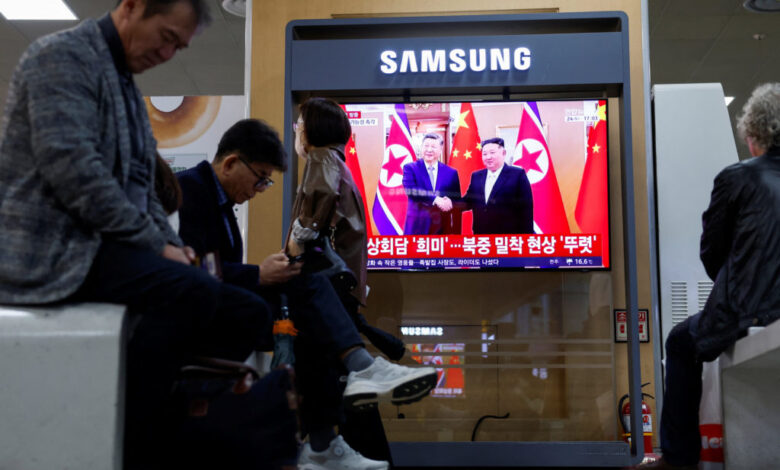
North Korean leader Kim Jong Un arrived in the Chinese border city of Dandong on Saturday, marking his first visit to the country in a year to inaugurate a major infrastructure project designed to bolster economic ties between the two neighbors. The centerpiece of the visit was the opening of the New Yalu River Bridge, a structure that officials and regional analysts say symbolizes Pyongyang’s deepening alignment with Beijing amid a shifting geopolitical landscape.
Kim’s arrival in Dandong followed a crossing of the newly completed bridge, which is now expected to facilitate 24-hour, two-way traffic. According to regional reports, the bridge is specifically engineered to handle heavy cargo trucks and container shipments, providing a significant upgrade to the existing infrastructure that has long governed the flow of goods across the border. During the ceremony, Kim emphasized his desire to expand “practical cooperation” with China, framing the relationship as a historical friendship that should deliver tangible benefits to the populations of both nations.
As part of the diplomatic itinerary, Kim met with Wang Huning, a member of the Standing Committee of China’s Communist Party. The two leaders toured a local car factory, a move seen by observers as an indicator of North Korea’s interest in Chinese industrial and manufacturing expertise. Kim expressed that his government stands ready to carry forward bilateral ties, which he has recently described as a top strategic priority.
This visit, Kim’s sixth since assuming power in 2011, appears to be carefully timed. It coincides with the upcoming October 25 anniversary of a significant military milestone from the Korean War, marking the period in 1950 when Chinese forces first crossed the Yalu River to support the North. Kim utilized the visit to memorialize those killed in the conflict, reinforcing the historical blood bond between the two nations. This traditional alliance has taken on renewed importance as Pyongyang seeks to build a united front with Beijing and Moscow against what it characterizes as a “new Cold War” led by the United States.
While Kim has recently prioritized military cooperation with Russia—including the deployment of troops and conventional weaponry to assist in the war in Ukraine—this trip to Dandong suggests a re-balancing toward China, which remains North Korea’s primary economic lifeline. Previous summits between Kim and Chinese President Xi Jinping, including a meeting in Pyongyang and a September 2025 encounter in Beijing, have laid the groundwork for expanded cooperation in sectors ranging from agriculture and technology to large-scale construction.
Global attention is also focused on how this deepening China-North Korea relationship impacts stalled diplomacy with the West. Kim has maintained a firm stance against Washington, demanding an end to what he calls “hostile policy” and rejecting denuclearization as a prerequisite for talks. This comes despite outreach from U.S. President Donald Trump, whose previous diplomatic efforts with Kim reached a stalemate in 2019.
In South Korea, where the government favors engagement, there is a hope that China might play a constructive role in stabilizing the peninsula. Intelligence assessments in Seoul have even suggested a 50% probability of a sideline meeting between Trump and Kim during next month’s Asia-Pacific Economic Cooperation (APEC) summit in Shenzhen, China. However, regional experts note that as long as Kim can secure economic and military support from Beijing and Moscow, the incentive to engage with Seoul or Washington remains low. For now, the opening of the New Yalu River Bridge stands as a concrete manifestation of North Korea’s strategy to prioritize its northern neighbors over Western-led diplomatic overtures.