In the final years of a two-term presidency, the occupant of the Oval Office often finds the levers of domestic power increasingly difficult to pull. With legislative agendas stalled by a hostile Congress and attention shifting toward the next election cycle, outgoing presidents frequently pivot toward the world stage to secure a lasting legacy. For George H.W. Bush, this meant a humanitarian intervention in Somalia; for Bill Clinton, it was a late-stage push for Middle East peace; and for Barack Obama, it involved restoring ties with Cuba and finalizing the Iran nuclear deal.
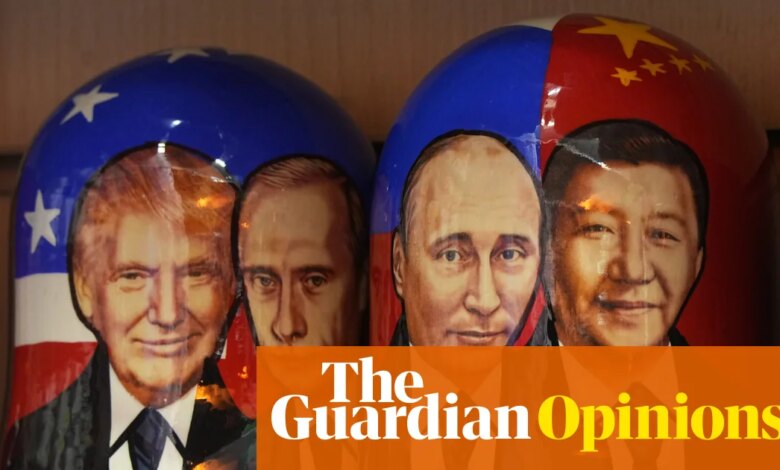
For Donald Trump, the transition into this political “twilight zone” appears to be marked by a fundamental rejection of the post-Cold War world order. As he approaches the final two years of his term, facing the likely loss of the House and potential investigations into his administration, the president is moving to consolidate a new, tri-polar global structure alongside Vladimir Putin and Xi Jinping. The centerpiece of this shift is a proposed summit between the three leaders to be held in Shenzhen, China, next month.
This proposed gathering of the “Great Powers” represents more than just a diplomatic photo opportunity. According to emerging reports, the three leaders intend to discuss a formal division of the world into distinct spheres of influence. Such a move would effectively dismantle the rules-based international order that has governed global affairs for decades, replacing the traditional power bloc of the U.S., China, and the European Union with a new troika consisting of Washington, Beijing, and Moscow.
The shift in policy is already manifesting in the administration’s handling of several geopolitical flashpoints. In Ukraine, the U.S. stance has moved toward what critics describe as appeasement. Trump recently stated that “Russia, frankly, has been fine on Ukraine,” while his envoy Steve Witkoff recently traveled to Moscow to meet with Putin. During a televised meeting, Witkoff praised the Russian leader as a “humanitarian,” a label that stands in stark contrast to the international consensus regarding Russia’s military actions.
This realignment is codified in a 33-page National Security Strategy that breaks sharply from tradition. The document offers almost no direct criticism of Russia or China. Remarkably, a six-paragraph section detailing potential threats to Taiwan fails to mention China a single time. Instead, the strategy describes China as a “rich and powerful” nation and focuses on how the United States can help Russia and Europe repair their fractured relationship. The strategy explicitly argues that the affairs of other nations are only a U.S. concern if they directly threaten specific American interests, claiming that traditional allies have long “sucked” the U.S. into peripheral conflicts.
The consequences of this withdrawal of the American security blanket are already causing alarm in foreign capitals. In East Asia, the maritime security of Japan, South Korea, and Taiwan appears increasingly precarious as the U.S. retreats from its role as a regional guarantor. In Europe, the future of NATO remains uncertain as the administration prioritizes economic dominance and resource security over democratic solidarity.
The economic implications of this tri-polar alliance are equally significant. The three governments are reportedly looking to increase economic ties through the control of global supply chains and technology platforms. There is also a shared interest in the next space race, with all three nations seeking both commercial and military dominance in orbit. For Putin, this represents the culmination of a decades-long effort to end American “interference” in Eastern Europe. For Xi, the U.S. retreat offers a clear path to maritime control in the East and South China Seas.
Despite the administration’s momentum, the proposed Shenzhen summit has faced internal pushback. Traditional conservatives and members of the MAGA movement are divided on the pivot, with the Wall Street Journal editorial board labeling the summit “arguably the worst idea of the second Trump term.” Former Canadian officials have noted that Trump’s approach has arguably been more beneficial to China’s global standing than any other president in history.
While previous presidents used their final months to attempt peaceful resolutions to long-standing conflicts, the current trajectory suggests a more disruptive outcome. Trump enters this phase of his presidency as an 80-year-old leader hampered by domestic political constraints, facing off against authoritarian leaders in their early 70s who have consolidated power for the long term. If the Shenzhen summit proceeds, it may be remembered not as a victory for American diplomacy, but as the moment the image of a unified West was finally replaced by a world divided into three.