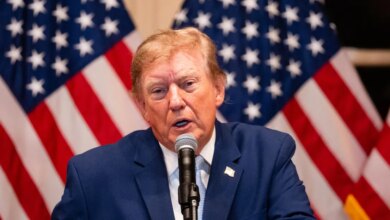
President Donald Trump escalated his attacks against Democratic Senate nominee Abdul El-Sayed on Sunday with rhetoric that questioned the Muslim candidate’s loyalties to the United States and repeatedly tried to tie him to extremism, claims that the Democrat has repeatedly denied and denounced.
“Over the past three weeks, I’ve traveled all over the country. But I’m here today in Michigan for a very important reason,” Trump told a crowd in Port Huron, located about 60 miles northeast of Detroit. “I’m here to keep a jihadist Muslim Brotherhood member from becoming a United States senator.”
The Republican president has repeatedly attacked El-Sayed’s faith throughout the campaign, claiming his past statements and background show sympathy for extremists. El-Sayed, a former public health official, has maintained that he is loyal to the U.S. and has disavowed the Muslim Brotherhood, an Islamic movement with branches that the U.S. government has designated as terrorist organizations. These claims by Republicans have been denounced by Democrats as attacks on El-Sayed’s faith and his Egyptian heritage. If elected, El-Sayed would become the first Muslim senator in U.S. history.
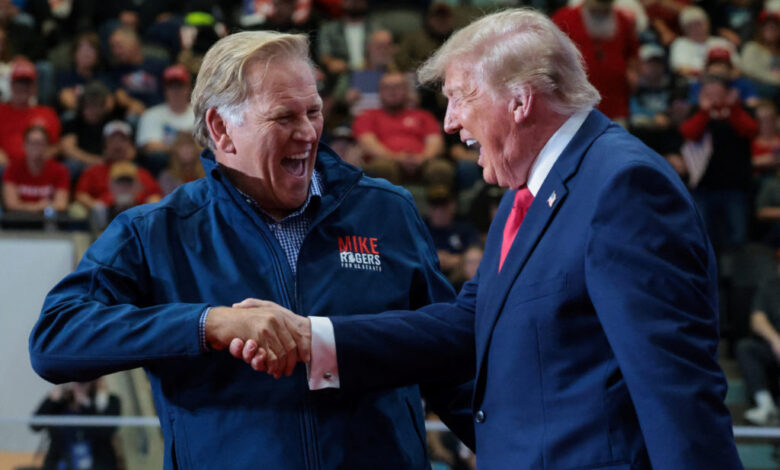
Trump’s return to Michigan highlights the immense importance of the race as Republicans eye an opening to flip a Senate seat and hold onto their majority in the chamber. El-Sayed faces Republican Mike Rogers, a former congressman backed by Trump, in the November 3 general election to succeed retiring Democratic Senator Gary Peters. The contest has taken on national significance, with Republicans casting El-Sayed as a symbol of a Democratic Party moving further to the left, while progressives view his candidacy as a key test for their agenda in a crucial battleground state ahead of the 2028 presidential election.
During Sunday’s rally, Trump invoked the September 11, 2001, terrorist attacks, drawing a comparison between stopping El-Sayed from entering the Senate and the passengers who fought back against hijackers aboard United Flight 93. Trump invited the parents of Todd Beamer, a Michigan native who died on the flight, onto the stage during the event.
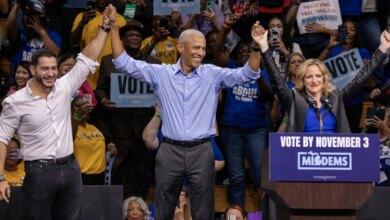
Trump’s visit to Port Huron followed appearances in Michigan and Ohio by former Democratic President Barack Obama on behalf of party candidates. The stop is part of Trump’s active schedule to bolster Republicans on the midterm ballot as the GOP navigates voter frustration surrounding the economy and the war with Iran. Unlike earlier trips to Republican-controlled states on defense, the GOP has not won a Senate race in Michigan for more than three decades, with Rogers having previously lost the 2024 Senate race to then-Representative Elissa Slotkin.
El-Sayed previously challenged Trump to visit Michigan, expressing belief that a visit would backfire on his Republican opponent. The progressive candidate, who won a divisive August primary, has publicly stated that the country needs to turn the page on Trump.
The campaign has emerged as one of the most contentious cycles of the year. During their second and final general election debate, Rogers directly questioned El-Sayed’s loyalty to the nation, asking whether he stood for America or overseas terrorist groups. El-Sayed called the questioning shameful, emphasizing his pride in the U.S. Constitution and its guarantee of religious freedom.
Speaking on stage before Trump’s arrival on Sunday, Rogers reiterated his allegations linking El-Sayed to the Muslim Brotherhood, claiming the movement celebrated its only U.S. primary victory through El-Sayed. Meanwhile, El-Sayed has also faced criticism over his own campaign rhetoric, particularly after remarking that “hurt people hurt people” following a Detroit-area synagogue attack committed by an individual who had lost four relatives in an Israeli airstrike in Lebanon a week earlier. El-Sayed later apologized for the comments, clarifying that he did not intend to justify the violence.
Internal party dynamics have also presented hurdles for the Democratic nominee. Following a contentious primary against Representative Haley Stevens, El-Sayed has struggled to fully unite the party. Appearing on CNN ahead of Sunday’s events, Stevens declined to explicitly state whether she remained fully behind El-Sayed, instead describing herself as part of the team while naming other Michigan Democratic candidates without mentioning the party’s Senate nominee.