As the November 3 midterm elections approach, a significant segment of the American electorate is expressing growing apprehension regarding the influence of the far-left on the Democratic Party. A new, extensive survey of swing-state voters indicates a sharp rise in unfavorable views toward the Democratic Socialists of America (DSA), suggesting a potential hurdle for Democratic candidates in highly competitive districts.
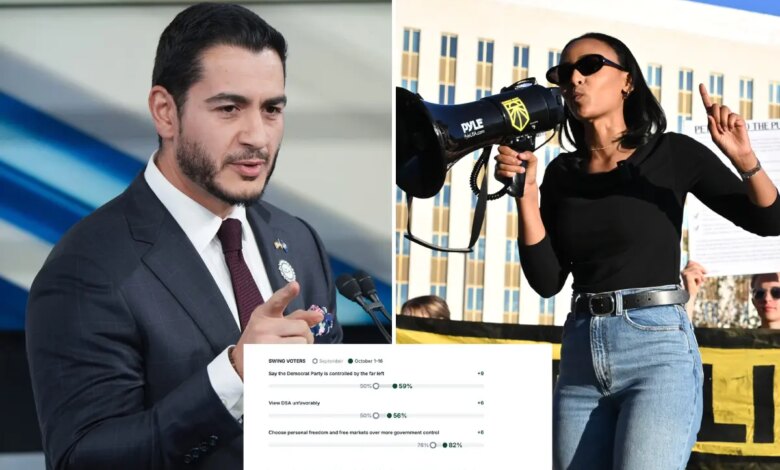
The data, released in the latest “Americans Unscripted” report by Americans for Prosperity, shows that 56% of respondents now hold an unfavorable view of the DSA. This represents a six-percentage-point increase from September, when the unfavorable rating stood at 50%. The shift reflects a broader trend among voters who are increasingly concerned about the ideological direction of the Democratic platform.
Beyond views of specific organizations, the survey found that nearly 60% of voters believe the Democratic Party is currently controlled by its far-left wing. This perception has also intensified recently, rising from 50% just one month ago. The sentiment appears rooted in a strong preference for traditional economic structures; approximately 82% of those surveyed indicated they favor personal freedom and free-market systems over increased government control.
The scale of the research is substantial, involving conversations with 81,673 voters between October 1 and October 16. The specific inquiry regarding the DSA was posed to a subset of approximately 9,000 to 10,200 individuals. Critically, the outreach focused on eight states likely to determine the balance of power in Congress: Alaska, Iowa, Michigan, Montana, New Hampshire, North Carolina, Ohio, and Wisconsin.
In Michigan, where the political divide is particularly acute, the impact of these perceptions is already being felt on the campaign trail. William Lawrence, a Democratic congressional candidate in a competitive race, recently made the decision to end his membership with the DSA. The move is seen as an attempt to distance his campaign from the “socialist” label as voters in his district express skepticism. Meanwhile, the campaign of Abdul El-Sayed, another prominent figure associated with the far-left in Michigan, is being watched as a test of whether progressive candidates can maintain momentum in a general election setting.
Individual accounts from the field reinforce the survey’s quantitative findings. In Holland, Michigan, a voter named Michael told researchers that he remains skeptical of progressive promises. “Nothing is free,” he said, suggesting that there is “an agenda behind all these promises of free benefits.”
However, the report is not entirely negative for Democrats. Despite the souring sentiment regarding socialism, the survey revealed a surprising turnaround on economic trust. Approximately 45% of respondents indicated they trust Democrats more to handle cost-of-living issues, such as inflation and rising prices. In contrast, only 36% favored Republicans on these issues, with 18% stating they trusted neither party. This marks a notable shift from August, when Republicans held a five-point lead of 44% to 39% over Democrats regarding economic concerns.
This contradiction suggests that while voters may be wary of the “far-left” label, they are simultaneously grappling with immediate financial pressures. In New Hampshire, a contractor named Nick noted that inflation and fuel costs are currently “squeezing” his business, highlighting the urgency of the economic climate for small business owners.
As the election enters its final stages, Republicans find themselves in a complex position. While the data regarding the DSA and party control offers a clear line of attack, the loss of their edge on cost-of-living concerns presents a significant challenge. With top forecasters currently viewing Republicans as underdogs in the fight for the House and Senate, the ability to capitalize on voter unease regarding socialism while reclaiming the economic narrative will be vital to their success on November 3.