
Court Documents Reveal Trump’s Proposed 250-Foot Victory Arch Could Break Ground Within Weeks

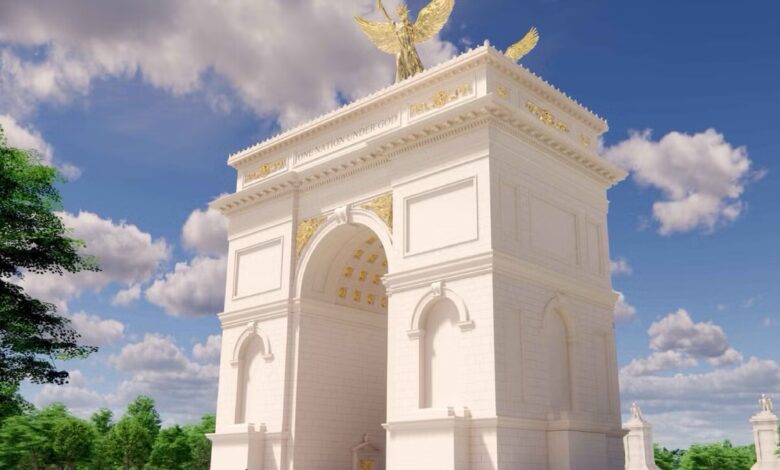
Construction on President Donald Trump’s proposed 250-foot victory arch could break ground in just a matter of weeks, potentially shortly after Election Day, according to recent court documents. In a filing submitted on a Wednesday, the Department of Justice stated that the National Capital Planning Commission is scheduled to meet on November 5 to consider approving the final plans for the monumental structure. Following that review, the Department of the Interior and the National Parks Service could issue formal authorization.
“NPS may publish such notice as early as November 5, 2026, and construction could commence as early as November 5, 2026,” the Justice Department noted in the filing. This judicial update arrives while a federal judge is actively considering whether to halt construction in response to an ongoing lawsuit aimed at blocking the project.
Modeled after the Arc de Triomphe in Paris, France, the proposed monument is slated for erection in Memorial Circle, situated across the Potomac River from the Lincoln Memorial. Architectural plans indicate that the structure will feature gilded statues and an observation deck, alongside the words “One nation under God” emblazoned across its white stone facade. While President Trump remarked last month that the arch would also double as a “top grade Military Complex,” plans released by the administration do not appear to incorporate any national security purpose.
Trump has stated that the towering monument is intended to commemorate the 250th anniversary of the signing of the Declaration of Independence. However, when asked by a journalist last year who the arch was dedicated to, he responded, “Me — it’s going to be beautiful.” Standing at 250 feet tall, the proposed arch would dwarf several prominent Washington landmarks, including the U.S. Capitol Building, the Lincoln Memorial, the White House, and the original Arc de Triomphe. “I’d like it to be the biggest one of all,” Trump told reporters in February, adding, “We’re the biggest, most powerful nation.”
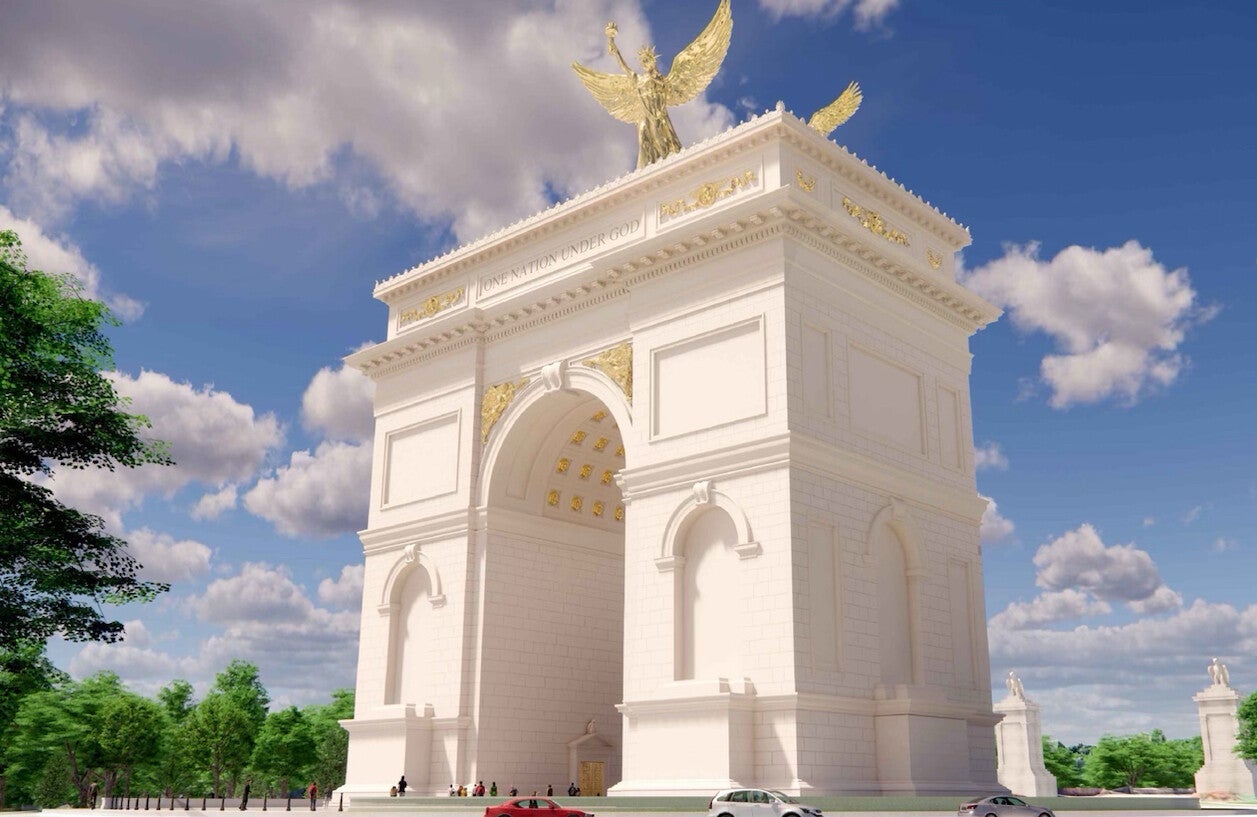
The financial cost of the project remains unclear. The White House has indicated that the development will likely rely on a combination of private and public funds, with the National Endowment for the Humanities having already set aside $15 million.
The initiative has sparked intense public debate and opposition since Trump first unveiled plans to build it last October. Several lawsuits have been filed in an attempt to stop the monument from moving forward, including legal action brought by a group of Vietnam veterans. Those plaintiffs argue that the arch lacks the necessary congressional approval and would obstruct views of Arlington National Cemetery, the final resting place for over 400,000 individuals. Democratic lawmakers have similarly criticized the venture as a vanity project, and numerous demonstrations have taken place at Memorial Circle in protest.
Public opinion polling reflects deep division over the plans. According to an Ipsos survey conducted in April, 52 percent of Americans oppose the construction of the arch, while 21 percent express support for the project.
If completed, the riverside monument will add to a growing portfolio of major construction and restoration efforts undertaken by Trump in the nation’s capital. Other notable projects include a $400 million White House ballroom and extensive renovations at the Trump-Kennedy Center.