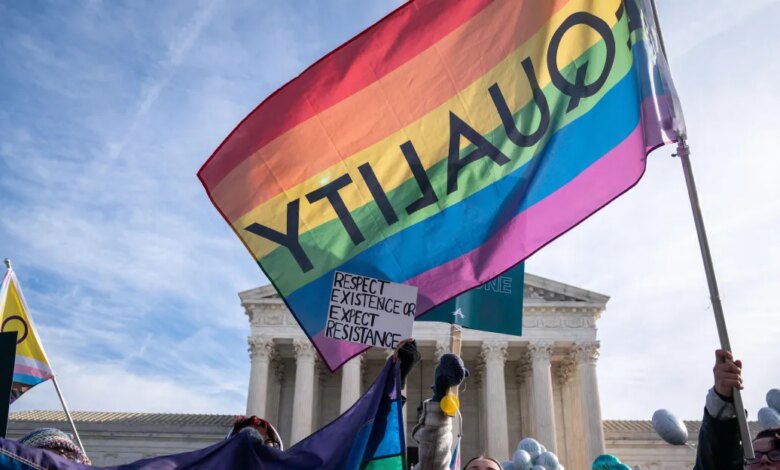
The U.S. Supreme Court is set to address a pivotal intersection of religious liberty and civil rights that could force taxpayers to fund institutions that openly discriminate against LGBTQ individuals. On November 3, the justices will hear arguments in St. Mary Catholic Parish v. Roy, a case that squarely asks whether religious schools can demand government subsidies while simultaneously claiming a constitutional right to bypass the anti-discrimination requirements attached to those funds.
The dispute centers on a Colorado program designed to provide universal preschool education to all four-year-olds in the state. Under the initiative, families can choose to send their children to a wide array of participating providers, including public, private, and religious institutions. However, the state imposes a condition on any school accepting these public funds: they must agree not to discriminate on the basis of sexual orientation or gender identity.
While Colorado’s broader civil rights laws already include an exemption for places “principally used for religious purposes”—allowing religious preschools to operate and discriminate privately—the state maintains that it is not required to subsidize that discrimination with public money. The plaintiffs in St. Mary argue that this exclusion from the funding program violates their right to the free exercise of religion. Given the current ideological makeup of the Court, legal observers suggest the case may mark the next step in a decade-long trend of expanding religious exemptions at the expense of LGBTQ protections.
This legal battle follows the Supreme Court’s 2022 decision in Carson v. Makin, which significantly altered the landscape of school choice. In that case, the Court struck down a Maine program that provided tuition vouchers for students in rural areas but restricted them to “nonsectarian” schools. The conservative majority ruled that if a state chooses to fund private education, it cannot exclude schools simply because they are religious.
However, the Colorado case presents a more complex question. Unlike the Maine program, Colorado does not bar schools for being religious; it bars them for refusing to follow a generally applicable non-discrimination rule. The outcome will determine if religious groups have an absolute right to taxpayer dollars while remaining exempt from the civil rights regulations that govern every other recipient of those same funds.
The Court’s approach to these issues has historically been guided by the 1990 precedent Employment Division v. Smith. Authored by the late Justice Antonin Scalia, Smith established that the government does not violate the Free Exercise Clause when it enforces a “neutral law of general applicability” that happens to burden religious practice. Under this rule, a non-discrimination law that applies to all schools would typically be upheld.
Yet, the current Court has frequently signaled its dissatisfaction with the Smith precedent without officially overturning it. In the 2018 Masterpiece Cakeshop case and the 2021 Fulton v. Philadelphia decision, the Court ruled in favor of religious objectors by focusing on the specific, narrow facts of those cases rather than establishing a new broad legal standard. In Fulton, Justice Amy Coney Barrett, joined by Justice Brett Kavanaugh, expressed hesitation about what should replace Smith if it were to be overruled, leaving the legal community in a state of uncertainty regarding how religious liberty claims should be handled in the future.
In their brief to the justices, the plaintiffs in St. Mary identified at least eight categories of cases where they argue Smith should not control. By agreeing to hear the case but pointedly declining to address whether Smith should be formally overruled, the justices may be signaling a preference for another narrow, case-specific ruling. This “ad hoc” approach has allowed the conservative majority to consistently rule in favor of religious conservatives without providing a coherent doctrine for lower courts to follow.
The implications for Colorado families are significant. If the Court rules in favor of the parish, it could effectively mandate that state taxpayers fund educational institutions that refuse to serve the children of same-sex couples or employ LGBTQ staff. This would bridge two previously distinct areas of the law: the requirement that states fund religious education and the expanding right of religious groups to seek exemptions from civil rights statutes.
While the Court has maintained older precedents requiring religious business owners to comply with tax laws and minimum wage regulations, it has shown a specific and consistent willingness to carve out exceptions in cases involving LGBTQ rights. As the Nov. 3 hearing approaches, the central question remains whether the Court will continue this pattern of situational exemptions or finally attempt to resolve the underlying tension between the Free Exercise Clause and the state’s interest in preventing discrimination.