Across Sudan, farmers who have spent more than three years struggling to harvest crops amidst a brutal civil war are now facing a new, silent adversary: a historic drought that threatens to trigger a wide-scale famine. Driven by the El Niño climate pattern, the lack of rainfall and extreme temperatures are scorching the southern regions of the country, where rain-fed agriculture serves as the primary source of food for millions.
The scale of the environmental crisis is unprecedented in modern records. Data from the United States Geological Survey (USGS) reveals that rainfall between July and September 2026—the peak of the rainy season—was the lowest recorded in over three decades. In North Darfur, precipitation levels fell to their lowest since 1984, the same year a catastrophic famine devastated Sudan and Ethiopia. Similar historic lows were recorded in North Kordofan, which saw its worst levels since 1990, and Gedaref state, which has not seen such dry conditions since 1991.
This climatic shift comes at a time when the nation is already reeling from a conflict that began in 2023. Pockets of famine have already been identified in areas under siege, including al-Fashir, the capital of North Darfur. While the start of the harvest season in November and December usually brings a reprieve from hunger, aid experts now warn that the drought will reverse any potential gains. The United Nations World Food Programme (WFP) projects that an additional 350,000 people will experience severe hunger by the end of 2026, a figure expected to swell to 1.2 million by August 2027.
On the ground, the impact is visible in the shriveled stalks and dusty fields of smallholders. In North Kordofan, Mariam Omar, a small-scale farmer near Um Ruwaba, described the current season as terrible as she attempted to clear weeds from sandy soil that should have been lush with crops. Mohamed Abdelrahman, a farmer and sesame trader who manages roughly 420 hectares in the same area, estimated that 40% of the land in the region would yield no harvest at all. He noted that many families who were displaced by the war and returned to their land are now finding it impossible to grow enough food to survive.
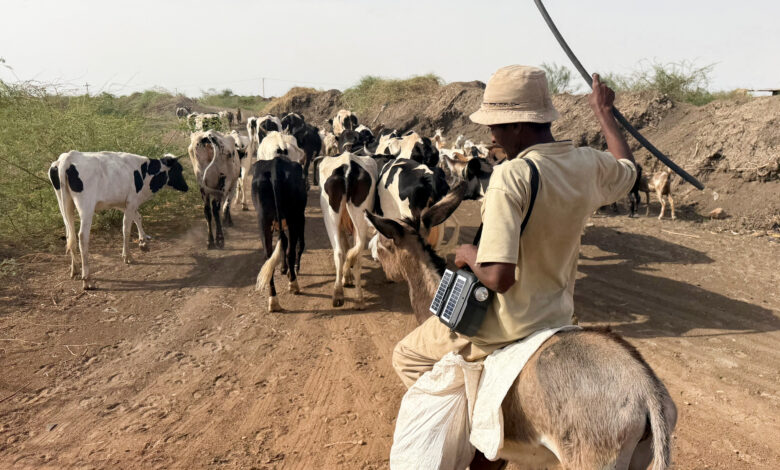
The crisis extends to the country’s livestock, a vital economic pillar. In the markets of El Obeid, traders report that cattle are arriving skinny and weak due to the scarcity of grazing land. Sirajaldeen Abdellateef, a local livestock trader, observed that the usual profits of the autumn season have vanished, a situation worsened by the rapid loss of value in the Sudanese pound, which has fueled rampant inflation and made basic necessities even harder to acquire.
Gedaref state, often considered the breadbasket of Sudan because it largely avoided the front lines of the fighting, has not been spared by the weather. Large-scale farmer Emad Kabsoor, who operates 14,700 hectares, reported that searing temperatures—recorded at 7 to 9 degrees above the historic average in late October—have scorched his fields. Kabsoor expects his total harvest to be just a quarter of what he produced last year, remarking that he has never seen a season this severe.
Humanitarian agencies are warning that the simultaneous decline of aid and domestic harvests is a recipe for disaster. The WFP reported that as of mid-October, it had approximately $276 million to fund its Sudan operations, which is less than half of its budget from the previous year. An additional $134 million is urgently needed to address the drought-induced hunger. Due to these funding constraints, the agency has already been forced to halve rations in some areas, including the Tawila displacement camp in Darfur, which houses roughly 700,000 people.
Displacement patterns are also shifting. While the threat of violence initially drove millions from their homes, hunger is now becoming the primary motivator for migration. Adam Rojal, a spokesman for a major displaced persons coordination group, stated that the crisis is no longer just about the bullets. In Tawila, aid workers recorded 9,000 new arrivals between September and mid-October, many of them families fleeing starvation in search of food and water.
Despite the alarming data from international monitors and the testimony of local farmers, the Sudanese government has downplayed the severity of the situation. Agriculture Minister Esmat Qureshi recently stated that while the harvest would be lower, it would not be significantly less than the previous year. Meanwhile, the Rapid Support Forces (RSF), the rival faction in the civil war, claimed they are seeking to coordinate early responses but cited a lack of resources and capacity.
Famine experts point out that while Sudan survived a similar drought in 1984, the current situation is far more precarious because of the ongoing conflict and a decrease in international aid mobilization. Alex De Waal, an expert on famine, noted that during the 1980s, the international community rallied resources in a way that is currently absent. As 2026 draws to a close, Sudanese farmers like Sirajaldin al-Tahir, who lived through the 1984 crisis, express deep uncertainty about the future. While aid once arrived to save his village decades ago, there is no guarantee that help is on the horizon this time.