
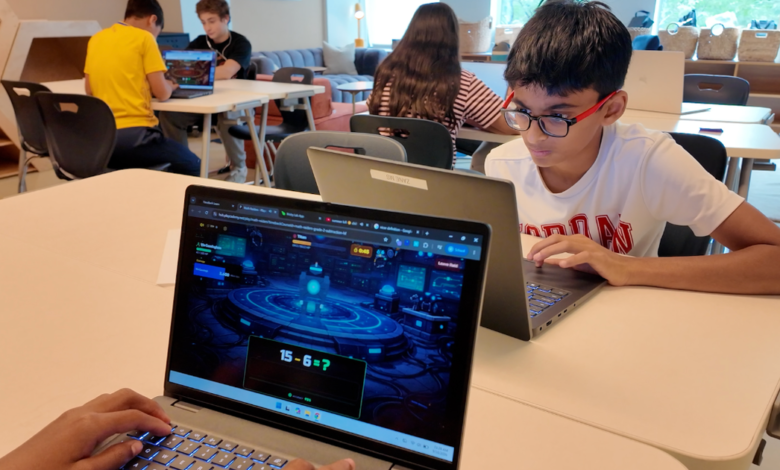
A new network of private institutions is betting that artificial intelligence can replace traditional classroom instruction, allowing students to complete their core academic coursework in roughly two hours a day. Alpha School, a for-profit network originally founded in Austin, Texas, in 2014 by MacKenzie Price, opened its first Chicago campus this fall. Serving students from pre-kindergarten through eighth grade, the school features no traditional teachers in the academic sense. Instead, adults inside the building are designated as “guides,” while laptop software powered by adaptive algorithms manages the primary curriculum.
Students begin their mornings at 9 a.m. working on math, reading, writing, language, and science through the school’s proprietary educational software, known as TimeBack. Developed by a research team led by cognitive scientist Carl Hendrick at the Netherlands’ Academica University of Applied Sciences, the software is designed to adjust dynamically to individual student capabilities throughout the school year. According to the school, if a student repeatedly struggles with a specific type of problem, the system automatically redirects them to earlier concepts to bridge any knowledge gaps. The technology is “closed,” meaning it does not draw information from the open internet, and school officials emphasize that students interact with adaptive learning checks rather than open-ended chatbots that simply provide answers.
Eighth-grader Zane Shah, 13, who transferred to Alpha Chicago after attending traditional schools, said the two-hour daily academic window accomplishes everything he previously learned across a standard eight-hour day. His father, Binoy Shah, noted that the change has noticeably altered his son’s engagement, sparking longer and more enthusiastic conversations about his school day.
That individualized mastery model comes with a substantial financial cost. Tuition at Alpha Chicago runs $55,000 annually, which exceeds the average yearly cost of an attending private college in the United States, according to U.S. News & World Report. The institution does not screen prospective students based on past grades or academic test scores, looking instead for applicants who are coachable, self-motivated, and open to the unique learning structure. School officials state that students are only asked to leave for behavioral infractions rather than a failure to meet academic benchmarks, and point to graduates being accepted into universities such as Stanford, Northwestern, and Rice.
Rather than lecturing, the adult guides in the building focus on emotional and motivational support. Carrington Haas, the lead guide at Alpha Chicago, explained that staff members do not handle academic questions. Instead, a globally based learning science team comprising licensed teachers, curriculum experts, and early childhood specialists reviews daily student data and dashboards remotely. This team intervenes through video coaching calls as a last resort if a student becomes stalled. Haas, who brings a background in traditional education through Teach For America and Waldorf charter schools, rejects the idea that the campus is entirely teacherless, arguing that guides remain essential for teaching crucial life skills and facilitating mastery-based progression.
Despite the network’s assertions that its students score in the top 1 percent on national standardized tests, education experts remain skeptical of the model. Rebecca Winthrop, a senior fellow at the nonpartisan Brookings Institution who has visited Alpha campuses, cautioned that families should view the approach as an experimental model lacking clear, externally validated evidence to support its academic claims. Winthrop also pointed to neuroscience research indicating that deep reflection and meaning-making, which compressed school schedules often restrict, are vital for long-term learning outcomes.
More pointed criticism came from Carol Corbett Burris, executive director of the Network for Public Education, a nonprofit advocacy group supporting public education. Burris argued that the model is less about expanding educational access than extracting maximum profit from schooling. She pointed to Unbound Academy, a free public charter school in Arizona that utilized the TimeBack platform, noting that the institution performed poorly compared to standard public options despite promises made in its charter application.