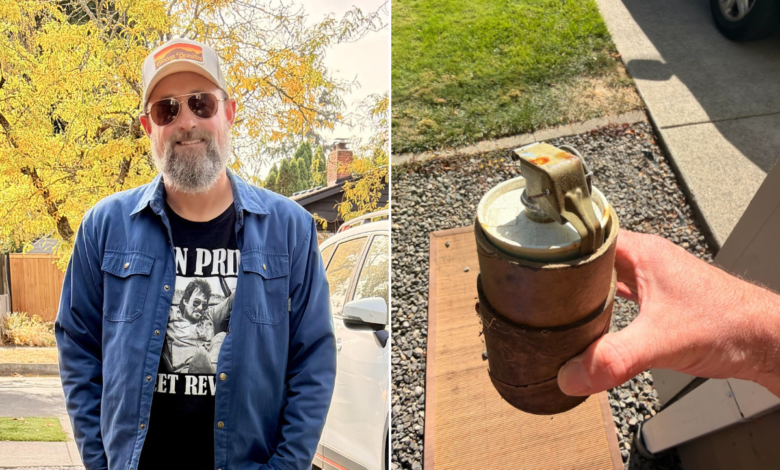
Moving into a new home usually brings a predictable wave of unpacking, organizing, and discovering minor quirks left behind by previous occupants. For Mat Reichardt of Portland, Oregon, however, the transition took a hazardous turn when he stumbled upon a military grenade hidden beside his property.
Reichardt was in the middle of sorting out utilities when the discovery occurred. Although the former homeowner—an electrician—had left behind a series of meticulous instructions regarding various systems around the house, two crucial details were omitted: directions to the outdoor spigot shut-off valve and the presence of an explosive device.

While searching for the elusive shut-off valve, Reichardt examined a rusty, capped metal pipe he had previously overlooked. To his surprise, the cover lifted off easily, revealing not a plumbing fixture, but a concealed canister. Upon opening it, he immediately recognized the telltale pin and fuse system.
Although it had been two decades since he last played a video game, Reichardt recognized the object from virtual titles he had played on his Xbox in years past. Realizing the potential danger, he decided to contact law enforcement.

Robert Burrell, a retired U.S. Marine, combat veteran, and senior research fellow at the University of South Florida Global and National Security Institute, reviewed photographs of the object. Burrell identified the artifact as likely being a U.S. military-issued grenade fitted with an M201A1 fuze, a design utilized in both the M18 colored-smoke grenade and the AN-M14 thermite incendiary grenade dating back to at least the 1950s.
Burrell noted that the AN-M14 version contains a thermite composition capable of generating temperatures exceeding 4,000 degrees Fahrenheit, presenting a severe hazard. He cautioned that despite the deteriorated state of the container from long-term environmental exposure, the device could not be assumed inert and should always be treated as potentially live and extremely dangerous. He advised anyone encountering similar munitions to halt handling immediately, keep others at a distance, and contact local police to request an Explosive Ordnance Disposal assessment.

When Reichardt initially contacted the police non-emergency line, two responding officers quickly escalated the situation by requesting a bomb squad. Authorities cordoned off the house, blocked the street, questioned the homeowner, and positioned an X-ray device next to the canister. Images transmitted to a computer inside an official vehicle allowed technicians to determine the object was a military smoke grenade. Because of its military origin, standard protocol required authorities to transfer the device to a nearby military base for safe disposal.
Reflecting on how the object came to be on the property, Reichardt admitted he remains baffled. He speculates it might have been related to home security or intruder preparedness, given the previous owner’s otherwise meticulous preparation, though he emphasizes this is purely guesswork.
The unexpected police presence also disrupted daily routines. At one point, Reichardt had to ask officers to temporarily reopen the road so he could pick up his six-year-old daughter from school, later having to explain to her why law enforcement and a bomb squad were blocking access to their front door. Working remotely from home, he was also preoccupied with explaining the chaotic scene to curious neighbors passing by.
Despite the disruption, Reichardt views the incident with humor, noting wryly, “Hopefully that was the last grenade on the property.”