Pentagon Scrambles to Fortify Domestic and Overseas Bases as Cheap Drones Upend Defense Strategy

Top defense officials are expressing growing alarm over the vulnerability of military installations both domestically and globally, warning that inexpensive drone technology and precision missile strikes are upending decades-old defense doctrines. The mounting anxiety follows a series of high-profile attacks and security threats against ground targets, including the destruction of major logistics and air operations centers in the Middle East, foiled plots targeting U.S. bombers at British air bases, and a persistent Russian sabotage campaign across European military facilities.
While defense leadership has historically faced skepticism regarding threat inflation aimed at securing larger budgets, officials stress that current operational fears are genuine. Despite the military’s vast expenditures, the United States is rushing to reinforce fortifications, protect expensive equipment, and draw down personnel in exposed regions. Foreign adversaries have closely monitored conflicts like the war in Ukraine and Iran’s capacity to bypass sophisticated air defenses using a combination of missiles and low-cost unmanned aerial vehicles.
In the Middle East, these vulnerabilities have materialized in devastating fashion. A February 28 missile and drone strike obliterated Navy facilities in Manama, Bahrain, which served as the region’s primary logistics hub. Around the same time, the Combined Air Operations Center at Al Udeid Air Base in Qatar was severely damaged and rendered inoperable. Both locations have faced subsequent strikes, casting doubt on whether they can ever be fully restored and fundamentally altering long-term U.S. force posture in the region. According to a recent Pentagon inspector general report, Iranian strikes have damaged and destroyed hundreds of buildings and structures across U.S. bases in Kuwait, Bahrain, Qatar, the United Arab Emirates, Saudi Arabia, Iraq, Oman, and Jordan.
The fallout has extended to diplomatic ranks. The State Department ordered further staff reductions across multiple Middle Eastern diplomatic posts, including in Jordan, Lebanon, Qatar, Saudi Arabia, and the United Arab Emirates, moves officials acknowledge reflect a diminished capacity to defend overseas assets. Meanwhile, the Trump administration leaked classified intelligence indicating that Iran has intensified efforts to target U.S. diplomats and officials, though some insiders question the timing of the leaks as an effort to justify continued military engagement.
Security fears have crossed the Atlantic and the Pacific. Last month, War Secretary Pete Hegseth acknowledged domestic vulnerabilities, noting that the Pentagon was actively hardening installations on American soil against sabotage and drones. In March, small drones flew over Barksdale Air Force Base in Louisiana, home to Global Strike Command, which oversees the nation’s bomber fleet and intercontinental ballistic missiles. An inspector general report published in January identified at least ten Department of Defense installations and activities where unauthorized drone incursions had occurred, while warning that critical military facilities and contractor-operated sites lacked designated protection.
To counter these emerging threats, the Air Force recently awarded a contract for counter-drone systems at Joint Base McGuire-Dix-Lakehurst in New Jersey, while the military studies defensive technologies for Yokota Air Base in Japan, Minot Air Force Base in North Dakota, Battle Creek Air National Guard Base in Michigan, and Shaw Air Force Base in South Carolina. Last August, Hegseth established Joint Interagency Task Force 401 to deploy counter-small unmanned aircraft system capabilities, though investigators have noted bureaucratic contradictions and gaps in defensive authorities.
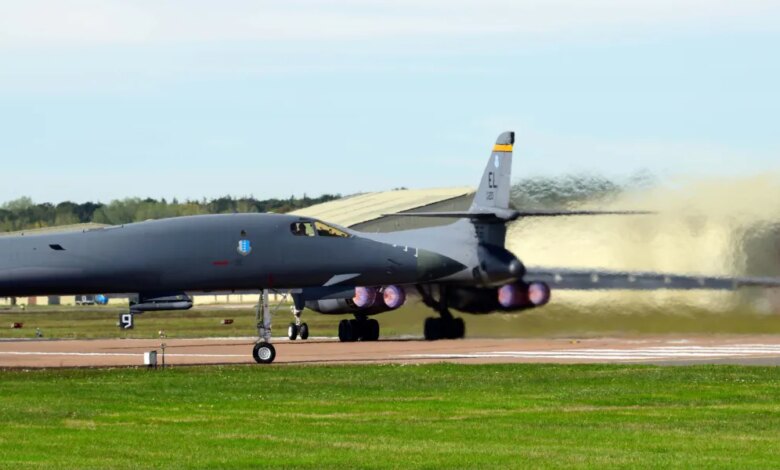
Threats from adversaries extend beyond drones to sophisticated operational sabotage. Intelligence assessments revealed a complex plot by Iran’s Islamic Revolutionary Guard Corps targeting U.S. B-1 bombers stationed in the open on the tarmac at Royal Air Force Fairford in the United Kingdom. Patterned after a Ukrainian drone tactic known as Operation Spider’s Web, the plot prompted military leaders to urgently fly the supersonic bombers back to the United States while emergency refueling assets were deployed. European facilities have also faced threats from Russian campaigns, including an August drone strike at Leipzig/Halle Airport in Germany that damaged military transport freighters bound for Ukraine.
In response to these multi-domain challenges, the Pentagon has quietly initiated procurement strategies to move past traditional concrete hardening. Spearheaded by the office of Dale R. Marks, the assistant secretary of war for energy, installations, and environment, the military is seeking advanced construction methods, metamaterials, energy-dissipating composites, self-healing concrete, and novel formulations designed to withstand kinetic impacts and blast overpressures.
Efforts also focus on reducing the profile of sensitive installations through terrain integration, camouflaging, thermal and electromagnetic signature masking, and the deployment of decoy structures. Furthermore, the military is exploring high-speed tunneling and shock-isolated underground structural designs to place critical capabilities deep beneath the surface, drawing lessons from subterranean warfare in Ukraine and the fortified underground networks utilized by Iran and other nations.
Domestically, Hegseth introduced the FORTRESS America initiative, designed to ensure that major military installations possess independent power grids, autonomous utility systems, and deep strategic reserves of munitions, fuel, medicine, and blood to sustain operations if supply lines collapse. While officials frame the initiative as a vital national insurance policy against cyberattacks and sabotage, critics and former analysts have raised concerns that such insular domestic planning signals an inward retreat that leaves the broader civilian population exposed during major conflicts.