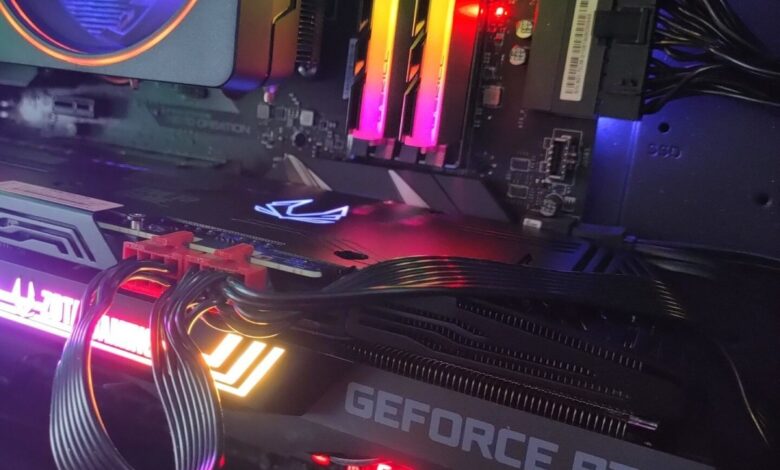
An open-source utility designed for Nvidia’s Ampere architecture is breathing new performance into older consumer graphics cards by unlocking restricted compute capabilities in specific Tensor Core workloads. Developed by GitHub user Zagitta, the project—known as gpu-unlock—targets an instruction issue-rate limitation affecting FP16 and BF16 Tensor Core operations that utilize FP32 accumulation.
According to the developer, these operations on supported consumer-grade cards run at roughly half the speed of equivalent professional-tier Nvidia hardware. The new open-source solution works by altering hardware speed selection registers to bypass this restriction, building upon previous research originally aimed at unlocking the capabilities of Nvidia CMP cryptocurrency mining cards.
The implementation relies on a custom Linux kernel module that loads before the primary Nvidia graphics driver initializes. The module modifies the relevant registers, resets the GPU, and then hands control back to the unmodified official driver. Because of this workflow, users do not need to permanently flash the graphics card’s VBIOS or install patched firmware and modified drivers.
Community compatibility reports illustrate significant performance gains across various compute benchmarks, though the actual improvements vary heavily depending on the specific workload. An Nvidia RTX 3090 card tested in BF16 matrix multiplication saw its performance jump from 77.5 TFLOPS to 129.6 TFLOPS, while its TF32 performance climbed from 40.2 TFLOPS to 69.8 TFLOPS. Meanwhile, the RTX 3090 Ti demonstrated an even larger jump, with BF16 throughput soaring from 87.5 TFLOPS to 157.4 TFLOPS, representing a near-80% increase in that specific metric.
Real-world testing in other applications yields mixed results aligned with workload demands. An RTX 3090 user evaluating local large language model inference observed a 16% speedup in processing long context prompts, though token generation speed remained largely unchanged. In image generation tests using ComfyUI on an RTX 3090 Ti, heavy BF16 workloads registered throughput increases ranging from approximately 47% to 59%.
Despite the gains in AI and matrix math tasks, the impact on gaming remains unverified. Although Nvidia’s DLSS technology utilizes Tensor Core hardware, no independent gaming benchmarks have yet confirmed whether the tool provides any measurable increase in frame rates.
At present, the project officially supports Linux environments only, though an experimental Windows port has demonstrated that an unclocked RTX 3090 can successfully boot into Windows on a specific test system. Because the utility remains strictly experimental, running it on a primary daily-use system carries inherent risks.