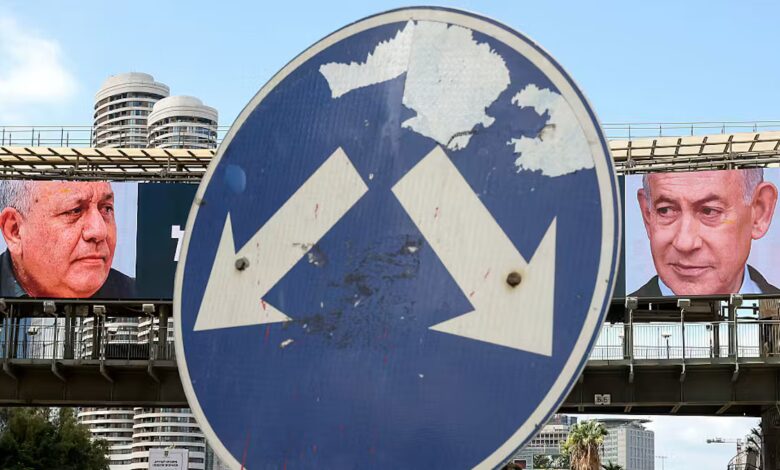
Israeli voters head to the polls Tuesday in an election that will test whether Prime Minister Benjamin Netanyahu can survive another political storm amid deep divisions over the October 7 failures, years of war, and military service requirements. Netanyahu, Israel’s longest-serving prime minister, faces a serious challenge from former Israel Defense Forces Chief of Staff Gadi Eisenkot, whose newly formed Yashar Party has surged in recent polls. The election will test whether Netanyahu can overcome criticism for October 7 intelligence failures, divisions over the war, and growing calls to end military service exemptions for ultra-Orthodox young men.
Unlike in the United States, Israelis do not directly elect their prime minister. They vote for political parties, which receive seats in Israel’s 120-member parliament, known as the Knesset. The leader who can assemble enough parliamentary support to form a government becomes prime minister. A majority generally requires 61 seats. Because Israel uses proportional representation, no single party has ever won an outright majority on its own. Instead, parties negotiate to form governing coalitions, often giving smaller factions significant influence over national policy. Parties must receive at least 3.25% of the vote to enter the Knesset, and those that fall short receive no seats.
Netanyahu’s Likud is a right-wing party that has long emphasized national security, a strong military, and a hard line toward Iran. Yashar, by contrast, is led by Eisenkot, a former military chief who has criticized Netanyahu’s handling of the October 7 failures and supports requiring broader military service. Another major challenger is B’Yachad, an alliance led by former prime minister Naftali Bennett that brings together centrist and right-leaning voters opposed to Netanyahu’s continued leadership. Recent polls have put Eisenkot’s Yashar Party ahead of Netanyahu’s Likud, although neither political bloc has demonstrated a consistent path to the 61 seats needed for a majority. A Walla poll published October 20 projected Yashar winning 23 seats, compared with 19 for Likud. Bennett’s B’Yachad party was projected to win 14 seats, while Netanyahu’s coalition bloc was projected at 48 seats compared with 54 for opposition parties.
Israel’s political landscape leans heavily to the right, with the left-wing having virtually no power. For much of Israel’s early history, the Labor Party and its predecessors dominated politics, leading the government from Israel’s founding in 1948 until 1977. That dominance ended when Menachem Begin’s Likud won power for the first time. Labor’s support has since dwindled, and in 2024 it joined with the left-wing Meretz party to form the Democrats. Its decline reflects a broader shift in Israeli politics, where right-wing and centrist parties now dominate and are competing to curb Netanyahu’s power.
Netanyahu is no stranger to high political stakes. Even before the October 7 attacks, Israel had already gone through five elections in just a few years as coalition governments repeatedly fell apart. Netanyahu served as prime minister from 1996 to 1999 and again from 2009 to 2021. Before October 7, Israel was consumed by mass protests over Netanyahu’s proposed judicial reforms, which critics argued threatened judicial independence while supporters said they would restore authority to elected officials. The Hamas attacks and ensuing war shifted national attention toward security, leading to a wartime coalition government that temporarily muted political tensions before campaign rhetoric reignited questions about governmental responsibility.
One of the most contentious issues in the current campaign is whether ultra-Orthodox, or Haredi, Jewish men should be required to serve in the Israel Defense Forces. The policy dates back to the founding of Israel, when Prime Minister David Ben-Gurion agreed to exempt approximately 400 yeshiva students from military service to help rebuild Jewish religious scholarship devastated by the Holocaust. The limited exemption gradually expanded over decades, allowing growing numbers of ultra-Orthodox to avoid service while studying Torah full-time. Netanyahu’s coalition has long included and depended on Haredi political parties that oppose drafting young men studying in religious seminaries. Many ultra-Orthodox leaders fear military service could pull students away from religious studies or expose them to secular lifestyles, while broader Israeli society increasingly argues that reservists have carried an unsustainable burden through repeated deployments since October 7 and that Haredi communities receive economic assistance without comparable service.
While still a minority, some ultra-Orthodox men do enlist, including in the IDF’s all-ultra-Orthodox Hasmonean Brigade founded after October 7. The brigade provides a framework for Haredi men to serve while maintaining religious practices as an all-male unit. According to Ynet, the brigade has recently carried out raids targeting weapons and terrorist infrastructure in Lebanon, and its first class of soldiers recently completed officer training courses. Netanyahu must balance demands for a broader draft against the risk of alienating the political parties whose support he needs to remain in power, whereas Eisenkot supports ending the broad exemptions.
Eisenkot, who served as IDF chief of staff from 2015 to 2019, presents himself as a security-focused alternative and carries a personal connection to the war’s toll, as his 25-year-old son, Gal Meir Eisenkot, died in December 2023 after being wounded during an operation in Gaza. Eisenkot’s policy positions on national security align closely with Netanyahu’s; he supports preventing Iran from obtaining nuclear weapons and opposes the feasibility of a two-state agreement with the Palestinians in the near future. His differences with Netanyahu center more on accountability, the management of security institutions, and Jewish extremist violence in the West Bank. Eisenkot has advocated stronger action against Jewish settlers committing violent crimes, including reinstating administrative detention for Jewish suspects, replacing security officials he believes failed to address the problem, and dismantling many newer settlement outposts, while opposing the planned E1 settlement project east of Jerusalem.
Regional security remains central to the campaign, with Netanyahu warning that Israeli military intelligence and the Mossad believe Iran and its proxies are considering ways to influence the election. Netanyahu sparked a political firestorm after sharing an AI-generated image depicting a nuclear explosion over Tel Aviv with a warning that voters opposing him risk exposing their families to a second Holocaust if Iran acquires nuclear weapons. Eisenkot fired back, accusing Netanyahu of using lies, scare tactics, and mass destruction threats after failing to achieve the objectives of the war in Iran. Meanwhile, President Donald Trump issued an emphatic endorsement of Netanyahu, warning that the United States could be forced to shoulder more of the burden of confronting Iran if Israelis choose a different leader.