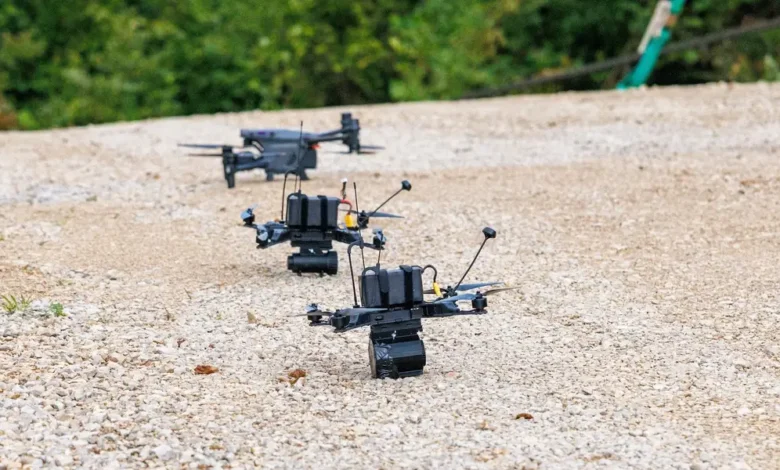
A NATO drone manufacturer is collaborating with Ukraine’s defense sector to construct underground component factories, seeking to adopt wartime manufacturing lessons that industry leaders say could prove critical for Western defense firms during a crisis. Croatian drone technology company ORQA and Ukrainian drone producer General Cherry are jointly developing and manufacturing interceptor drones, components, and counter-drone systems across both nations.
As part of the joint initiative, the companies are establishing an underground factory within Ukraine to produce specific drone parts. Operating amid wartime risks offers valuable manufacturing insights while under attack, according to ORQA Chief Executive Officer Srđan Kovačević. Producing components directly in Ukraine also proves more efficient than manufacturing them in NATO member states and shipping the finished goods to the Ukrainian military.
Ukrainian defense enterprises are dividing their manufacturing operations across multiple locations, frequently relocating facilities, and moving select work underground to evade targeted Russian strikes. While this decentralized approach involves lower operational efficiency, it provides significantly greater resilience against attacks. European industry leaders and Western officials have warned that European defense manufacturers must adopt similar practices amid growing concerns regarding Russian aggression.
Distributed systems offer substantially higher resilience to disruptions than concentrated, centralized systems by eliminating single points of failure, Kovačević noted. He added that Ukraine possesses immensely valuable, practical experience in building and scaling production under fire, an asset that Western companies have frequently abstracted and neglected. European perspectives are beginning to shift as decision-makers recognize that a distributed operational nature reinforces overall resilience despite economic trade-offs.
Latvian Defense Minister Raivis Melnis pointed out that NATO defense companies traditionally operate in a far more concentrated manner than their Ukrainian counterparts. He emphasized that the primary challenge for the region lies in determining readiness to produce systems across dispersed locations and organizing that logistical transition effectively. Melnis supports closer cooperation between Latvian and Ukrainian defense industries to help partner nations learn how Ukrainian manufacturers sustain production during active conflict. Davyd Aloian, deputy secretary of Ukraine’s National Security and Defense Council, previously stated that defense companies within NATO territories should definitively begin fragmenting their production models.
Other European defense figures have echoed these warnings. Karmo Saar, head of sales for Estonian drone manufacturer Krattworks, cautioned that if European companies fail to disperse operations prior to any potential conflict with Russia, the sector faces severe consequences.
Decentralizing production does involve distinct trade-offs. Achi, CEO of the Ukrainian-Estonian defense technology firm and ground robot maker Ark Robotics, described such defensive measures as necessary but not ideal, noting that operations remain simpler when consolidated in a single location.
While some Ukrainian defense companies have established production footprints inside NATO countries to share expertise and operate free from the immediate threat of Russian bombardment, Kovačević emphasized distinct advantages to building inside Ukraine. ORQA supplies equipment to 24 NATO allies, encompassing drones and related technology including controllers, receivers, goggles, video equipment, and flight simulators. Although the partnership could have concentrated all operations in Croatia, the companies elected to distribute their work across both countries.
Localizing the supply chain allows all participating parties to exchange battlefield information and operational requirements more efficiently. Kovačević expressed understanding for Ukrainian firms establishing facilities on NATO soil, but maintained that partnering directly with General Cherry inside Ukraine yields substantial value. General Cherry, recognized as one of Ukraine’s largest drone makers, demonstrates high operational excellence in managing manufacturing operations safely under constant threat.
The collaboration provides insights extending beyond manufacturing. Kovačević observed that while the West possesses deep technical expertise, it lacks the lived experience required to apply that technology to the operational realities of 21st-century warfare. The overarching objective is to supply Ukraine while simultaneously equipping NATO with weaponry shaped directly by Ukrainian battlefield expertise.
The partners are establishing a joint serial-production facility in Croatia dedicated to co-developed interceptor drones and counter-drone systems designated for NATO allies. Simultaneously, the partners intend to establish a component facility in Ukraine that will manufacture electronics and communications systems. General Cherry plans to supply these components to all partners operating within Ukraine rather than reserving them exclusively for internal use. While Ukraine maintains the capability to manufacture the finished drones produced in the Croatian facility, Kovačević explained that the Ukrainian facility focuses on fulfilling local needs for internal components without disrupting existing supply chains. An additional priority for ORQA involves reducing reliance on Chinese products by helping modernize Ukraine’s industrial supply chain.