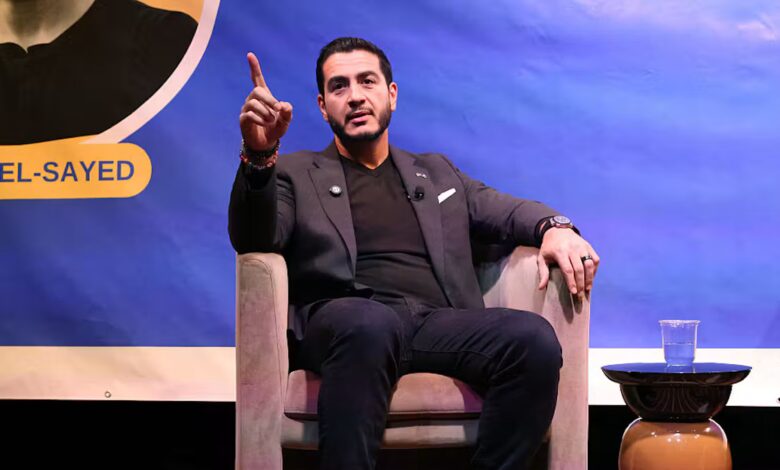
Abdulrahman Mohamed El-Sayed, a Michigan Democrat campaigning to become the first Muslim U.S. Senator, is facing intensified scrutiny regarding his alleged historical and ideological connections to the Muslim Brotherhood. The controversy has emerged as a defining issue in the final stages of his campaign, highlighting a deep divide between supporters who view the questions as bigoted and critics who argue they are essential to understanding the candidate’s political leanings.
El-Sayed has consistently dismissed inquiries regarding his associations, characterizing them as a classic maneuver rooted in Islamophobia. However, researchers and critics of the organization, often referred to by its Arabic name, the Ikhwan, argue that the candidate’s denials ignore the documented goals of the movement. The Muslim Brotherhood is designated as a terrorist organization in several countries, including Egypt, Saudi Arabia, the United Arab Emirates, and Bahrain, while Jordan has banned the group entirely.
The ideological foundation of the Muslim Brotherhood dates back to 1928, when it was founded by Egyptian preacher Hassan al-Banna. Established just four years after the abolition of the Ottoman Caliphate, the organization sought to restore Islamic rule and achieve dominance over society and the state. The group’s enduring slogan, which has been cited by critics as evidence of its revolutionary nature, states: “Allah is our objective. The Prophet is our leader. The Quran is our constitution. Jihad is our way. Dying in the path of Allah is our highest hope.”
Critics argue that this lineage is not merely a historical footnote but a precursor to modern jihadism. The teachings of Sayyid Qutb, a prominent Brotherhood ideologue, have been linked to the radicalization of figures such as al-Qaeda’s Ayman al-Zawahiri. While the Brotherhood occasionally claims to have renounced violence, skeptics point out that it has never officially renounced the core ideology that underpins such violence. A primary example cited by regional experts is Hamas, which identified itself in its 1988 founding charter as “one of the wings of the Muslim Brotherhood in Palestine.”
The practical implications of the Brotherhood’s rise to power were seen during the brief presidency of Mohamed Morsi in Egypt. Elected in 2012, Morsi faced widespread domestic opposition after he placed his decisions above judicial review and pushed through a constitution that prioritized sharia principles. The resulting economic instability and social polarization led to a massive popular uprising in June 2013, which eventually saw millions of Egyptians demand his removal from office.
Concerns regarding the Brotherhood’s influence are not confined to the Middle East. In North America, federal investigations have previously uncovered internal documents outlining the movement’s long-term strategy. During the Holy Land Foundation trial, the FBI recovered a 1991 “Explanatory Memorandum” that described the movement’s work in the United States as a “Civilization-Jihadist Process.” The document stated that its aim was to destroy Western civilization from within through a process of “sabotaging its miserable house.”
In Michigan, the debate has centered on El-Sayed’s family ties, past social media activity, campus affiliations, and donor networks. While some liberal voices have defended the candidate, arguing that the Brotherhood is essentially a harmless social movement or a conservative civic group, others suggest that the candidate’s denials are inconsistent with the patterns of the organization. Critics contend that the Ikhwan operates through a “soft” public face—using student groups, charities, and political advocacy—to fund and legitimize a harder underlying ideological project.
As the campaign enters its final weeks, the debate remains unresolved. El-Sayed continues to maintain that any scrutiny of his background is an act of bigotry, while those raising the alarms argue that a candidate’s relationship with a global political-religious movement is a matter of legitimate public interest. The central question for voters remains whether the Brotherhood’s historical goals are a relic of the past or a continuing influence on the modern political landscape.