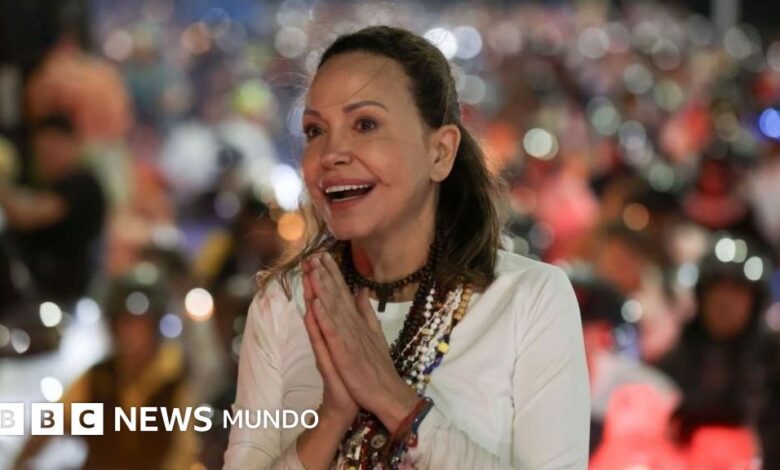
Venezuelan opposition leader María Corina Machado has returned to her home country after months in exile, traveling in a buoyant procession from the western state of Lara to the capital, Caracas. The vibrant homecoming stood in sharp contrast to her departure ten months prior, when she slipped out of the country in the dead of night to accept the Nobel Peace Prize in Oslo. Until now, her return had been blocked by both the Venezuelan government and the U.S. administration under President Donald Trump, with officials insisting the timing was inappropriate.
Much has shifted since Machado left Venezuela. Former President Nicolás Maduro was removed from power by U.S. troops on January 3 and flown to New York, where he faces federal charges including drug trafficking, weapons possession, and torture. Maduro has pleaded not guilty. He was succeeded by his former vice president, Delcy Rodríguez, who has pivoted sharply toward Washington, establishing a bilateral relationship that bears little resemblance to the years of hostility under Maduro and his predecessor, Hugo Chávez.
This altered landscape presents distinct dilemmas for all sides. When Machado departed, she was widely regarded as Washington’s preferred alternative to Maduro. Upon her return, however, she finds that the Trump administration is currently satisfied with the leadership of Rodríguez. Recently, Washington finalized a major oil agreement with Venezuela granting the United States a 100-year concession over 65,000 billion barrels of crude oil. The deal was brokered in cooperation with a private Venezuelan firm, North American Blue Energy Partners, led by businessman Alejandro Betancourt. Machado has openly criticized the accord and Betancourt, while carefully sparing President Trump from direct criticism, as she seeks his continued support and previously awarded him a peace prize.
Despite Washington’s warmth toward Rodríguez—whom President Trump has praised as “wonderful” and “exceptional”—Machado’s reception demonstrated that she retains robust grassroots mobilization capacity. Venezuelan political analyst Benigno Alarcón described her return as the most significant political event since January 3, emphasizing that the opposition now possesses an active leadership presence on the ground rather than relying solely on exiles. Data from political research centers Polis and Nexo indicates that Venezuela recorded three times as many street protests in the first nine months of the year compared to all of 2025, addressing issues ranging from labor rights to water supplies, alongside a reported halving of protest repression.
U.S. Secretary of State Marco Rubio asserted that Machado’s secure return resulted directly from U.S.-backed reconciliation talks. Nonetheless, Machado still faces lingering domestic charges in Venezuela, including treason and insurrection conspiracy, which she and her supporters have long dismissed as politically motivated. Prior to receiving clearance, Machado made at least eight unsuccessful attempts to reenter the country by air and sea. Her current return proceeds with tacit approval from Washington, a reality that Rodríguez has not challenged.
Rodríguez dismissed Machado’s cross-country tour as a “spectacle,” and state television channels largely ignored the live-streamed weekend events. Yet Rodríguez must maintain amicable ties with Washington to avoid her predecessor’s fate, and she has indicated a potential willingness to engage in dialogue. Meanwhile, reports suggest that key policy decisions in Caracas are heavily influenced by regular communications from Secretary Rubio to the acting president. For the young supporters crowding the streets of Caracas, however, Machado’s return signals a profound psychological shift, as public fear of open dissent appears to recede.