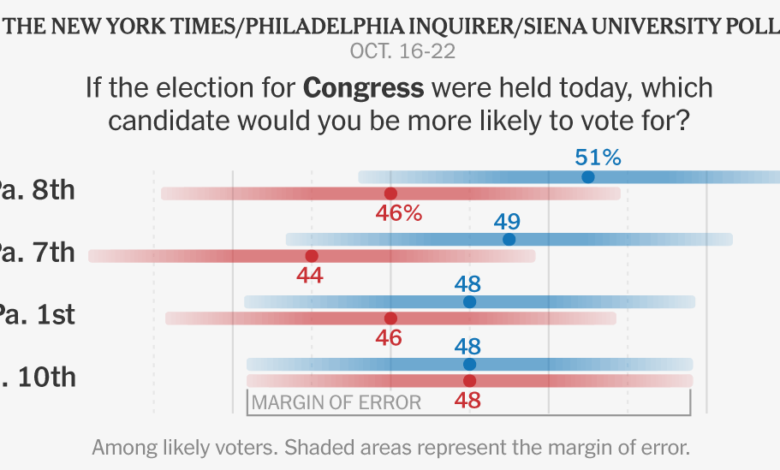
Fresh polling data from across Pennsylvania’s most contested congressional districts suggests a significant shift in the political landscape, with Democratic challengers leading in three of four key races and tied in a fourth. The findings represent a notable pivot in a state where Republicans recently saw major gains, signaling that the GOP’s thin majority in the U.S. House of Representatives may be increasingly precarious.
The surge in Democratic support is most visible in the districts Republicans recently flipped. In Pennsylvania’s Eighth District, Democratic challenger Paige Cognetti, the mayor of Scranton, has opened a five-point lead over Republican Representative Rob Bresnahan, 51 percent to 46 percent. Cognetti’s campaign has heavily focused on character and ethics, specifically targeting Bresnahan with allegations of profiting from insider stock trading. These efforts appear to be resonating, as voters gave Cognetti an 11-point advantage when asked which candidate they trusted more to handle government corruption.
In the Seventh District, another seat the GOP recently claimed, Representative Ryan Mackenzie now trails his Democratic opponent, Bob Brooks, by five points. Brooks, a local firefighters union leader, has found success building a coalition of nonwhite voters, particularly within the growing Hispanic populations in cities like Allentown. This shift is significant given that Donald Trump won this swing district by three points in the last election cycle, while Mackenzie narrowly secured his seat by a single point.
The race for the First District in suburban Bucks County also shows signs of trouble for the Republican incumbent. Representative Brian Fitzpatrick, widely considered one of the more moderate members of his caucus, currently trails Democratic challenger Bob Harvie by two points, 48 percent to 46 percent. Despite Fitzpatrick’s long history of outperforming the top of the Republican ticket, nearly half of the district’s voters expressed concern that he has become too closely aligned with the president. Even on the issue of immigration—traditionally a Republican stronghold—Harvie holds a slim two-point edge over the incumbent.
In the 10th District, a rematch between Republican Representative Scott Perry and Democratic former news broadcaster Janelle Stelson remains a dead heat, with both candidates tied at 48 percent. Perry, the former chairman of the hard-right House Freedom Caucus, maintains strong support on issues of immigration and foreign policy. However, Stelson is favored on the cost of living, which voters consistently rank as their primary concern. In this district, Trump remains more popular than in the other three battlegrounds, with half of the electorate approving of his immigration policies.
Economic anxiety continues to dominate the regional discourse, with 25 percent of voters identifying the economy as their top issue and another 13 percent specifically citing inflation or the cost of living. While Trump’s approval on the cost of living sits at just 32 percent within these districts, Democratic candidates have only managed a six-point advantage over their Republican rivals on economic trust. This suggests that while voters are dissatisfied with the status quo, they remain divided on which party offers the better solution.
A significant factor in these races is the popularity of Democratic Governor Josh Shapiro, who leads his Republican challenger, Stacy Garrity, by 18 points across these four districts. While roughly 15 percent of Republicans in these areas say they intend to vote for Shapiro, many appear ready to split their tickets. For instance, Fitzpatrick is being buoyed by the support of 20 percent of voters who plan to back Shapiro at the state level but remain loyal to the incumbent congressman.
Demographic shifts among white voters without a college degree are also providing an opening for Democrats. While this group remains a core part of the Republican base, 50 percent of such voters in these four districts now disapprove of the current administration’s job performance, and 60 percent disapprove of the handling of the cost of living. Democratic candidates are currently drawing about 40 percent support from this bloc, a higher-than-usual figure that could prove decisive in close contests.
The intensity of these races is reflected in the massive financial investment flowing into the state. According to the ad-tracking service AdImpact, approximately $100 million in advertising has aired across these four districts since the beginning of September. While local issues like the development of data centers for artificial intelligence have surfaced in campaigns—most notably in the Seventh District—voters remain focused on broader national concerns. Only 2 percent of respondents identified A.I. or data center infrastructure as their primary voting issue, despite significant spending on the topic by the Brooks campaign.