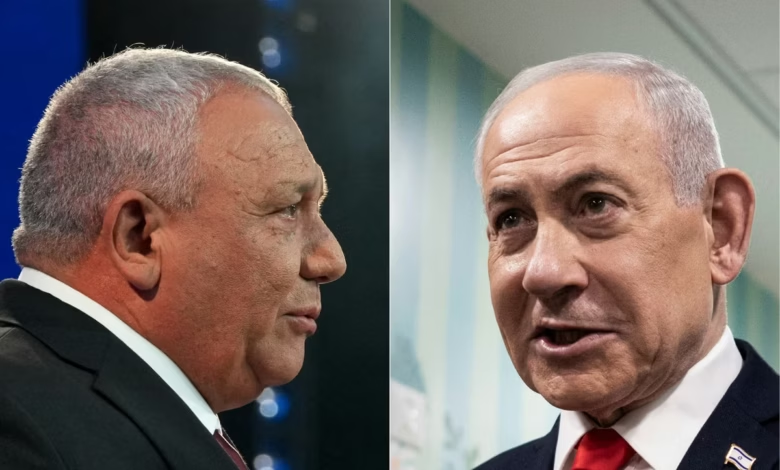
Vote counting continued across Israel as the Central Elections Committee processed ballots from the latest parliamentary election, leaving the path to power uncertain for both incumbent Prime Minister Benjamin Netanyahu and main challenger Gadi Eisenkot. With 84 per cent of ballots tallied by Wednesday afternoon, preliminary figures indicated that neither major political grouping was on track to achieve an outright majority in the 120-seat Knesset.
Partial returns placed Netanyahu’s right-wing bloc on course for 54 seats, while Eisenkot’s opposing grouping stood at 49 seats. Arab-led parties, including the Joint List and Ra’am, were projected to hold 17 seats. Because no single political party has ever won an outright majority in Israel’s history, coalition-building remains essential, and minor parties frequently emerge as kingmakers during weeks of negotiations where every single seat carries substantial leverage.
Netanyahu’s coalition brings together his own Likud party alongside far-right and religious factions, including Itamar Ben-Gvir’s Jewish Power, Bezalel Smotrich’s Religious Zionism, United Torah Judaism, Shas, and the People of Israel. Far-right religious parties led by Ben-Gvir and Smotrich were projected to capture a combined 13 seats within that bloc without experiencing major gains. Meanwhile, Eisenkot’s bloc encompasses his Yashar party, liberal Zionist formations Together and The Democrats, and the right-wing party Israel Our Home. Unaffiliated groups include the Reservists party, which failed to clear the 3.25 per cent electoral threshold required to enter parliament.
Both major blocs face significant hurdles in securing the 61 seats necessary to govern. Netanyahu’s bloc has explicitly ruled out forming a governing partnership with Arab parties, which campaigned specifically to unseat the prime minister and his far-right allies. At the same time, Eisenkot—a 66-year-old former military chief who entered politics four years ago—has also all but ruled out partnering with Arab parties, complicating his own trajectory toward forming a government. Eisenkot joined Netanyahu’s war cabinet following the October 2023 Hamas attack before resigning eight months later and openly criticizing the prime minister’s leadership. Having lost a son and two nephews in the Gaza conflict, Eisenkot has characterized Israel’s military response as a failure because Hamas remains in control.
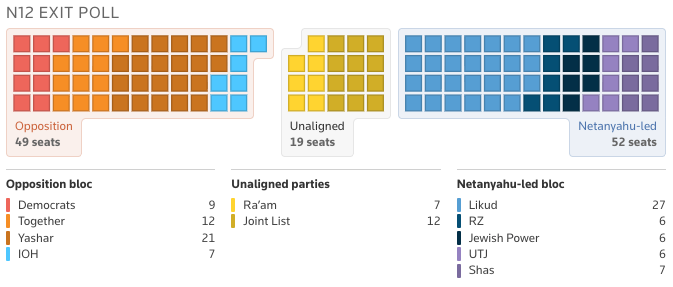
While the current seat distribution poses a setback for Netanyahu and his nationalist-religious allies, a persistent political deadlock could ultimately benefit the 77-year-old leader. A stalemate would allow him to remain in office as a caretaker prime minister throughout what are expected to be protracted coalition negotiations, or potentially until a new election is called. Different television projections, including outlets N12 and Channel 13, similarly pointed to a tightly contested race, with some estimates suggesting both primary blocs could draw even at 51 seats each.
Elsewhere, election night brought moments of celebration at the headquarters of the Joint List, where exit polls and high turnout among Palestinian citizens of Israel drew applause and cheers. Faten Gattas, a candidate in the Joint List, addressed supporters in Nazareth, declaring resistance to occupation and racism. Palestinian candidates had hoped robust voter turnout would enable them to play a decisive role in blocking Netanyahu from reclaiming power.
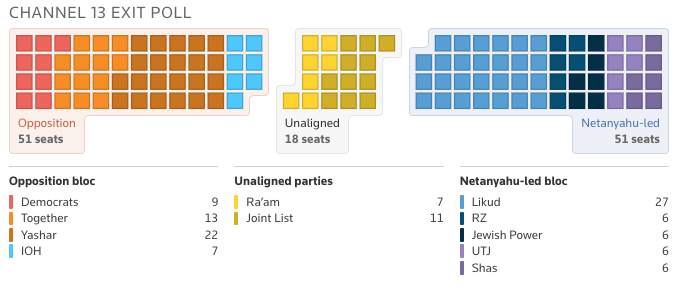
Israel’s Central Elections Committee expects to finalize definitive election results by Thursday, with official results scheduled for publication on November 4, exactly one week after the close of voting.