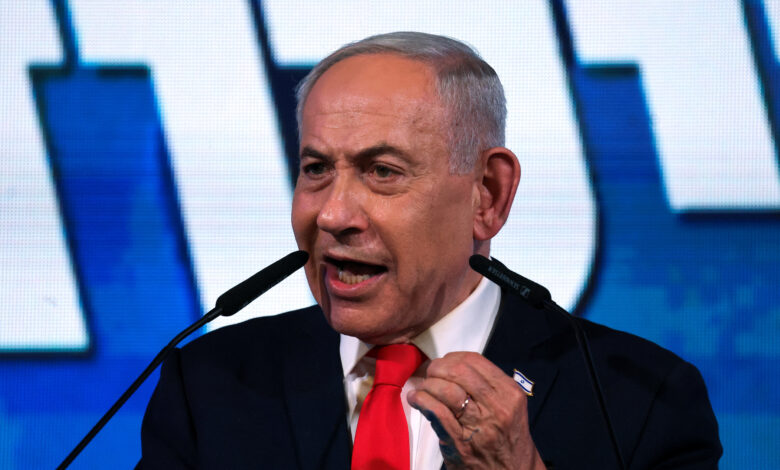
Israeli Prime Minister Benjamin Netanyahu is poised to encounter tighter administrative boundaries in his capacity as caretaker prime minister following national elections, yet legal and political analysts emphasize that his administration retains sweeping authority over national security matters, including the legal latitude to initiate a war against Iran.
Neither the right-wing coalition led by Netanyahu nor the opposition block headed by former military chief Gadi Eisenkot secured a projected majority within the 120-seat legislature, according to projections from Israeli media outlets following Tuesday’s vote. In the wake of the ballot, Eisenkot acknowledged Netanyahu’s ongoing tenure as caretaker leader while cautioning that security matters might be leveraged for political advantage.
Netanyahu’s office, which did not immediately respond to a request for comment on Wednesday, has previously denied accusations that the ongoing conflict involving Iran is being manipulated for political gain.
Under Israeli legal frameworks, the administrative boundaries governing a transitional executive are distinct. Guy Lurie, a research fellow at the Israel Democracy Institute, noted that while the literal text of the law grants a caretaker administration authority equivalent to that of a standard government, convention dictates a standard of restraint and reduced discretion across specific domains.
While institutional appointments and administrative decisions face notable restrictions during a caretaker period, policy flexibility remains intact where urgent public interest is demonstrated. Security affairs represent the most prominent exception to traditional transitional constraints, according to Or Asher, a researcher at the Tel Aviv-based Tachlith Institute.
Asher pointed out that the Israeli Supreme Court has historically maintained that caretaker administrations must steer clear of sweeping long-term decisions absent an immediate, pressing necessity. Nevertheless, judicial intervention regarding decisions to initiate military conflicts has been rare. Furthermore, parliamentary oversight remains minimal during the transitional weeks following an election before newly formed Knesset committees officially commence operations, allowing a caretaker prime minister significant legal latitude to commit the nation to military action, including against Iran.
The political transition moves next to President Isaac Herzog, who is scheduled to consult with political party leaders once final election tallies are certified. Herzog will then designate the candidate assessed to hold the strongest prospects for coalition-building, granting the chosen nominee up to 42 days to successfully establish a government.