A string of high-profile immigration enforcement actions, policy pivots, and sudden operational shifts has triggered internal friction within U.S. Immigration and Customs Enforcement, with agency insiders questioning whether the moves are designed to boost political prospects ahead of the midterm elections.
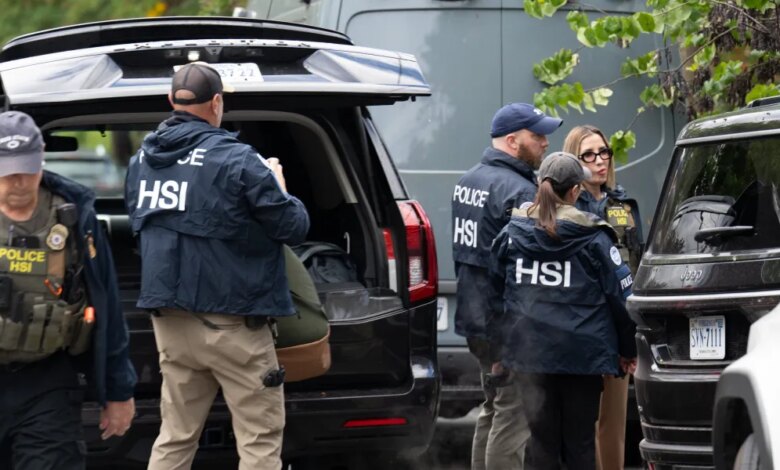
The debate intensified following a Monday morning raid by Homeland Security Investigations agents on the Washington, D.C., home of Rep. Ilhan Omar. While the investigation into the Minnesota lawmaker has reportedly been ongoing for years, an ICE immigration enforcement official questioned the timing of the operation.
“She’s always been a thorn in the side of the Trump administration,” said the official, who spoke on the condition of anonymity to protect their livelihood. “This has to be politically motivated.”
The raid is part of what several internal sources described as a broader pattern of policy changes, sweeping initiatives, and targeted operations aimed at shoring up political support. Over the preceding month, ICE undertook steps including mandatory vehicle stop training, announcements of enforcement surges into sanctuary cities, and a brief freeze on non-criminal deportations that officials characterized as a midterm scramble.
Aaron Reichlin-Melnick, a policy analyst and senior fellow at the American Immigration Council, noted that politically charged actions degrade the reputation of law enforcement. “Throughout the Trump administration, we have seen them use law enforcement for overtly political purposes, often directly targeting blue states or blue politicians for their actions,” Reichlin-Melnick said. “This is something that has really been a significant challenge for the reputation of law enforcement, because we have seen so many issues along these lines where there are allegations of these overtly political actions.”
Publicly, reporting linked the raid on Omar’s home to immigration paperwork concerning her arrival in the United States as a refugee in 1995 and her naturalization five years later. However, a second Homeland Security Investigations official expressed skepticism over that rationale. “There is something more than that, there have to be other charges for the substantiation of the warrant because a judge wouldn’t sign something beyond statute of limitations,” the official said.
Media reports suggested the investigation might stem from a 2019 effort by Omar to correct her birth year in a Minnesota state legislature library shortly after arriving in Congress. Under Justice Department guidelines, the statute of limitations for citizenship-related crimes is 10 years, whereas civil denaturalization proceedings carry no statute of limitations but require the government to prove fraud or initial ineligibility.
Inside the agency, employees reported widespread chaos and resentment. Another Homeland Security Investigations official lamented the diversion of resources from core duties like child exploitation and trafficking investigations. “Instead we are being used as pawns in our administration’s games,” the agent said, adding that current actions are intended to “stoke divisive fires.”
According to internal accounts, politically motivated operations escalated in early September when agents were ordered to pursue a criminal voter fraud probe across nine states. The first ICE official dismissed the voter fraud initiative as inefficient and ridiculous, noting that questioning people at their doors without prior evidence was a non-starter and a waste of time.
Fresh controversies erupted as the midterms approached. On September 20, enforcement officers from ICE’s Enforcement and Removal Operations shot and wounded a 28-year-old Venezuelan man during a traffic stop in Austin, Texas.
In response, ICE leadership quietly issued internal orders over the weekend of September 25 directing deportation officers to halt the arrest of undocumented immigrants without criminal histories. Although the Department of Homeland Security denied the story after it leaked to the media, multiple ICE officials confirmed the orders remained active for four to five days, temporarily restoring Biden-era enforcement standards even for individuals with standing deportation orders from immigration judges.
Concurrently, the Department of Homeland Security announced a public safety surge in sanctuary cities targeting criminal foreign nationals. By October 1, media reports highlighted a leaked guidance formally amending ICE’s vehicle stop policy to keep inexperienced personnel from engaging with vehicles, though the department maintained that the memo introduced no new changes and that all officers had always received vehicle stop training.
Training standards had previously been altered in 2025, when the Department of Homeland Security cut academy training time by approximately 40 percent—including reductions in driving and firearms instruction—ahead of a hiring spree that added roughly 12,000 personnel to meet deportation goals. The vehicle policy adjustments marked the third time over the summer that leadership ordered changes following traffic stop shootings in Texas and Maine in July.
The operational strain culminated on October 8, when plainclothes ICE officers fired at least seven rounds into a vehicle during a targeted operation in New York City. The driver, a 28-year-old Dominican man, was struck in the neck while his 5-year-old son sat in the backseat.
Reviewing video footage of the incident, a Homeland Security Investigations official remarked that the operation resembled a carjacking. Citing the recent influx of newly hired personnel and reduced tactical training, the official pointed to a dangerous disconnect between field realities and leadership directives.