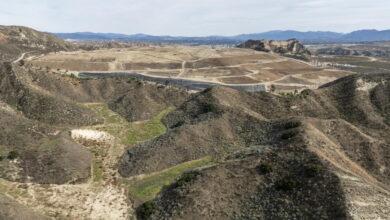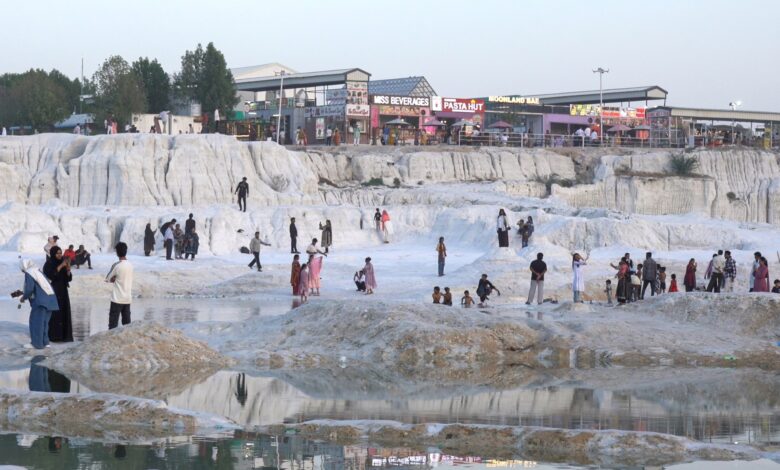
On the outskirts of Kishangarh in western India’s Rajasthan state, a 300-acre expanse of blinding white hills and turquoise water-filled pits draws hundreds of visitors daily. Known locally as the “Snow Yard,” the site resembles a alpine landscape, attracting newlyweds for pre-wedding photoshoots, social media influencers filming video reels, and tourists who compare the surreal backdrop to Kashmir.
Yet this picturesque destination is actually the largest marble slurry dumping yard in Asia, situated in a major granite and marble hub encompassing nearly 1,200 processing units. Every day, roughly 1,000 tankers empty approximately 5,500 tonnes of industrial waste onto the government-allotted site in the Ajmer district, generating an estimated daily business of more than 160 million rupees ($1.7m) and employing about 25,000 people according to the Federation of Indian Granite and Stone Industry. For tourists like Salim Shahzada, who traveled from Uttar Pradesh with his family, the attraction offers free entry and an exotic visual escape, largely detached from the industrial reality.

“I do not have much knowledge about this place or its ill effects. I only know that this is where marble cutting waste is dumped and that the hill itself is made of this waste,” Shahzada said.
For the nearly 5,000 residents living across at least six nearby villages, however, the dump represents an escalating environmental and public health crisis. Bagharam Gurjar, a 53-year-old farmer living 6 kilometers away in Bhogiyawas, spends his days tending maize fields that are increasingly choked by fine industrial dust. When settling dust coats the soil, it hardens the earth and stunts crop growth. Gurjar and his wife, like many villagers, suffer from chronic chest infections, skin allergies, and dental issues requiring continuous medication.

“How many problems can I even tell you about? If there were just one or two, we could deal with them,” Gurjar said. “But here, almost everything is going wrong because of the dumping yard. People like me are suffering from chest infections, dental problems and skin allergies.”
Medical professionals in the region confirm these health risks. Aditi Goyal, a general physician at Ajmer’s Ganga Narayan Hospital, noted that respiratory and skin ailments have surged among Kishangarh residents, with processing unit workers facing even greater vulnerability to chronic illness from prolonged dust exposure. In addition to industrial pollutants, Dr. Goyal pointed out that agricultural dust from local soil contributes to regional respiratory challenges, prompting recommendations for residents to wear protective masks.

Scientific research underscores the severity of the contamination. A study led by Laxmi Kant Sharma, an environmental science professor at the Central University of Rajasthan, revealed that concentrations of lead silicate in the local soil are several times higher than normal, driving extreme contamination. Because the waste particles measure smaller than 75 micrometres, they disperse widely across the landscape. The study also found that ambient air quality standards for PM2.5 are regularly exceeded, warning that numerous residents may be suffering from silicosis.
Longtime residents recall a time before the slurry transformed their environment. Ugam Singh, 65, pointed to his decayed, weakened teeth and pale, pitted enamel, which he attributes to high fluoride levels that have rendered local groundwater salty and unfit for consumption. Singh expressed frustration that local grievances lodged with authorities, including the Rajasthan State Pollution Control Board (RSPCB), have yielded little action.

“What I have come to understand is that it does not matter which government is in power. No one listens to the poor,” Singh said. “Even today all we want is for this marble slurry dumping to stop so that we can breathe freely again and our fields can become green and productive once again.”
Legal and regulatory scrutiny has begun to mount. Last year, environmentalist Drupad Malik filed a case before the National Green Tribunal, which acknowledged that unregulated dumping was contaminating local air and groundwater, prompting orders for the RSPCB to enforce monitoring, conduct inspections, and penalize non-compliant processing units. A senior official at the RSPCB’s regional office in Kishangarh declined to comment when contacted.

Professor Sharma argued that the surrounding area is fundamentally unfit for human habitation and urged state authorities to relocate the dumping yard to an isolated site, noting his surprise that visitors enter the toxic zone without protective gear. He has suggested routing the waste toward tile manufacturing, where marble slurry can be repurposed.
Meanwhile, villagers like Ram Lal from neighboring Tokra village continue to press for relocation and public support, requesting the establishment of free medical camps to assist residents whose health has declined under years of airborne dust.

“Kishangarh is full of slurry, and it is time to shift the dumping yard out of here to some other place where no one will suffer for at least two to three decades,” Lal said.