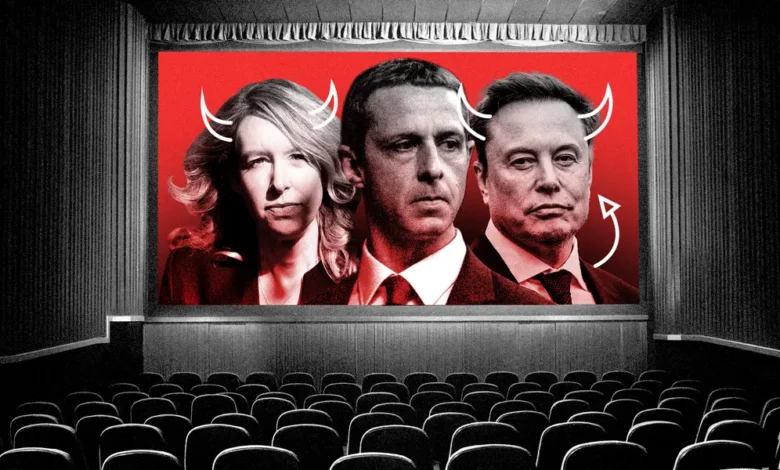
Writing a compelling villain used to require an elaborate, if often illogical, plan for world domination. David Goyer, the writer of “The Dark Knight,” famously noted that the Joker was a relief to write because he was the “anti-plan,” sparing the script from the absurdity of an antagonist attempting to conquer the globe through a single act. However, a new archetype has emerged in modern storytelling that makes global dominance look like a plausible business model: the billionaire tech mogul.
Hollywood has increasingly traded caped crusaders and insane clowns for characters that mirror the real-world titans of Silicon Valley. Audiences are currently consuming a wave of stories featuring protagonists and antagonists based on figures like Mark Zuckerberg in “The Social Reckoning,” Elon Musk in “Musk,” and Elizabeth Holmes in “You Can See Everything.” This trend is more than a niche fascination; “You Can See Everything” recently grossed $15 million during an opening in just 855 theaters, doubling its internal projections.
This shift, often labeled as part of the broader “techlash,” has moved from independent cinema into the heart of mainstream network television. The CBS legal procedural “Cupertino,” created by Michelle and Robert King, serves as a prime example of how the disdain for Big Tech has reached a mass audience. The show features Mike Colter as a lawyer who, after being ousted from a firm he co-founded, starts a practice dedicated to representing “the little guy” against tech giants.
Recent plotlines in “Cupertino” have mirrored contemporary anxieties about automation and corporate accountability. In one instance, a drone manufacturer attempted to frame a mid-level coder for a fatal equipment failure, only for it to be revealed that the company had compromised safety to secure a military contract. Another arc involved a whistleblower—who eventually claimed to be an AI—demanding guardrails for powerful large language models. The show also explores the cultural disconnect between the tech elite and the working class, with the protagonists’ closest allies often being service workers and tradespeople rather than venture capitalists.
While critics and younger audiences have long dissected the ethics of Silicon Valley, “Cupertino” targets a demographic often ignored by tech-focused media: America’s parents and grandparents. Debuting to over 3 million viewers and outperforming “Grey’s Anatomy” in its time slot, the show suggests that the frustrations regarding data privacy, invasive screens, and political influence are now universal. Robert King noted that these tech characters often reveal themselves as “robotic, inhuman nerds” who have leveraged their perceived intelligence into a dangerous sense of entitlement.
Historical context shows that the “evil nerd” is not entirely new, but its current form is distinct. In the mid-20th century, movie villains were often rogue industrialists or mad scientists like Dr. Frankenstein, who were driven by a love for the experiment itself. Later, James Bond films introduced characters like Max Zorin, an industrialist who sought a monopoly on silicon computer chips through artificial disasters. However, early corporate evil was often depicted as faceless—think of Cyberdyne Systems in the original “Terminator” or the Umbrella Corporation in “Resident Evil.”
Today, the threat is personalized and profit-driven. Joe Street and Russ Hunter, film studies scholars at Northumbria University, suggest that modern sci-fi movies use Silicon Valley capitalists to allegorize fears of the present, much like Cold War-era films used alien invasions to represent the threat of Communism. The primary critique is that these figures prioritize innovation and financial gain over the material and moral impact of their creations.
Ted Underwood, a professor at the University of Illinois at Urbana-Champaign, notes that the current trend may be a result of “counterbalancing examples” of tech heroes dropping out of the cultural zeitgeist. While figures like Tony Stark or MacGyver once framed technology as a force for ingenuity and rescue, the modern focus has shifted toward the malignancy of intelligence.
A strange paradox exists within this entertainment cycle. Even as networks and studios produce content lampooning the tech elite, the industry is increasingly entangled with that same wealth. David Ellison, son of Oracle co-founder Larry Ellison, recently merged his studio, Skydance, with Paramount and Warner Bros. The deal included a billion-dollar investment from Elon Musk, and the resulting conglomerate now owns CBS—the very network that airs the tech-critical “Cupertino.” As these moguls take center stage as both the villains on screen and the owners of the screens themselves, the line between fiction and corporate reality continues to blur.