Palestinian Protests Erupt in Hebron as Israeli Military Displaces Thousands During National Election

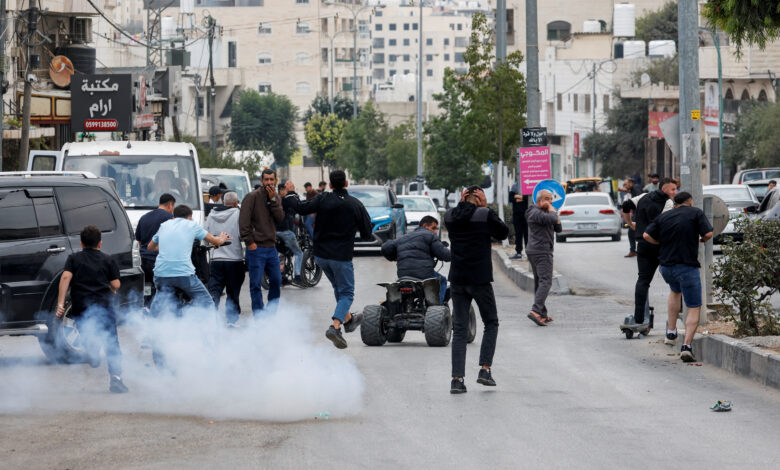
Israeli troops deployed stun grenades on Tuesday to disperse Palestinian protesters in the West Bank city of Hebron, as a major military operation continues to displace thousands of residents during an Israeli national election. The unrest, centered in the Israeli-occupied West Bank, follows a week of escalating tensions and widespread movement restrictions that have effectively paralyzed many Palestinian communities.
The confrontation on Tuesday involved a crowd of Palestinian men, women, and children who gathered to demonstrate against the ongoing displacement of residents from a Hebron neighborhood. Protesters carried placards condemning the military’s actions, with one elderly participant’s sign reading: “No to collective punishment, no to closures, and no to displacement.” The military confirmed the use of a stun grenade, stating the measure was necessary to disperse the crowd so that operations in the area could proceed.
According to United Nations reports released Monday, more than 3,000 Palestinians have been forced from their homes since the military operation began. The surge in activity follows an incident last Friday in which Palestinian gunmen shot and killed two Israeli soldiers at a nearby checkpoint. In response, the Israeli military announced on Sunday that it would carry out demolitions in neighborhoods adjacent to the site of the attack. Despite these actions, military officials noted in a statement that searches of the targeted homes have yet to locate any weapons.
The timing of the crackdown has drawn sharp criticism from Palestinian officials, who allege that Prime Minister Benjamin Netanyahu launched the operation to energize his right-wing base while Israelis are at the polls. The government maintains that the measures are a necessary security response to the killing of its soldiers. However, UN Human Rights Chief Volker Türk warned that the scale of the response raises serious legal and humanitarian concerns. Türk characterized the actions as a potential “grave violation of international law,” noting that threats to erase entire neighborhoods raise the specter of ethnic cleansing.
For residents in Hebron and the surrounding areas, the military operation has translated into a near-total blockade. Since Friday, entrances to most Palestinian cities and towns across the West Bank have been obstructed, severely limiting access to essential services. Noura Nassar, a displaced resident who joined Tuesday’s protest, described her inability to seek medical care due to the closures. “Where is the democracy in all of this?” Nassar asked. “Their elections are today, sure, but what about us? Aren’t we human beings? We want to go out, we want to visit the doctor.”
Inside Israel, the posture of the government toward the West Bank has remained a central pillar of the election. Both Prime Minister Netanyahu and his primary challenger, Gadi Eisenkot, have expressed opposition to the creation of an independent Palestinian state. This shared stance has left many Palestinians skeptical that the election results will improve their daily lives. Sana’ Salman Abu Sneineh, another resident expelled from the Hebron neighborhood, dismissed the significance of the vote for those living under occupation. “Among themselves they will elect who is the oppressor and who will destroy the Palestinian people,” she said. “That is their election.”
The current operation takes place against a backdrop of rapid Israeli settlement expansion and a reported increase in militant settler violence. While UN bodies and most of the international community consider these settlements illegal, the Israeli government continues to dispute that characterization. As the military continues its search and demolition efforts in Hebron, the long-term displacement of thousands remains the most immediate consequence of the current security cycle.