Google Positioned to Avoid AI Spending Backlash Following Meta’s Negative Earnings Surprises

As Alphabet prepares to release its latest quarterly financial results, market analysts suggest the Google parent company may avoid the sharp investor backlash that recently hit Meta. While Meta surprised Wall Street with its first period of negative free cash flow in over a decade, Google has already taken steps to transparently address its rising infrastructure costs and insulate its leadership from the fallout of shifting tax laws.
Investors are entering this earnings cycle with more clarity regarding Google’s fiscal trajectory. During its second-quarter report, the company had already signaled a significant increase in capital expenditure (capex) planned for the coming year. This early admission may have effectively pre-empted the kind of “reckoning” that occurred when Meta recently revealed aggressive AI spending targets that caught the market off guard. Meta’s shift toward negative free cash flow, the first such instance since 2012, was compounded by signals that spending would only accelerate in the quarters ahead.
Beyond the raw balance sheet, a major differentiator for Alphabet involves the personal financial planning of its co-founders, Larry Page and Sergey Brin. In California, the loom of Proposition 40—a proposed 5% wealth tax on billionaires—has created significant uncertainty for tech executives. The tax is set to take effect on January 1, 2026. While Meta CEO Mark Zuckerberg has committed to remaining in California, necessitating a new stock structure to handle potential tax bills, Google’s founders have already established residency elsewhere.
According to property and public records, Page and Brin moved out of California before the critical 2026 cutoff. Page reportedly purchased two estates in Miami for a combined $173.4 million, while Brin has moved to the Nevada side of Lake Tahoe and also acquired a property in Miami this year. Because they have established residency in states without the proposed billionaire tax, analysts note that Page and Brin are unlikely to be forced into large-scale, tax-motivated sales of their Alphabet shares. This removes a significant “overhang” for investors who might otherwise fear downward pressure on the stock price.
In contrast, Meta has been forced to innovate its corporate structure to manage the combined pressures of AI funding and Zuckerberg’s tax obligations. The company recently established a new class of nonvoting Class C common stock, effectively a 2-for-1 stock split. Under this arrangement, shareholders will receive one new Class C share for every Class A or Class B share they currently hold, with trading expected to begin in January 2027. This move allows Zuckerberg to raise external capital for Meta’s expensive AI build-out without diluting his majority voting control over the firm.
With these structural and tax concerns largely settled for Alphabet, investor focus is expected to shift back to the company’s competitive standing in the artificial intelligence sector. D.A. Davidson analyst Gil Luria notes that Google is currently fighting to regain its primacy in several high-stakes markets where it has fallen behind. Currently, Google is ranked second in the AI chat market behind OpenAI’s ChatGPT. In the enterprise AI space, it holds third place behind both OpenAI and Anthropic. Furthermore, Google’s personal AI assistant offerings are currently seen as trailing Meta’s “Muse” technology.
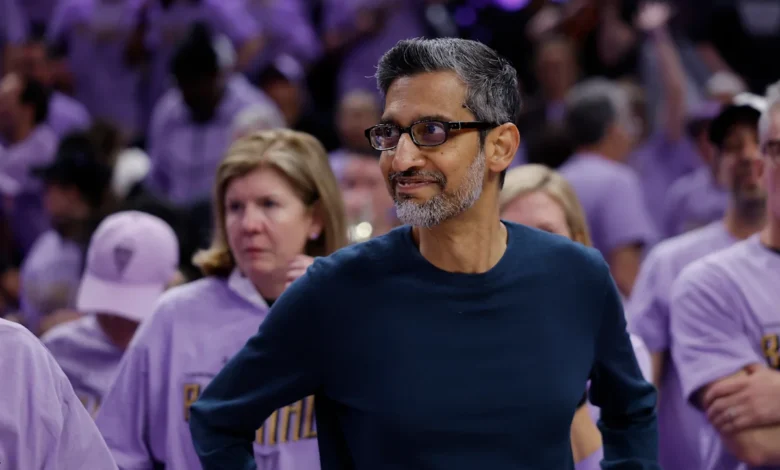
Despite these competitive hurdles, there are areas of notable momentum. Alphabet CEO Sundar Pichai, who was recently seen attending the WNBA Finals, is expected to emphasize the role of Anthropic-driven growth within Google Cloud. As the cloud division becomes an increasingly vital part of the Alphabet portfolio, the integration of high-level AI models like those from Anthropic remains a key pillar of the company’s growth strategy. By moving past the initial shock of capital expenditures and the complexities of founder tax liabilities, Alphabet may find the market more willing to focus on these long-term technical developments.